

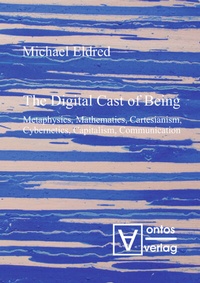
The Digital Cast of Being
Metaphysics, Mathematics, Cartesianism, Cybernetics, Capitalism, Communication
1st Edition
Published on 2. May 2013
137 pages
978-3-11-031947-7 (ISBN)
Description

We live today surrounded by countless digital gadgets and navigate through cyberspace as if it were the most natural thing in the world. This digital cast of being, however, comes from a long history of philosophical and mathematical thinking in which the Western will to productive power over movement has attained its consummation. This study traces the digital dissolution of beings from the Pythagoreans, Plato and Aristotle's ontology via Cartesian mathematical science through to our digitized economy and telecommunications. With an appendix reinterpreting quantum mechanical indeterminacy phenomenologically.
More details
Other editions
Additional editions
Michael Eldred
The Digital Cast of Being
Metaphysics, Mathematics, Cartesianism, Cybernetics, Capitalism, Communication
Book
06/2009
1st Edition
De Gruyter
€84.95
Shipment within 7-9 days
Content
1 - Table of contents [Seite 5]
2 - 1. Approaching the question concerning digital being [Seite 9]
3 - 2. Number and being [Seite 15]
3.1 - 2.1. Aristotle's ontology of number and geometric figure [Seite 15]
3.2 - 2.2. Heidegger's review of Aristotle's thinking on modes of connectedness from discreteness to continuity [Seite 17]
3.3 - 2.3. The crucially important analogy between logos and number for the appropriation of beings: arithmological knowledge [Seite 22]
3.4 - 2.4. Prelogical access to beings in their being [Seite 23]
3.5 - 2.5. The essentially 'illogical' nature of time [Seite 26]
3.6 - 2.6. Bridging the gulf between the discrete and the continuous [Seite 28]
3.7 - 2.7. Cartesian rules for an algebra of magnitudes in general as foundation for the modern mathematical sciences [Seite 30]
3.8 - 2.8. The calculative assault on movement and time through infinitesimal calculus [Seite 33]
3.9 - 2.9. Time and movement in Aristotle's thinking [Seite 36]
4 - 3. Digital beings [Seite 45]
4.1 - 3.1. The appropriation of the truth of beings, digital interpretation of world-movement and its outsourcing through executable, cyberneticmachine-code [Seite 45]
4.2 - 3.2. Digital beings arbitrarily reproducible in the electromagnetic medium [Seite 50]
4.3 - 3.3. Loss of place in and connectedness of the electromagnetic network [Seite 51]
4.4 - 3.4. The forgetting encouraged by digital code and automated cybernetic control in the robotic age [Seite 53]
4.5 - 3.5. The onto-theological nexus in abstract thinking, cybernetic control and arithmological access tomovement and time [Seite 56]
5 - 4. Spatiality of the electromagnetic medium [Seite 59]
5.1 - 4.1. A stampable mass [Seite 59]
5.2 - 4.2. Dasein's spatial being-in-the-world: approximation and orientation [Seite 60]
5.3 - 4.3. Abstraction from bodily experience in cyberspace through reduction of place to numeric co-ordinates [Seite 64]
5.4 - 4.4. Dreaming in cyberspace [Seite 65]
5.5 - 4.5. Inside and outside the digital electromagnetic medium [Seite 66]
5.6 - 4.6. Spatiality of Dasein with regard to the global electromagnetic medium [Seite 67]
5.7 - 4.7. The global network: geometric or purely arithmetic [Seite 70]
5.8 - 4.8. Difference between Aristotelean/Platonic and digital ontology and the latter's specifically totalizing nature - Merely an oppressive over-presence of digital beings? [Seite 72]
6 - 5. Digital technology and capital [Seite 77]
6.1 - 5.1. Two exemplary industries at the forefront of the digitization of beings: telecommunications and banking [Seite 77]
6.2 - 5.2. Globalization driven from afar by the digital casting of being [Seite 80]
6.3 - 5.3. Does the essence of capital correspond to the essence of technology? [Seite 81]
6.4 - 5.4. The casting of the totality of beings as valuable and capital as value power play [Seite 82]
6.5 - 5.5. Time in a capitalist economy [Seite 84]
6.6 - 5.6. The global power play measured by money-value and its movement [Seite 87]
6.7 - 5.7. Recovery of the three-dimensional, complexly interwoven social time of who-interplay [Seite 91]
6.8 - 5.8. Fetishism [Seite 92]
6.9 - 5.9. A capitalist economy is not merely complex, but simply ontologically playful [Seite 94]
6.10 - 5.10. The capitalist value-play an essential limitation to cybernetic technology [Seite 97]
6.11 - 5.11. Recapitulation: Digitization of the economy [Seite 100]
7 - 6. A global communication network? [Seite 105]
7.1 - 6.1. What is communication in a global network? [Seite 105]
7.2 - 6.2. Communication among digital beings themselves [Seite 108]
7.3 - 6.3. The intermeshing of the movement of digital beings in the global network and the movement of value as capital [Seite 108]
7.4 - 6.4. An alternative message from outer cyberspace [Seite 109]
8 - 7. Appendix: A demathematizing phenomenological view of quantum mechanical indeterminacy [Seite 115]
8.1 - 7.1. The Heisenberg indeterminacy principle reinterpreted [Seite 115]
8.2 - 7.2. The necessity of introducing three-dimensional, ecstatic time [Seite 124]
8.3 - 7.3. The phenomena of movement and indeterminacy in relation to continuity, discreteness and limit [Seite 130]
8.4 - 7.4. A mundane example to help see movement in threedimensional time [Seite 135]
2 - 1. Approaching the question concerning digital being [Seite 9]
3 - 2. Number and being [Seite 15]
3.1 - 2.1. Aristotle's ontology of number and geometric figure [Seite 15]
3.2 - 2.2. Heidegger's review of Aristotle's thinking on modes of connectedness from discreteness to continuity [Seite 17]
3.3 - 2.3. The crucially important analogy between logos and number for the appropriation of beings: arithmological knowledge [Seite 22]
3.4 - 2.4. Prelogical access to beings in their being [Seite 23]
3.5 - 2.5. The essentially 'illogical' nature of time [Seite 26]
3.6 - 2.6. Bridging the gulf between the discrete and the continuous [Seite 28]
3.7 - 2.7. Cartesian rules for an algebra of magnitudes in general as foundation for the modern mathematical sciences [Seite 30]
3.8 - 2.8. The calculative assault on movement and time through infinitesimal calculus [Seite 33]
3.9 - 2.9. Time and movement in Aristotle's thinking [Seite 36]
4 - 3. Digital beings [Seite 45]
4.1 - 3.1. The appropriation of the truth of beings, digital interpretation of world-movement and its outsourcing through executable, cyberneticmachine-code [Seite 45]
4.2 - 3.2. Digital beings arbitrarily reproducible in the electromagnetic medium [Seite 50]
4.3 - 3.3. Loss of place in and connectedness of the electromagnetic network [Seite 51]
4.4 - 3.4. The forgetting encouraged by digital code and automated cybernetic control in the robotic age [Seite 53]
4.5 - 3.5. The onto-theological nexus in abstract thinking, cybernetic control and arithmological access tomovement and time [Seite 56]
5 - 4. Spatiality of the electromagnetic medium [Seite 59]
5.1 - 4.1. A stampable mass [Seite 59]
5.2 - 4.2. Dasein's spatial being-in-the-world: approximation and orientation [Seite 60]
5.3 - 4.3. Abstraction from bodily experience in cyberspace through reduction of place to numeric co-ordinates [Seite 64]
5.4 - 4.4. Dreaming in cyberspace [Seite 65]
5.5 - 4.5. Inside and outside the digital electromagnetic medium [Seite 66]
5.6 - 4.6. Spatiality of Dasein with regard to the global electromagnetic medium [Seite 67]
5.7 - 4.7. The global network: geometric or purely arithmetic [Seite 70]
5.8 - 4.8. Difference between Aristotelean/Platonic and digital ontology and the latter's specifically totalizing nature - Merely an oppressive over-presence of digital beings? [Seite 72]
6 - 5. Digital technology and capital [Seite 77]
6.1 - 5.1. Two exemplary industries at the forefront of the digitization of beings: telecommunications and banking [Seite 77]
6.2 - 5.2. Globalization driven from afar by the digital casting of being [Seite 80]
6.3 - 5.3. Does the essence of capital correspond to the essence of technology? [Seite 81]
6.4 - 5.4. The casting of the totality of beings as valuable and capital as value power play [Seite 82]
6.5 - 5.5. Time in a capitalist economy [Seite 84]
6.6 - 5.6. The global power play measured by money-value and its movement [Seite 87]
6.7 - 5.7. Recovery of the three-dimensional, complexly interwoven social time of who-interplay [Seite 91]
6.8 - 5.8. Fetishism [Seite 92]
6.9 - 5.9. A capitalist economy is not merely complex, but simply ontologically playful [Seite 94]
6.10 - 5.10. The capitalist value-play an essential limitation to cybernetic technology [Seite 97]
6.11 - 5.11. Recapitulation: Digitization of the economy [Seite 100]
7 - 6. A global communication network? [Seite 105]
7.1 - 6.1. What is communication in a global network? [Seite 105]
7.2 - 6.2. Communication among digital beings themselves [Seite 108]
7.3 - 6.3. The intermeshing of the movement of digital beings in the global network and the movement of value as capital [Seite 108]
7.4 - 6.4. An alternative message from outer cyberspace [Seite 109]
8 - 7. Appendix: A demathematizing phenomenological view of quantum mechanical indeterminacy [Seite 115]
8.1 - 7.1. The Heisenberg indeterminacy principle reinterpreted [Seite 115]
8.2 - 7.2. The necessity of introducing three-dimensional, ecstatic time [Seite 124]
8.3 - 7.3. The phenomena of movement and indeterminacy in relation to continuity, discreteness and limit [Seite 130]
8.4 - 7.4. A mundane example to help see movement in threedimensional time [Seite 135]
