

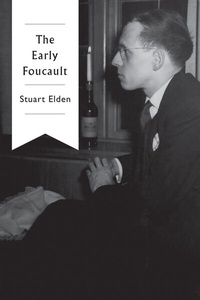
The Early Foucault
Description

It was not until 1961 that Foucault published his first major book, History of Madness. He had already been working as an academic for a decade, teaching in Lille and Paris, writing, organizing cultural programmes and lecturing in Uppsala, Warsaw and Hamburg. Although he published little in this period, Foucault wrote much more, some of which has been preserved and only recently become available to researchers.
Drawing on archives in France, Germany, Switzerland, Sweden and the USA, this is the most detailed study yet of Foucault's early career. It recounts his debt to teachers including Louis Althusser, Jean Hyppolite, Maurice Merleau-Ponty and Jean Wahl; his diploma thesis on Hegel; and his early teaching career. It explores his initial encounters with Georges Canguilhem, Jacques Lacan, and Georges Dumézil, and analyses his sustained reading of Friedrich Nietzsche, Edmund Husserl and Martin Heidegger. Also included are detailed discussions of his translations of Ludwig Binswanger, Victor von Weizsäcker, and Immanuel Kant; his clinical work with Georges and Jacqueline Verdeaux; and his cultural work outside of France.
Investigating how Foucault came to write History of Madness, Stuart Elden shows this great thinker's deep engagement with phenomenology, anthropology and psychology. An outstanding, meticulous work of intellectual history, The Early Foucault sheds new light on the formation of a major twentieth-century figure.
Stuart Elden is Professor of Political Theory and Geography at the University of Warwick.
More details
Other editions
Additional editions
Person
Content
Abbreviations and Archival References
Introduction
1. Studying Philosophy and Psychology in Paris
2. Teaching at Lille and the École Normale Supérieure
3. Psychology and Mental Illness
4. Translating Binswanger and von Weizsäcker
5. Nietzsche and Heidegger
6. Madness - Uppsala to Warsaw
7. Hamburg, Kant
8. Defence, Publication, Reception, Revision
Coda: Towards Archaeology
Notes
Index
Introduction
In the late 1970s Foucault said to Jean-Pierre Barou: 'when I die, I will leave no manuscripts'.1 Writing in 1993, his biographer David Macey judged that 'he came close to fulfilling that promise'. Foucault's close friend Hervé Guibert 'was ordered to destroy the drafts of the final volumes of Histoire de la sexualité and all the preparatory materials'.2 This was due to Foucault's wish that no one do to him what Max Brod had done to Franz Kafka.3 We now know that neither Foucault nor Macey was correct.
The publication of Foucault's thirteen Collège de France courses has been supplemented by volumes of lectures given elsewhere. Other lectures, transcriptions of radio programmes, interviews and discussions have all appeared in the past several years. Most notably, the fourth volume of the History of Sexuality, Les Aveux de la chair [Confessions of the Flesh] appeared in early 2018.4 Attention is now turning to materials relating to courses given at universities in France, Brazil and Tunisia from the 1950s and 1960s. In addition, Foucault's working notes and manuscripts are available at the Bibliothèque Nationale de France.5
This book is chronologically the first of a sequence of four books providing an account of Michel Foucault's entire career. It is the third to be written, following Foucault's Last Decade and Foucault: The Birth of Power.6 The missing years of 1962-9, from Birth of the Clinic to The Archaeology of Knowledge, will be the topic of the final volume, The Archaeology of Foucault. The order of the books' writing has in large part been dictated by the availability of materials either by posthumous publication or in the archive.
The focus here is on the very earliest Foucault, from the traces of his intellectual formation until the publication and defence of his thesis Folie et déraison: Histoire de la folie à l'âge classique in 1961. That work, better known in French simply as Histoire de la folie and in English as the History of Madness, was a book that Foucault regularly described as his first, marginalizing his earlier works as peripheral and insignificant.
Foucault certainly did not publish much before 1961 - the short book Maladie mentale et personnalité, a couple of book chapters, a long introduction to a translation, a book-length translation, and a short book notice. All those publications are discussed in this book, of course, but its sources are deeper. The posthumous publications and the archives are invaluable to this approach. Like the previous books, this book makes use of all available material in tracing a story of intellectual history. Yet while this book is not itself a biography, compared to Foucault's Last Decade and Foucault: The Birth of Power it does use more biographical sources. This is because there are relatively few other pieces of evidence for this early part of Foucault's career. There are almost no interviews from this period; Foucault published little compared to later periods; and because he was not yet famous, there are fewer contemporary accounts of his work.
This is also, relatively speaking, a period which has been neglected by his commentators. Back in 1993, biographer James Miller complained that 'the available evidence for Foucault's early intellectual itinerary is sketchy, and open to different interpretations'.7 Today the sources are more extensive, though doubtless the possibility of multiple readings remains. There are good reasons for this beyond the limited publications. For one, Foucault did much to try to cover over the traces of this period. He tried, albeit unsuccessfully, to prevent the re-edition of his 1954 book; eventually consenting to revise it in 1962 as Maladie mentale et psychologie so that it removed some of the claims that no longer worked with his later writing. But that version too went out of print in the late 1960s. His two early translations, of the psychologist Ludwig Binswanger and the physician Viktor von Weizsäcker, went out of print, and when the Binswanger translation was republished it was without his long introduction and his role in the translation and its notes was unmentioned. His other publications from the 1950s were in such obscure outlets that even French readers had little access to them: it was only with the publication of Dits et écrits ten years after his death that they were collected and more widely available. One short review was missed by the editors of that volume. Of these early texts only the Binswanger introduction has been translated into English. Maladie mentale et psychologie has been translated, but that only gives a partial insight into the original book.
While much has been preserved in archives, much has also been lost. There are almost no extant materials relating to Foucault's teaching in Uppsala, Warsaw and Hamburg. The only records of some of Foucault's early 1950s lectures in France are in the form of student notes. Draft materials were often discarded or reused as scrap paper. There is also a long-standing rumour that Foucault and the sociologist Jean-Claude Passeron ghost-wrote articles for the French Communist Party (PCF) journal La Nouvelle Critique in the early 1950s, stemming from two conversations with the author and diarist Claude Mauriac.8 Neither Foucault's first biographer Didier Eribon nor Macey was able to substantiate these rumours, and no new evidence seems to have come to light since.9 There is also the tantalizing mention of a text written by Foucault on René Descartes in 1952, which was commissioned by the PCF for the journal Clarté. It was apparently considered too difficult for students and not published.10 No archive seems to have a copy of this text, whose non-publication frustrated Foucault and contributed to his growing distance from the party (C 18/18).
Reading and Writing
While Foucault's childhood and early schooling will not be discussed here, an anecdote told by his brother, Denys Foucault, is revealing.11 Foucault's father Paul was a well-known surgeon and medical practitioner, whose Titres et travaux scientifiques was published by a local press the year Foucault was born.12 Foucault's mother Anne was the daughter of a surgeon and anatomy professor at the University of Poitiers. In their childhood home in Vendeuvre-du-Poitou, there were two libraries - the father's and the mother's. His father's library, in his study, was medical and off-limits; the library of his mother was literary and free to use. If the former would dominate Foucault's interests through the 1950s and early 1960s, in his work on psychology, madness and medicine, with traces throughout his career; the literary would be a theme to which he often returned. It was in their mother's library, Denys Foucault suggests, that Michel found Honoré de Balzac, Gustav Flaubert, and classical literature. He wrote on these topics, from an afterword to Flaubert's Temptation of Saint Anthony to a lecture on that text and Bouvard and Pécuchet, and one on Balzac's The Search for the Absolute, both given at SUNY Buffalo in 1970.13 His writings in the 1960s for Critique and Tel Quel, on writers including Georges Bataille, Maurice Blanchot, André Breton, Pierre Klossowski, Alain Robbe-Grillet, the Marquis de Sade, and Jules Verne, and of course his book on Raymond Roussel in 1963, all show this enduring literary interest.14
In an interview, Foucault's partner Daniel Defert says a great deal about his working practices. Foucault apparently worked to a very strict schedule, likening it to a factory job (FMT 215-16/214). He would leave his apartment to reach the library at 9am, often by bicycle, and continue working there until 5.30 or 6pm (FMT 216/215, 232/227). The evenings would be spent on 'his social and political life', followed by an hour of reading. This rhythm was not broken at weekends, nor on public holidays, and rarely on vacations. Defert's recollection is largely of later periods in Foucault's life - they met in 1960, and much of this relates to the period after Foucault's return to France from Tunisia. But Foucault had got into these habits early. As a student at the École Normale Supérieure (ENS) he used its library on the rue d'Ulm, as well as the Bibliothèque Sainte-Geneviève situated between the Sorbonne and the Panthéon in the Latin Quarter. From the early 1950s he became an habitué of the Bibliothèque Nationale de France (BNF), then entirely situated on the rue Richelieu near the Louvre and the Palais Royal. This building, with rooms designed by Henri Labrouste, is where the bulk of Foucault's papers are archived today. Even when based in Uppsala, Warsaw and Hamburg, he would regularly return there on visits to Paris. He resumed working there on a daily basis in the 1960s, apart from while in Tunisia, and this continued until 1979 when he moved to work at the Bibliothèque du Saulchoir.15 As Eribon suggests, the BNF was 'no doubt the one place in which Foucault spent the most years of his life'.16
While the printed texts and some manuscripts, such as the Clairambault and Joly...
