

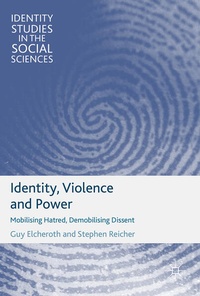
Identity, Violence and Power
Description

This book provides a systematic examination of the re-patterning of collective identities through violence and the role of power politics in such critical transitions. The authors show how identity is created through shared social practices and how it is transformed when collective violence disrupts common practices. Three case studies show how this model sheds new light on the dynamics of religious violence in parts of India, on ethnic violence in the former Yugoslavia, as well as on anti-war protest in the UK in reaction to the military invasion of Iraq.
The book explores an alternative way of looking at conflict, and dissects the policies and processes that bring specific identities to the fore, taking seriously the capacity to resist and face abusive authority.
Identity, Violence and Power will be of interest to students and scholars of sociology, social psychology, history, political science and conflict studies.
Reviews / Votes
"The book is interesting and uses diverse examples from around the world. . I would recommend this book for scholars who are interested in the topics of identity, violence, and power and/or who are interested in how historical case studies can be used in a scientific way to help us understand relationships between thoughts and behaviors." (Helen C. Harton, PsycCRITIQUES, Vol. 62 (32), August, 2017)More details
Other editions
Additional editions
Persons
Guy Elcheroth is Senior Lecturer in Social Psychology at the University of Lausanne, Switzerland. He is currently Principal Investigator of the Pluralistic Memories Project, a cross-national research for development consortium, and Co-director of the Lausanne Life Course and Inequality Research Centre.
Stephen Reicher is Wardlaw Professor of Psychology at the University of St. Andrews, UK. He is a Fellow of the British Academy, a Fellow of the Royal Society of Edinburgh and a Fellow of the Academy of Social Sciences.
Content
Part I - Critique.- 1. Hateful groups and weak powers?.- 2. Evil leaders and obedient masses?.-3. Part II - Model.- 4.Identity: the group as a collective performance.- 5.Violence: the transformation of identity by collective shocks.- 6. Power: the role of leadership in critical junctures.- 7. Part III - Case Studies.- 8. Riots, religion and the mobilisation of communal hatred in India.- 9. Ethnic violence in the former Yugoslavia: from myth to reality.- 10. When 'rallying the nation' fires back.- Conclusion
