

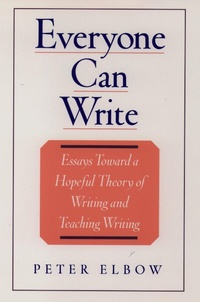
Everyone Can Write
Essays toward a Hopeful Theory of Writing and Teaching Writing
1st Edition
Published on 27. January 2000
500 pages
978-0-19-535587-1 (ISBN)
Description

With Writing without Teachers (OUP 1975) and Writing with Power (OUP 1995) Peter Elbow revolutionized the teaching of writing. His process method--and its now commonplace "free writing" techniques--liberated generations of students and teachers from the emphasis on formal principles of grammar that had dominated composition pedagogy.
This new collection of essays brings together the best of Elbow's writing since the publication of Embracing Contraries in 1987. The volume includes sections on voice, the experience of writing, teaching, and evaluation. Implicit throughout is Elbow's commitment to humanizing the profession, and his continued emphasis on the importance of binary thinking and nonadversarial argument. The result is a compendium of a master teacher's thought on the relation between good pedagogy and good writing; it is sure to be of interest to all professional teachers of writing, and will be a valuable book for use in composition courses at all levels.
More details
Other editions
Additional editions
Book
05/2000
Oxford University Press Inc
€242.40
Shipment within 15-20 days
Book
03/2000
Oxford University Press Inc
€71.70
Shipment within 15-20 days
Person
Peter Elbow is Professor of English and Director of the writing program at the University of Massachusetts, Amherst. In 2001, he received the James R. Squire Award from the National Council of Teachers of English "for his transforming influence and lasting intellectual contribution to the English Profession."
Content
- Intro
- Contents
- Introduction
- Part I: Premises and Foundations
- 1 Illiteracy at Oxford and Harvard: Reflections on the Inability to Write
- 2 A Map of Writing in Terms of Audience and Response
- 3 The Uses of Binary Thinking
- Fragments: The Believing Game-A Challenge after Twenty-Five Years
- Part II: The Generative Dimension
- 4 Freewriting and the Problem of Wheat and Tares
- 5 Closing My Eyes as I Speak: An Argument for Ignoring Audience
- 6 Toward a Phenomenology of Freewriting
- Fragments: Wrongness and Felt Sense
- The Neglect and Rediscovery of Invention
- Form and Content as Sources of Creation
- Part III: Speech, Writing, and Voice
- 7 The Shifting Relationships Between Speech and Writing
- 8 Voice in Literature
- 9 Silence: A Collage
- 10 What Is Voice in Writing?
- Fragments: On the Concept of Voice
- Audible Voice: How Much Do We Hear the Text?
- Voice in Texts as It Relates to Teaching
- Part IV: Discourses
- 11 Reflections on Academic Discourse: How It Relates to Freshmen and Colleagues
- 12 In Defense of Private Writing: Consequences for Theory and Research
- 13 The War Between Reading and Writing- and How to End It
- 14 Your Cheatin' Art: A Collage
- Fragments: Can Personal Expressive Writing Do the Work of Academic Writing?
- Part V: Teaching
- 15 Inviting the Mother Tongue: Beyond "Mistakes," "Bad English," and "Wrong Language
- 16 High Stakes and Low Stakes in Assigning and Responding to Writing
- 17 Breathing Life into the Text
- 18 Using the Collage for Collaborative Writing
- Fragments: Being a Writer vs. Being an Academic: A Conflict in Goals
- Separating Teaching from Certifying
- What Kind of Leadership Is Best for Collaborative Learning?
- Part VI: Evaluation and Grading
- 19 Getting Along Without Grades- and Getting Along With Them Too
- 20 Starting the Portfolio Experiment at SUNY Stony Brook Pat Belanoff, co-author
- Fragments: Problems with Grading
- The Conflict Between Reliability and Validity
- How Portfolios Shake Up the Assessment Process and Thereby Lead too Minimal Holistic Scoring and Multiple Trait Scoring
- Multiple Trait Scoring as an Alternative to Holistic Scoring
- Tracking Leads to a Narrow Definition of Intelligence
- The Benefits and Feasibility of Liking
- 21 Writing Assessment in the Twenty-First Century: A Utopian View
- Published Works by Peter Elbow
