

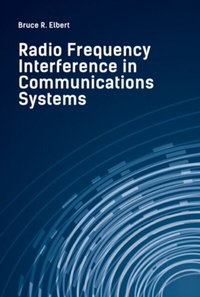
Radio Frequency Interference in Communications Systems
1st Edition
Published on 29. February 2016
242 pages
978-1-60807-966-7 (ISBN)
Description

This authoritative resource describes how to assess and mitigate RF interference in radio systems and presents effective methods to identify and resolve RFI before, during and after its appearance. Authored by a leading authority in the field, this book provides engineers and managers with the knowledge they need in the control of Radio Frequency Interference. Readers find practical guidance in an array of critical areas, including engineering of radiocommunication and wireless systems in light of RFI, identifying RFI modes, electromagnetic compatibility and spectrum sharing. Key concepts in evaluating radio frequency interference, propagation on obstructed paths, interference protection radio and RFI resolution and mitigation techniques such as filtering, spectral capture, radiolocation, cancellation and cognitive radio are covered in this book. This book concludes with prospective for RFI resolution in future radiocommunication systems.
More details
Other editions
Additional editions
Book
01/2016
Artech House Publishers
Unfortunately, price unknown
Available (delivery time upon request)
Content
- Radio Frequency Interference in Communications Systems
- Contents
- Preface
- Part I: Radiocommunication Systems and the RFI Environment
- Chapter 1 The What and Why of RFI in Radio and Wireless Communications
- 1.1 Engineering of Radiocommunication and Wireless Systems in Light of RFI
- 1.1.1 Efficient Use of Radio Spectrum
- 1.1.2 Frequencies Band Assignments
- 1.1.3 Efficient Use of the Geostationary Satellite Orbit and Other Space Environments
- 1.2 Identifying RFI Modes and Consequences
- 1.3 Electromagnetic Compatibility and Spectrum Sharing
- 1.4 Addressing RFI When It Occurs
- References
- Chapter 2 The Radiocommunication System in an Interference-Limited Environment
- 2.1 Radiocommunication Requirements
- 2.1.1 Who: The Organization or Market
- 2.1.2 What: Network Topology and Frequencies
- 2.1.3 Where: Locations to Be Served
- 2.1.4 When: Timing for Fixed, Mobile, or Temporary Communications
- 2.1.5 How: Equipment and Other Resources
- 2.2 Transmitters and Receivers
- 2.2.1 Modem Properties
- 2.2.2 Frequency Conversion and Amplification
- 2.2.3 Land-Based Radiocommunication Concepts
- 2.2.4 Space-Based Radiocommunication Concepts
- 2.2.5 Communications in Space Research and Remote Sensing.
- 2.3 Antennas in Radiocommunication Services
- 2.3.1 Nondirectional Antenna Radiation Patterns
- 2.3.2 Waveguide Horns
- 2.3.3 Directional Antennas
- 2.3.4 Multiple Element (Yagi-Uda Array)
- 2.3.5 Reflector Aperture (Dish Antenna)
- 2.3.6 Array of Elements (Flat-Panel Array)
- 2.3.7 Phased Array
- 2.3.8 Integrating RF Electronics with the Antenna
- References
- Chapter 3 Key Concepts for Evaluating RFI
- 3.1 Manmade RFI (Unintentional and Intentional)
- 3.2 RF Intermodulation and Harmonics
- 3.3 Interference From Radars and Other Pulsed Sources
- 3.4 Protection Ratio and Receiver Sensitivity
- 3.4.1 How to Determine Receiver Threshold
- 3.4.2 Receiver Desensitization
- References
- Part II: Key Aspects of Radio Wave Propagation
- Chapter 4 Link Properties Under Free Space Conditions
- 4.1 Path Geometries
- 4.1.1 Ground to Ground
- 4.1.2 Air to Ground
- 4.1.3 Space to Earth
- 4.1.4 Space to Space
- 4.2 Line-of-Sight Propagation Characteristics in Atmosphere
- 4.2.1 Coupling to the Antenna
- 4.2.2 Alternative Measures of Signal Strength
- 4.2.3 Atmospheric loss
- 4.2.4 Rain Attenuation
- 4.2.5 Tropospheric Scatter
- References
- Chapter 5 Propagation on Obstructed Paths
- 5.1 Path profiles and obstructions
- 5.2 Fading on Direct and Blocked Paths
- 5.2.1 Direct and Reflected Signals: Vector Addition
- 5.2.2 Ricean Multipath Fading
- 5.2.3 Rayleigh fading
- 5.3 Geographic coverage analysis
- 5.3.1 Path Computation Using Software
- 5.3.2 Measures of Radio Coverage
- 5.4 Complex Propagation Models
- 5.4.1 Okumura and Hata Macroscopic Propagation Models
- 5.4.2 ITS: Longley-Rice Models
- References
- Part III: RFI Assessment and Resolution Methodologies
- Chapter 6 Interference Protection Ratio (C/I) and Its Application
- 6.1 C/I Criteria
- 6.1.1 Calculation of Static Values
- 6.1.2 Antenna characteristics and isolation
- 6.2 Non-Steady State Propagation: Scatter, Rain-Induced Interference, Ionospheric Conditions
- 6.3 Service Performance in the Presence of Interference
- 6.4 Interference Among Various Systems
- 6.4.1 Radars vs. Land Mobile Systems
- 6.4.2 Protection of GPS from Terrestrial Wireless Systems
- 6.5 Satellite Communications vs. Terrestrial Microwave Systems
- References
- Chapter 7 RFI Resolution Techniques
- 7.1 Spectrum Analysis and Monitoring
- 7.1.1 Spectrogram View and Adjustment
- 7.2 Spectrum Monitoring and Carrier Measurement
- 7.3 Interference location and radio direction finding
- 7.4 Transmitter ID
- 7.5 Additional Resources and Strategies
- 7.5.1 Planning and Coordination
- 7.5.2 Research and Testing
- 7.5.3 Remediation
- References:
- Chapter 8 How to Identify, Prevent, and Fix Common RFI problems
- 8.1 Frequency Planning Techniques
- 8.1.1 Frequency Assignment
- 8.1.2 Transmitter Control and ID
- 8.1.3 Interleaving Spectra and Band Segmentation
- 8.1.4 Power Control
- 8.2 Avoiding Intermodulation
- 8.3 Interference Cancellation
- 8.3.1 Cancellation at RF (Antenna)
- 8.3.2 Cancellation at IF
- 8.3.3 Cancellation at Baseband (Postdetection)
- 8.4 RFI as an Incident Needing Effective Tools and Management
- References
- Chapter 9 Prospective for RFI Resolution in Future Radiocommunication Systems
- 9.1 New Approaches to Interference Management
- 9.2 Cognitive Radio
- 9.3 Spectrum Management Tools and Resources
- 9.3.1 Licensed Shared Access
- 9.3.2 Model Cities Demonstrations
- 9.3.3 Spectrum Monitoring and RFI Remediation
- References
- List of Acronyms
- About the Author
- Index
