

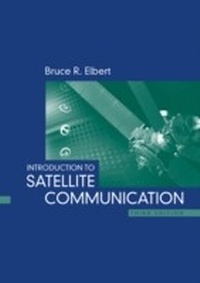
Introduction to Satellite Communication, Third Edition
1st Edition
Published on 1. January 2008
620 pages
978-1-59693-211-1 (ISBN)
Description

Whether you are a technical or management professional, you can turn to this highly understandable and comprehensive overview of satellite technology, applications, and management. Thoroughly updated and expanded, this third edition boasts a wealth of new material, including added coverage of systems engineering as applied to satellite communications, clear explanations of all aspects of building and using a satellite systems, and discussions on digital communications and processing in modern satellite networks. The new edition also examines critical success factors and how to avoid the pitfalls in selecting satellite and ground resources. The book covers all the fundamentals of satellites, ground control systems, and earth stations, considering the design and operation of each major segment. You gain a practical understanding of the basic construction and usage of commercial satellite networks-how parts of a satellite system function, how various components interact, which role each component plays, and which factors are the most critical to success. Moreover, the book explores the economic, legal, and management issues involved in running the business of satellite communications.
More details
Other editions
Additional editions
Bruce R. Elbert
Introduction to Satellite Communications
Book
07/2008
3rd Edition
Artech House Publishers
€110.50
Shipment within 10-20 days
Content
- Introduction to Satellite Communication Third Edition
- Contents
- Preface
- Acknowledgments
- C H A P T E R 1 Fundamentals of Satellite Systems
- 1.1 Basic Characteristics of Satellites
- 1.1.1 Advantages of Satellite Communication
- 1.1.2 Use of Microwave Frequencies
- 1.1.3 Digital Transmission, Compression, and Routing
- 1.1.4 Improved Space Platforms and Launching Systems
- 1.1.5 Integration with Terrestrial Wired and Wireless Networks
- 1.2 System Elements
- 1.2.1 Space Segment
- 1.2.2 Ground Segment
- 1.2.3 Overall System
- 1.3 Satellite Orbit Configurations
- 1.4 Frequency Spectrum Allocations
- 1.4.1 ITU Spectrum Allocations and Regions
- 1.4.2 VHF and UHF Frequency Ranges
- 1.4.3 Microwave Bands: L and S
- 1.4.4 Microwave Bands: C, X, and Ku
- 1.4.5 Millimeter Wave and Higher: Ka-, Q-, and V-Bands
- 1.4.6 Guided and Unguided Optical Properties
- References
- C H A P T E R 2 Evolution of Satellite Communication
- 2.1 Source of the Original Idea
- 2.1.1 SYNCOM
- 2.1.2 COMSAT
- 2.2 Evolving Satellite Coverage
- 2.2.1 Global Service: INTELSAT, PanAmSat, and Orion
- 2.2.2 Regional Coverage: EUTELSAT and SES
- 2.2.3 Domestic Systems: Telesat, Westar, and Palapa
- 2.3 Specialized Systems: DTH and Mobile
- 2.3.1 DTH Development
- 2.3.2 MSS Development
- 2.3.3 Digital Information Broadcasting
- 2.4 Expansion at Higher Frequency Bands: Ka-Band
- References
- C H A P T E R 3 Satellite Network Architectures
- 3.1 General Features of Satellite Networks
- 3.1.1 Dedicated Bandwidth Services
- 3.1.2 Circuit-Switched Services
- 3.1.3 Packet-Switched Services
- 3.1.4 Flexibility Features
- 3.1.5 Reliability of Satellites and Links
- 3.1.6 Quality Features and Issues
- 3.2 Point-to-Multipoint (Broadcast) Networks
- 3.2.1 Video Distribution
- 3.2.2 Direct-to-Home Television
- 3.2.3 Content Distribution Networks
- 3.2.4 Mobile Satellite Communications
- 3.3 Point-to-Point Networks
- 3.4 VSAT Networks
- References
- C H A P T E R 4 Microwave Link Engineering
- 4.1 The Decibel
- 4.2 Propagation on the Earth-Space Link
- 4.2.1 Basic Microwave Propagation
- 4.2.2 Isotropic Radiator
- 4.2.3 Directional Properties of Antennas
- 4.2.4 Polarization (Linear and Circular)
- 4.2.5 Propagation Losses
- 4.3 Microwave Transmitters and Receivers
- 4.3.1 Transmitting Station
- 4.3.2 Receiving Station
- 4.3.3 Definition of a Transponder
- 4.4 Overall Link Quality
- 4.4.1 How Noise and Interference Affect a Microwave Link
- 4.4.2 Carrier-to-Noise Ratio
- 4.4.3 Link Budget Analysis
- 4.4.4 Link Margin
- References
- C H A P T E R 5 Modulation, Multiple Access, and Impairments
- 5.1 Digital Baseband Signals and Hierarchies
- 5.1.1 Digital Information Sources and Bandwidth Requirements
- 5.1.2 Analog-to-Digital Conversion
- 5.1.3 Compression
- 5.1.4 Error Detection and Correction
- 5.1.5 Scrambling and Encryption
- 5.2 Digital Modulation
- 5.2.1 Frequency Shift Keying
- 5.2.2 Phase Shift Keying
- 5.2.3 Amplitude and Phase Shift Keying
- 5.3 Multiple Access Methods
- 5.3.1 Frequency Division Multiple Access
- 5.3.2 Time Division Multiple Access
- 5.3.3 ALOHA Packet Multiple Access
- 5.3.4 Code Division Multiple Access
- 5.3.5 RF Bandwidth Utilization in Multiple Access
- 5.4 Distortion and Impairments
- 5.4.1 Digital Signal Impairments
- 5.4.2 Transponder Intermodulation Impairment
- 5.4.3 Uplink and Downlink RF Interference
- References
- C H A P T E R 6 Spacecraft and Repeater
- 6.1 Overview of Communications Spacecraft
- 6.1.1 Overall Payload Requirements
- 6.1.2 Transmit Effective Isotropic Radiated Power (EIRP)
- 6.1.3 Receive Gain-to-Noise Temperature Ratio (G/T)
- 6.1.4 Bent-Pipe Transponder Filtering
- 6.1.5 Linearity
- 6.1.6 Frequency Translation Effects
- 6.2 Analog Bent-Pipe Repeaters
- 6.3 Digital Processing Repeaters
- 6.3.1 Multiple Beam Switching and Routing
- 6.3.2 Digital Processor Architecture
- 6.3.3 Demod-Remod Repeater
- 6.4 Standard Repeater Elements
- 6.4.1 Wideband Receiver
- 6.4.2 Redundancy Switching
- 6.4.3 Waveguide Filters and Multiplexers
- 6.4.4 Traveling Wave Tube Amplifiers
- 6.4.5 Solid-State Power Amplifiers
- 6.4.6 Transponder Gain Control and Linearization
- References
- C H A P T E R 7 Spacecraft Antennas
- 7.1 Horn Antennas
- 7.2 Reflector Antennas
- 7.2.1 Center-Fed Parabolic Reflectors
- 7.2.2 Offset-Fed Parabolic Reflectors
- 7.3 Antenna Patterns
- 7.4 Direct Radiating Array Antennas
- References
- C H A P T E R 8 Spacecraft Mission and Bus Subsystems
- 8.1 Mission Summary
- 8.1.1 GEO Mission Profile
- 8.1.2 On-Station Operation Requirements
- 8.1.3 Non-GEO Requirements
- 8.2 Spacecraft Configuration
- 8.3 Spacecraft Bus Subsystems
- 8.3.1 Attitude-Control Subsystem
- 8.3.2 Solar Cells and Panels
- 8.3.3 Battery Design and Configuration
- 8.3.4 Liquid Propulsion System
- 8.3.5 Electric and Ion Propulsion
- 8.3.6 Solid-Fuel Rocket Motors
- 8.3.7 Tracking, Telemetry, and Command (TT&C)
- 8.3.8 Thermal Control
- 8.3.9 Structural Arrangements
- References
- C H A P T E R 9 Earth Stations and Network Technology
- 9.1 Basic Earth Station Configuration
- 9.2 Performance Requirements
- 9.2.1 Transmit EIRP
- 9.2.2 Receive G/T
- 9.2.3 Location and Platform Requirements
- 9.3 Radio Frequency Equipment
- 9.3.1 Antennas for Earth Stations
- 9.3.2 Antenna Beam Pointing
- 9.3.3 High-Power Amplifiers
- 9.3.4 Upconverters and Downconverters
- 9.3.5 RF Combining
- 9.3.6 Uplink Power Control
- 9.4 Intermediate Frequency and Baseband Equipment
- 9.4.1 Modulators, Demodulators, and Modems
- 9.4.2 Multiplexing and Packet Processing
- 9.5 Tail Links and Terrestrial Interface
- 9.5.1 Terrestrial Tail Options
- 9.5.2 Terrestrial Network Interfaces
- 9.6 Earth Station Facility Design
- 9.7 Major Classes of Earth Stations
- 9.7.1 TT&C Ground Facilities
- 9.7.2 TV Uplinks and Broadcast Centers
- 9.7.3 FDMA Digital Communications Service
- 9.7.4 Full-Mesh TDMA Earth Station
- 9.7.5 VSAT Star Network Terminal
- 9.7.6 TV Receive-Only Design
- 9.7.7 MSS User Terminals
- References
- C H A P T E R 1 0 Launch Vehicles and Services
- 10.1 The Launch Mission
- 10.1.1 The Boost Phase
- 10.1.2 Non-GEO Missions
- 10.1.3 Geostationary Transfer Orbit
- 10.1.4 Drift Orbit for GEO Operation
- 10.1.5 Deployments and In-Orbit Testing
- 10.1.6 RCS Fuel Allocation
- 10.2 Launch Technology and Systems
- 10.3 Typical Launch Vehicles
- 10.3.1 Ariane
- 10.3.2 Atlas
- 10.3.3 Delta
- 10.3.4 H-1 and H-2
- 10.3.5 Long March
- 10.3.6 Proton
- 10.3.7 Zenit
- 10.4 Launch Interfaces
- 10.4.1 Physical Launch Interfaces
- 10.4.2 Management Interfaces
- 10.5 Risk Management in Launch and Operation
- 10.5.1 Launch Insurance
- 10.5.2 Backup and Replacement Satellites
- C H A P T E R 1 1 Satellite Operations and Organization
- 11.1 The Satellite Control System
- 11.1.1 GEO Satellite Control
- 11.1.2 Non-GEO Satellite Control
- 11.2 Intercommunication Networks
- 11.2.1 Backbone Communications
- 11.2.2 Alternate Routing for High Reliability
- 11.2.3 Network Management
- 11.3 Network Operations
- 11.3.1 Standard GEO Transponder Services
- 11.3.2 User Network Monitor and Control
- 11.3.3 Payload Configuration Management
- 11.4 Human Resources for Satellite Operations
- References
- C H A P T E R 1 2 Satellite Systems Engineering and Economics
- 12.1 Satellite Systems Engineering Principles
- 12.1.1 Fixed Satellite Systems and Services
- 12.1.2 Mobile Satellite Systems and Services
- 12.2 Satellite System Economic Principles
- 12.3 System Development Methodology
- 12.4 Space Segment Economics
- 12.4.1 Space Segment Investment Cost Elements
- 12.4.2 Annual Space Segment Costs
- 12.5 Earth Station Economics
- 12.5.1 Earth Station Investment Cost Elements
- 12.5.2 Annual Costs for Earth Station Networks
- 12.5.3 Teleport Earth Stations
- 12.6 Analysis of Network Economics
- 12.6.1 Determining Traffic Requirements
- 12.6.2 Laying Out the Network
- 12.6.3 Total Network Evaluation
- 12.6.4 Optimizing the Space and Ground Segments
- 12.7 Satellite Communications: Instant Infrastructure
- 12.7.1 Satellites Versus Fiber Optics
- 12.7.2 Emphasis on the Broadcast Feature
- 12.7.3 Paralleling the Terrestrial Networks
- 12.7.4 Mobility Enhancements
- 12.7.5 Creating the Future
- 12.7.6 Advancing Technology
- 12.8 Conclusions for the Next Generation
- References
- About the Author
- Index
