

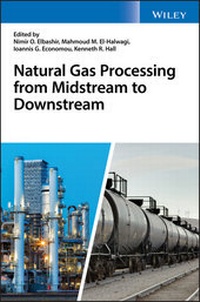
Natural Gas Processing from Midstream to Downstream
Description

A comprehensive review of the current status and challenges for natural gas and shale gas production, treatment and monetization technologies
Natural Gas Processing from Midstream to Downstream presents an international perspective on the production and monetization of shale gas and natural gas. The authors review techno-economic assessments of the midstream and downstream natural gas processing technologies.
Comprehensive in scope, the text offers insight into the current status and the challenges facing the advancement of the midstream natural gas treatments. Treatments covered include gas sweeting processes, sulfur recovery units, gas dehydration and natural gas pipeline transportation.
The authors highlight the downstream processes including physical treatment and chemical conversion of both direct and indirect conversion. The book also contains an important overview of natural gas monetization processes and the potential for shale gas to play a role in the future of the energy market, specifically for the production of ultra-clean fuels and value-added chemicals. This vital resource:
- Provides fundamental chemical engineering aspects of natural gas technologies
- Covers topics related to upstream, midstream and downstream natural gas treatment and processing
- Contains well-integrated coverage of several technologies and processes for treatment and production of natural gas
- Highlights the economic factors and risks facing the monetization technologies
- Discusses supply chain, environmental and safety issues associated with the emerging shale gas industry
- Identifies future trends in educational and research opportunities, directions and emerging opportunities in natural gas monetization
- Includes contributions from leading researchers in academia and industry
Written for Industrial scientists, academic researchers and government agencies working on developing and sustaining state-of-the-art technologies in gas and fuels production and processing, Natural Gas Processing from Midstream to Downstream provides a broad overview of the current status and challenges for natural gas production, treatment and monetization technologies.
More details
Other editions
Additional editions
Content
List of Contributors xix
About the Editors xxv
Preface xxvii
1 Introduction to Natural Gas Monetization 1 Nimir O. Elbashir
1.1 Introduction 1
1.2 Natural Gas Chain 2
1.3 Monetization Routes for Natural Gas 4
1.4 Natural Gas Conversion to Chemicals and Fuels 9
1.5 Summary 13
Acknowledgment 13
References 13
2 Techno-Economic Analyses and Policy Implications of Environmental Remediation of Shale GasWells in the Barnett Shales 15 Rasha Hasaneen, Andrew Avalos, Nathan Sibley, and Mohammed Shammaa
2.1 Introduction 15
2.2 Shale Gas Operations 18
2.3 The Barnett Shale 22
2.4 Environmental Remediation of Greenhouse Gas Emissions Using Natural Gas as a Fuel 22
2.5 Environmental Remediation ofWater and Seismic Impacts 24
2.6 Theoretical Calculations 28
2.7 Results and Discussion 35
2.8 Opportunities for Future Research 49
References 50
3 ThermodynamicModeling of Natural Gas and Gas Condensate Mixtures 57 Epaminondas Voutsas, Nefeli Novak, Vasiliki Louli, Georgia Pappa, Eirini Petropoulou, Christos Boukouvalas, Eleni Panteli, and Stathis Skouras
3.1 Introduction 57
3.2 Thermodynamic Models 61
3.3 Prediction of Natural Gas Dew Points 64
3.4 Prediction of Dew Points and Liquid Dropout in Gas Condensates 70
3.5 Case Study: Simulation of a Topside Offshore Process 75
3.6 Concluding Remarks 81
References 82
4 CO2 Injection in Coal Formations for Enhanced Coalbed Methane and CO2 Sequestration 89 Ahmed Farid Ibrahim and Hisham A. Nasr-El-Din
4.1 Coalbed Characteristics 89
4.2 Adsorption Isotherm Behavior 91
4.3 CoalWettability 95
4.4 CO2 Injectivity 101
4.5 Pilot Field Tests 106
4.6 Conclusions 108
References 108
5 Fluid Flow: Basics 113 Paul A. Nelson, Todd J.Willman, and Vinay Gadekar
5.1 Introduction 113
5.2 Thermodynamics of Fluids 116
5.3 Fundamental Equations of Fluid Mechanics 121
5.4 Incompressible Pipeline Flow 126
5.5 Laminar Flow 130
5.6 Compressible Pipeline Flow 132
5.7 Comparison with Crane Handbook 139
References 142
6 Fluid Flow: Advanced Topics 143 Paul A. Nelson,MoyeWicks III, Todd J.Willman, and Vinay Gadekar
6.1 Introduction 143
6.2 Notation 143
6.3 Piping Networks 145
6.4 Meters 152
6.5 Control Valves 159
6.6 Two-Phase Gas-Liquid Flow 161
References 171
7 Use of Process Simulators Upstream Through Midstream 173 Justin C. Slagle
7.1 Introduction 173
7.2 Upstream 174
7.3 Midstream 183
7.4 Going Further 192
Acknowledgement 196
References 196
8 Optimization of Natural Gas Network Operation under Uncertainty 197 Emmanuel Ogbe, Ali Elkamel,Michael Fowler, and Ali Almansoori
8.1 Introduction 198
8.2 Literature Review 199
8.3 Natural Gas Supply Chains 200
8.4 Optimization Model 202
8.5 Computation Study 208
8.6 Results and Discussion 209
8.7 Conclusions and Recommendations 212
References 213
Appendix 215
8.A.1 Stochastic Model for the Sources 216
8.A.2 Stochastic Model for Mixing Stations 216
8.A.3 Stochastic Model for End Users 217
8.A.4 Stochastic Pipeline Performance Model 217
8.A.5 Stochastic Compression Performance Model 217
9 A Multicriteria Optimization Approach to the Synthesis of Shale Gas Monetization Supply Chains 219 Ahmad Al-Douri, Debalina Sengupta, andMahmoud M. El-Halwagi
9.1 Introduction 219
9.2 Methodology 220
9.3 Case Study 221
9.4 Case Study Results 224
9.4.1 Feedstock 224
9.5 Conclusion 232
References 232
10 Study for the Optimal Operation of Natural Gas Liquid Recovery and Natural Gas Production 235 MozammelMazumder and Qiang Xu
10.1 Introduction 235
10.2 Methodology Framework 237
10.3 New Process Design for NGL Recovery 238
10.4 Thermodynamic Analysis for Propane Refrigeration System 244
10.5 Optimization for Natural Gas Liquefaction 245
10.6 Conclusion 254
Acknowledgements 254
Abbreviations 254
Nomenclature 255
References 256
11 Modeling and Optimization of Natural Gas Processing and Production Networks 259 Saad A. Al-Sobhi,Munawar A. Shaik, Ali Elkamel, and Fatih S. Erenay
11.1 Introduction 259
11.2 Background and Process Description 260
11.3 Simulation of Natural Gas Processing and Production Network 265
11.4 LP Model for Natural Gas Processing and Production Network 274
11.5 MILP Model for Design and Synthesis of Natural Gas Upstream Processing Network 280
11.6 MILP Model for Design and Synthesis of Natural Gas Production Network 288
11.7 Sustainability Assessment of Natural Gas Network 296
11.7.1 Case Study 1 297
11.7.2 Case Study 2 298
11.7.3 Case Study 3 298
11.8 Conclusion 300
References 300
12 Process Safety in Natural Gas Industries 305 Monir Ahammad and M. SamMannan
12.1 Introduction 305
12.2 Incident History 306
12.3 Process Safety Methods 309
12.4 Equipment and Plant Reliability 312
12.5 Facility Siting and Layout Optimization 315
12.6 Relief System Design 323
12.7 Toxic and Heavy Gas Dispersion 324
12.8 Fire and Explosion 326
12.9 Effective Mitigation System 329
12.10 Regulatory Program and Management Systems for Process Safety and Risks 332
12.11 Concluding Remarks 335
Nomenclature 336
References 338
13 ThermodynamicModeling of Relevance to Natural Gas Processing 341 Georgios M. Kontogeorgis and Eirini Karakatsani
13.1 Introduction to the Problem 341
13.2 The Models 343
13.3 Systems Studied and Selected Results: Part 1. No Chemicals 348
13.4 Systems Studied and Selected Results: Part 2.With Chemicals 360
13.5 Conclusions and Future Perspectives 372
Nomenclature 374
Acknowledgment 376
References 376
14 Light Alkane Aromatization: Efficient use of Natural Gas 379 Swarom R. Kanitkar and James J. Spivey
14.1 Introduction 379
14.2 Aromatization of Light Alkanes 381
14.3 Future Perspective 394
References 397
15 Techno-Economic Analysis of Monetizing Shale Gas to Butadiene 403 Ecem Özinan andMahmoud M. El-Halwagi
15.1 Introduction 403
15.2 Process Description 404
15.3 Techno-Economic Analysis 406
15.4 Conclusions 406
References 411
16 Fractionation of the Gas-to-Liquid Diesel Fuels for Production of On-Specification Diesel and Value-Added Chemicals 413 Mostafa Shahin, Shaik Afzal, and Nimir O. Elbashir
16.1 Introduction 413
16.2 Experimental Study to Measure Properties of GTL Diesel for Different Specifications 416
16.3 Experimental Study Results and Discussion 420
16.4 MathematicalModels for Properties-Composition Relationship 427
16.5 Summary and Conclusion 434
References 437
17 An Energy Integrated Approach to Design a Supercritical Fischer-Tropsch Synthesis Products Separation and Solvent Recovery System 439 Tala Katbeh, Nimir O. Elbashir, and Mahmoud El-Halwagi
17.1 Introduction 439
17.1.1 Block 1: Syngas Generation (Natural Gas Reformer) 439
17.1.2 Block 2: Fischer-Tropsch Synthesis 440
17.1.2.1 Conventional FT Reactors 441
17.1.3 Introduction on the Utilization of Supercritical Fluids in the FT Synthesis 442
17.1.3.1 Block 3: Products Upgrading 442
17.2 Approach and Methodology 444
17.2.1 The FT Reactor Conditions 445
17.2.2 The Process Design Approach 445
17.3 Results and Discussion 447
17.3.1 Scenario 1: Separation of the Heavy Components First 447
17.3.2 Alternate Separation Design for Scenario 1 450
17.3.3 Scenario 2: Separation of theWater First 452
17.3.4 Scenario 3: Separation of the Vapor and Liquid Components and Use of 3-phase Separator to RecoverWater, Solvent, and Syngas 455
17.4 Conclusion 460
Acknowledgements 461
References 461
18 Multi-Scale Models for the Prediction of Microscopic Structure and Physical Properties of Chemical Systems Related to Natural Gas Technology 463 Konstantinos D. Papavasileiou, Manolis Vasileiadis, Vasileios K.Michalis, Loukas D. Peristeras, and Ioannis G. Economou
18.1 Introduction 463
18.2 Natural Gas Pipeline Transportation:Modeling Gas Hydrates 467
18.3 Modeling Porous Media in Separation and Storage Procedures 470
18.4 Molecular Simulation of Downstream Natural Gas Processing:The GTL Technology 476
18.5 Future Outlook 485
List of Abbreviations 487
Acknowledgements 488
References 488
19 Natural Gas to Acetylene (GTA)/Ethylene (GTE)/Liquid Fuels (GTL) The Synfuels International, Inc. Process 499 Kenneth R. Hall, Joel G. Cantrell, and Ben R.Weber, Jr
19.1 Introduction 499
19.2 Additive and Subtractive Processes 500
19.3 The Synfuels Process 501
19.4 Pilot Plant 503
19.5 Location, Location, Location 505
19.6 Biofuels 505
19.7 Conclusion 507
20 Natural-Gas-Based SOFC in Distributed Electricity Generation:Modeling and Control 509 Gerald S. Ogumerem, Nikolaos A. Diangelakis, and Efstratios N. Pistikopoulos
20.1 Introduction 509
20.2 MathematicalModel 513
20.3 Simulation 517
20.4 MultiparametricModel Predictive Control (mpMPC) 519
20.5 Closed-Loop Validation and Results 523
20.6 Conclusion 523
References 524
21 Design of Synthetic Jet Fuel Using Multivariate Statistical Methods 527 RajibMukherjee, Noof Abdalla, NasrMohamed,Marwan ElWash, Nimir O. Elbashir, and MahmoudM. El-Halwagi
21.1 Introduction 527
21.2 Methodology 529
21.3 Results and Discussions 534
21.4 Conclusions 543
Acknowledgements 543
References 543
Index 545
1
Introduction to Natural Gas Monetization
Nimir O. Elbashir
Petroleum Engineering Program, Texas A&M University at Qatar, Qatar
TEES Gas and Fuels Research Center, Texas A&M Engineering Experiment Station, USA
Chapter Menu
- 1.1 Introduction
- 1.2 Natural Gas Chain
- 1.3 Monetization Routes for Natural Gas
- 1.4 Natural Gas Conversion to Chemicals and Fuels
- 1.5 Summary
1.1 Introduction
Natural gas, mainly methane, has been known and utilized since the ancient Greek and Chinese civilizations. Natural gas began playing a prominent role in the energy market as early as the 1780s, during the start of the Industrial Revolution, where it was used in the United Kingdom as a source of lighting for homes and streets. Baltimore became the first city in the United States to light its streets using natural gas by the mid-1880s.
Currently, natural gas enjoys a significant share in the primary energy mix market compared to other fossil fuel sources (oil and coal) as well as renewables and other sources (hydro and nuclear). As shown in Figure 1.1 the contribution of natural gas as a primary energy source increased by almost 40% from 1995 to 2017, and as the fastest-growing fuel per annum, its share is expected to reach 30% by 2035 [1, 2]. Countries with the largest natural gas reserves are Russia (~1,688 trillion cubic feet (tcf)), Iran (~1,187 tcf), Qatar (~890 tcf), the United States of America (~388.8 tcf), Turkmenistan (~353 tcf), Saudi Arabia (~290 tcf), United Arab Emirates (~215 tcf), Venezuela (~195 tcf), Nigeria (~182 tcf), and Algeria (~159 tcf). These countries control almost 80% of the proven global natural gas reserves [3].
The global demand for natural gas is shown in Figure 1.2. The figure shows the apparent rise of natural gas demand in the United States and the rest of the world as a result of the significant enhancement in shale gas production, while the forecast shows a slight decrease in demand for the European nations. The world's largest consumers of natural gas are the United States, Russia, China, and Iran, while the most significant producers are Russia, the United States, Canada, Qatar, and Iran.
Figure 1.1 The global energy sources and their forecasted shares (*Renewables includes wind, solar, geothermal, biomass, and biofuels) [1].
Figure 1.2 The past and the prospected demand of natural gas (data obtained from [2]).
Qatar, a small country in the Middle East, is a good example of a success story in natural gas production and monetization since it is the fourth-largest producer of natural gas, globally [4]. At current reserves-to-production (R/P) rates, Qatar has more than 135 years' worth of natural gas [4]. Thus, natural gas will continue to be a major contributor to Qatar's economy for the foreseeable future. Qatar also aims to be at the forefront of developing innovative ways to monetize natural gas, not only in economic terms but also in environmental terms. This chapter sheds light on the differences in natural gas monetization pathways of major world players in this field, either as producers or as consumers, with a focus on Russia, the United States, and Qatar. The first section of this chapter will briefly highlight the differences between the significant monetization routes for natural gas while the second part will reflect the differences in natural gas monetization between Russia, the United States, and Qatar.
1.2 Natural Gas Chain
As shown in Figure 1.3, the "Upstream" part of natural gas chain starts with the exploration and the production of natural gas from either a conventional source (associated and non-associated reservoirs) or a non-conventional source (shale, coalbed methane (CBM), oil sand, or tight gas reservoir). The different technologies that have been used to extract, process, transport, store, and distribute natural gas depend on the location and composition of the gas as well as the production location. The second part of the natural gas chain is the "Midstream," whereby the major treatment takes place, depends on the application of the gas and the specification required by downstream processes and the end users. A typical composition of natural gas from the wellhead to the pipeline is shown in Table 1.1. The purpose of the "Midstream" part is to remove components other than methane from natural gas in a series of separation processes that would combine different technologies and processes. Figure 1.4 shows a typical sequence of midstream natural gas processing plant. The "Downstream" part of the natural gas chain depends mainly on the end use of natural gas, and it could be composed of a physical treatment (e.g., liquefied natural gas (LNG)) or chemical treatment (e.g., gas-to-liquid (GTL)).
Table 1.1 Typical composition of natural gas from the wellhead to the pipeline.
Component Wellhead Gas, Mole% Pipeline Gas, Mole% Methane (CH4) 70-98 95-98 Ethane (C2H6) 1-10 2-5 Propane (C3H8) Trace-5 0.5-1.5 Butanes (C4H10) Trace-2 0.2-0.5 Pentanes (C5H12) Trace-1 Trace Hexanes (C6H14) Trace-0.5 Trace Heptanes & heavier(C7H16+) Trace Trace Carbon Dioxide (CO2) Trace-3 0.5-2.0 Nitrogen (N2) Trace-15 0.5-1.5 Hydrogen Sulfide (H2S) Trace-2 <0.000004 Mercury (Hg) *200 to 300 µg/m3 *200 to 300 µg/m3 Water (H2O) Trace-5 <0.0001
1.3 Monetization Routes for Natural Gas
1.3.1 Large Industries and Power Plants
The industry and the power plants sector account for the highest monetization of natural gas compared to others [5]. Specifically in the United States, coal began modestly in 2008 and dropped from 48.21% to 33.18% in 2015. Coal lost 15 % of the market, while natural gas increased 11% in the same period, as shown in Table 1.2. Renewable sources (not including solar and hydropower) increased 3.6% to 6.7% overall. The electricity sector is a major emitter of CO2 in the United States, and it is assumed to be responsible of 29% of global warming emissions. Coal is the major source for these emissions, and therefore natural gas and renewables emerged to substitute for coal in this sector [6, 7]. That results in natural gas and renewables picking up 14.8% of the market (i.e., or ~99% of the market lost by coal). In 2016, natural gas become the major sources of electricity in the United States (~34%) followed by coal (30%), nuclear (~20%), and the renewables (~16%) [8].
Table 1.2 Role of natural gas in the United States electricity generation.
Annual Total Coal Natural Gas Renewables 2006 48.97% 20.09% 2.36% 2007 48.51% 21.57% 2.52% 2008 48.21% 21.43% 3.04% 2009 44.45% 23.31% 3.63% 2010 44.78% 23.94% 4.02% 2011 42.28% 24.72% 4.69% 2012 37.40% 30.29% 5.29% 2013 38.89% 27.66% 6.01% 2014 38.64% 27.52% 6.39% 2015 33.13% 32.66% 6.65% 2016 30.4% 33.8% 13.10%Figure 1.3 Natural gas chain from the upstream to the downstream.
Figure 1.4 The processes of midstream natural gas plant.
Table 1.3 lists the main advantages and disadvantages of monetizing natural gas in the large industry and power plant sectors. The major advantage is that natural gas doesn't require an expensive midstream treatment, while the major challenge is the low load factor due to the use of dual-fired generators, which is common practice in many places.
Table 1.3 Advantages and disadvantages for monetizing natural gas in industry and power plants.
...