

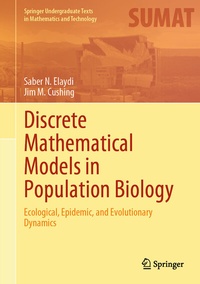
Discrete Mathematical Models in Population Biology
Description

This text lays the foundation for understanding the beauty and power of discrete-time models. It covers rich mathematical modeling landscapes, each offering deep insights into the dynamics of biological systems. A harmonious balance is achieved between theoretical principles, mathematical rigor, and practical applications. Illustrative examples, numerical simulations, and empirical case studies are provided to enhance mastery of the subject and facilitate the translation of discrete-time mathematical biology into real-world challenges. Mainly geared to upper undergraduates, the text may also be used in graduate courses focusing on discrete-time modeling.
Chapters 1-4 constitute the core of the text. Instructors will find the dependence chart quite useful when designing their particular course. This invaluable resource begins with an exploration of single-species models where frameworks for discrete-time modeling are established. Competition models and Predator-prey interactions are examined next followed by evolutionary models, structured population models, and models of infectious diseases. The consequences of periodic variations, seasonal changes, and cyclic environmental factors on population dynamics and ecological interactions are investigated within the realm of periodically forced biological models.
This indispensable resource is structured to support educational settings:
- A first course in biomathematics, introducing students to the fundamental mathematical techniques essential for biological research.
- A modeling course with a concentration on developing and analyzing mathematical models that encapsulate biological phenomena.
- An advanced mathematical biology course that offers an in-depth exploration of complex models and sophisticated mathematical frameworks designed to tackle advanced problems in biology.
With its clear exposition and methodical approach, this text educates and inspires students and professionals to apply mathematical biology to real-world situations. While minimal knowledge of calculus is required, the reader should have a solid mathematical background in linear algebra.
Reviews / Votes
"In this friendly written and easy-to-follow book, the authors lay the foundation for analyzing discrete mathematical models in population biology. . Though a solid mathematical background in linear algebra is required, with the numerous exercise problems, the book can be used as textbook for upper undergraduates and even for graduates concentrating on discrete-time modeling. It can also serve as a reference for researchers in mathematical biology." (Yuming Chen, zbMATH 1567.92002, 2025)
More details
Other editions
Additional editions
Persons
Saber N. Elaydi is Professor of Mathematics and the department chair at Trinity University in San Antonio, Texas. His main objectives in teaching is to make mathematics accessible to all Trinity students regardless of their background or academic focus. His UTM entitled An Introduction to Difference Equations is in its 3rd edition with Springer.
Jim M. Cushing is Professor Emeritus of the Department of Mathematics at University of Arizona. His research involves the derivation and analysis of mathematical models that describe population and evolutionary dynamics. Professor Cushing is particularly interested in structured population dynamics and also studies evolutionary game theoretic versions of population models.
Content
Preface.- 1.Scalar Population Models.- 2. Linear Structured Population Models.- 3. Linear and Nonlinear Systems.- 4. Infectious Disease Models I.- 5. Models with Multiple Attractors.- 6. Nonlinear Structured Population Models.- 7. Infectious Disease Models II.- 8. Evolutionary Models.- 9. Autonomous Models.- Bibliography.- Index.
