

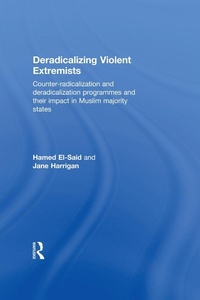
Deradicalising Violent Extremists
Counter-Radicalisation and Deradicalisation Programmes and their Impact in Muslim Majority States
1st Edition
Published on 24. October 2018
288 pages
978-1-136-24366-0 (ISBN)
Description

Terrorism remains one of the major threats facing the world community. While literature on the subject is dominated by discussion of the factors leading individuals and groups to join violent extremist, terrorist groups, the question of what can lead them to disengage from such groups is an equally important one. This book is the first study to provide a detailed analysis of both counter-radicalization and deradicalization programmes in eight Muslim-majority states, representing hitherto one of the largest, detailed, and most systematic inventory of such programmes in the world.
Drawing on detailed case-studies from a number of countries, the book:
traces the historical evolution of violent extremist groups and individuals in each country case study, including the period before independence;
describes in detail states' response to this phenomenon in each period;
provides important empirical analyses for counter-and-deradicalization policies and programmes based on extensive fieldwork and interviews with state officials, former radicals, and members of civil society organizations in each country;
provides a first systematic evaluation of the effectiveness and success of these programmes and policies;
focuses simultaneously on factors that have led to deradicalization at an individual or organizational level, and on the macro environment, both external-global and internal, that encourages counter-radicalization and deradicalization of groups and individuals.
The detailed comparative analyses allow the reader to identify conditions, both internal and external, which are conducive to both success and failure of counter-radicalization and deradicalization programmes, and the authors identify best practice and provide policy implications for states facing threats from violent extremism, as well as for international institutions and organizations working in the field of counter-terrorism.
Drawing on detailed case-studies from a number of countries, the book:
traces the historical evolution of violent extremist groups and individuals in each country case study, including the period before independence;
describes in detail states' response to this phenomenon in each period;
provides important empirical analyses for counter-and-deradicalization policies and programmes based on extensive fieldwork and interviews with state officials, former radicals, and members of civil society organizations in each country;
provides a first systematic evaluation of the effectiveness and success of these programmes and policies;
focuses simultaneously on factors that have led to deradicalization at an individual or organizational level, and on the macro environment, both external-global and internal, that encourages counter-radicalization and deradicalization of groups and individuals.
The detailed comparative analyses allow the reader to identify conditions, both internal and external, which are conducive to both success and failure of counter-radicalization and deradicalization programmes, and the authors identify best practice and provide policy implications for states facing threats from violent extremism, as well as for international institutions and organizations working in the field of counter-terrorism.
More details
Edition
1. Auflage
Language
English
Place of publication
London
United Kingdom
Publishing group
Taylor & Francis Ltd
Target group
College/higher education
Illustrations
2 s/w Tabellen
2 Tables, black and white
File size
1,54 MB
ISBN-13
978-1-136-24366-0 (9781136243660)
Copyright in bibliographic data and cover images is held by Nielsen Book Services Limited or by the publishers or by their respective licensors: all rights reserved.
Schweitzer Classification
Other editions
Additional editions
Hamed El-Said | Jane Harrigan
Deradicalising Violent Extremists
Counter-Radicalisation and Deradicalisation Programmes and their Impact in Muslim Majority States
Book
09/2012
1st Edition
Routledge
€206.70
Shipment within 15-20 days
Hamed El-Said | Jane Harrigan
Deradicalising Violent Extremists
Counter-Radicalisation and Deradicalisation Programmes and their Impact in Muslim Majority States
Book
08/2012
1st Edition
Routledge
€77.20
Shipment within 15-20 days
Persons
Hamed El-Said is Chair and Professor of International Political Economy at Manchester Metropolitan University Business School.
Jane Harrigan is Professor of Economics at the School of Oriental and African Studies, University of London.
Jane Harrigan is Professor of Economics at the School of Oriental and African Studies, University of London.
Content
1. Introduction 2. Clemency, Civil Accord and Reconciliation: The Evolution of Algeria's Deradicalisation Process 3. The Rise of Religious-based Radicalism and De-radicalisation Programme in Bangladesh 4. Group De-Radicalisation in Egypt: The Unfinished Agenda 5. Jordan's Response to Jihadi Salafism 6. Counter-radicalisation without De-radicalisation: The case of Morocco 7. Malaysia: A History of Dealing with Insurgency and Extremism 8. Saudi Arabia: The Master of De-Radicalisation 9. Yemen's Passive De-radicalisation Programme 10. Conclusion
