

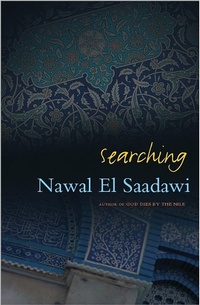
Searching
2nd Edition
Published on 9. June 2009
152 pages
978-1-84813-224-5 (ISBN)
Description

Fouada meets Farid, her lover, every Tuesday in a restaurant overlooking the Nile. But this week their usual table is deserted. She calls his home, but the shrilling of the telephone echoes in an empty room. Farid has disappeared.
As she searches for him, Fouada becomes tormented by questions. She is a trained research chemist, but works in a dead-end ministry job. Convinced that she has something to give to the world, she cannot find it. What is it? Why does she search?
'Searching' expresses the poignancy of loss and doubt with the hypnotic intensity of a remembered dream.
As she searches for him, Fouada becomes tormented by questions. She is a trained research chemist, but works in a dead-end ministry job. Convinced that she has something to give to the world, she cannot find it. What is it? Why does she search?
'Searching' expresses the poignancy of loss and doubt with the hypnotic intensity of a remembered dream.
Reviews / Votes
Reading Searching again, in light of a growing body of work in the Arab world on gender, feminism and social change, is like taking a look at this body from the inside out and seeing it in its raw state. * Anastasia Valassopoulos, The University of Manchester * Searching is an intense psychological exploration of the state of mind of a young Egyptian woman who longs for both professional and personal meaning in her life, but finds herself isolated and adrift in a kafkaesque world of senseless work, with a dying mother and a lover who has gone missing. Nawal El Saadawi creates a hellish vision of Cairo. Her protagonist finds heself utterly alone in a world dominated by casual, brutal patriarchy and a shadowy authoritarian state. Searching is a disturbing text that makes the reader feel trapped in a world that often feels like a particularly bad recurrent dream. * Jane Plastow, Leeds University * In Searching, Nawal El Saadawi once again presents a psychological drama that will take you into the depths of a woman's despair. Intimate details and vivid descriptions fill this story of an ordinary person who ends up teetering over the abyss of insanity. Disappointed in love, Fouada wanders away from her job as biochemical researcher in a government agency, the emblem of soul-deadening routine. She calls her beloved obsessively, but he does not answer the phone's urgent ring. Questions fill her mind, as she doubts the basis of their love. With her mother's financial help, she starts up a little laboratory in an apartment without caring what people would think in a place where a woman living alone is assumed to be for sale. She pays little heed to her loving mother who worries about her daughter and her deteriorating health. Disgust with the attention paid her by the landlord who turns out to be an important government official adds to her self-absorption. Then the world and life come crashing back. This is a novel of Cairo with the languid Nile winding its way through a story of love, guilt, betrayal and redemption. * Miriam Cooke, Duke University * Nawal El Saadawi writes with directness and passion * New York Times Book Review *More details
Edition
2nd edition
Language
English
Place of publication
London
United Kingdom
Publishing group
Bloomsbury Publishing PLC
Target group
Professional and scholarly
ISBN-13
978-1-84813-224-5 (9781848132245)
Copyright in bibliographic data and cover images is held by Nielsen Book Services Limited or by the publishers or by their respective licensors: all rights reserved.
Schweitzer Classification
Other editions
Persons
Nawal El Saadawi was a renowned Egyptian writer, novelist and activist. She published over 40 books, which have been translated into over 30 languages.
Nawal El Saadawi graduated from the University of Cairo Medical College in 1955, specializing in psychiatry, and practiced as a medical doctor until taking the position of Director General for Public Health Education in the Ministry of Health. In 1972 she lost her job in the Egyptian government because of her banned book: Woman and Sex. In 1982, she established the Arab Women's Solidarity Association (AWSA), the Egyptian Branch of which was outlawed in Egypt in 1991.
In 1981 Saadawi was arrested and imprisoned for publicly criticizing President Anwar Sadat's policies. She was released one month after his assassination. Her name appeared on a fundamentalist death list after publishing her novel The Fall of the Imam in Cairo in 1988 and she was obliged to leave her country, to teach in the USA. Other court cases have been raised against both her and her daughter and defeated. In 2008 she defeated a case that demanded the withdrawal of her Egyptian Nationality in response to her play God Resigns at the Summit Meeting.
Her most famous novel, Woman at Point Zero was published in Beirut in 1973. It was followed in 1976 by God Dies by the Nile and in 1977 by The Hidden Face of Eve. The Hidden Face of Eve was her first book to be translated to English and was published by Zed Books in 1980. Her most recent novel is Zina: The Stolen Novel (2008).
Nawal El Saadawi heldmore than ten honorary doctorates from different universities in Europe and the USA. Her many prizes and awards include the Great Minds of the Twentieth Century Prize (2003), the North-South Prize from the Council of Europe, the Premi Internacional Catalunya (2004) , and most recently she was the 2007 recipient of The African Literature Association's Fonlon-Nichols Award. Her books are taught in universities across the world.
Nawal El Saadawi graduated from the University of Cairo Medical College in 1955, specializing in psychiatry, and practiced as a medical doctor until taking the position of Director General for Public Health Education in the Ministry of Health. In 1972 she lost her job in the Egyptian government because of her banned book: Woman and Sex. In 1982, she established the Arab Women's Solidarity Association (AWSA), the Egyptian Branch of which was outlawed in Egypt in 1991.
In 1981 Saadawi was arrested and imprisoned for publicly criticizing President Anwar Sadat's policies. She was released one month after his assassination. Her name appeared on a fundamentalist death list after publishing her novel The Fall of the Imam in Cairo in 1988 and she was obliged to leave her country, to teach in the USA. Other court cases have been raised against both her and her daughter and defeated. In 2008 she defeated a case that demanded the withdrawal of her Egyptian Nationality in response to her play God Resigns at the Summit Meeting.
Her most famous novel, Woman at Point Zero was published in Beirut in 1973. It was followed in 1976 by God Dies by the Nile and in 1977 by The Hidden Face of Eve. The Hidden Face of Eve was her first book to be translated to English and was published by Zed Books in 1980. Her most recent novel is Zina: The Stolen Novel (2008).
Nawal El Saadawi heldmore than ten honorary doctorates from different universities in Europe and the USA. Her many prizes and awards include the Great Minds of the Twentieth Century Prize (2003), the North-South Prize from the Council of Europe, the Premi Internacional Catalunya (2004) , and most recently she was the 2007 recipient of The African Literature Association's Fonlon-Nichols Award. Her books are taught in universities across the world.
Content
- Cover
- Title
- Copyright
- Foreword
- Part- One
- Part- Two
- Part- Three
