

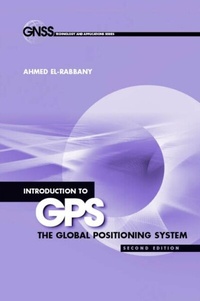
Introduction to GPS
The Global Positioning System, Second Edition
1st Edition
Published on 1. January 2006
230 pages
978-1-59693-017-9 (ISBN)
Description

This thoroughly revised edition of the Artech House bestseller, Introduction to GPS: The Global Position System offers professionals and students an up-to-date, easy-to-understand treatment of this tremendously important technology. The second edition includes a wealth of brand new material, including a chapter on GPS satellite orbit and new coverage of today's hottest issues, such as precise point positioning and location based services. Without bogging readers down with advanced mathematics, the book addresses all aspects of the GPS, emphasizes GPS applications, examines the GPS signal structure, and covers the key types of measurement being utilized in the field today.
More details
Other editions
Additional editions
Ahmed El-Rabbany
Introduction to GPS: The Global Positioning System, Second Edition
2e the Global Positioning Sy
Book
10/2006
Artech House Publishers
€84.00
Shipment within 10-20 days
Content
- Intro
- Introduction to GPS The Global Positioning System
- Contents vii
- Preface xiii
- 1 Introduction to GPS 1
- 1.1 Overview of GPS 2
- 1.2 GPS Segments 3
- 1.3 GPS Satellite Generations 4
- 1.4 Current GPS Satellite Constellation 6
- 1.5 Control Sites 7
- 1.6 GPS: The Basic Idea 8
- 1.7 GPS Levels of Service 10
- 1.8 Why Use GPS? 11
- References 11
- 2 GPS Details 13
- 2.1 GPS Signal Structure 13
- 2.2 GPS Modernization 16
- 2.3 GPS Receiver Types 18
- 2.4 Time Systems 20
- 2.5 Pseudorange Measurements 21
- 2.6 Carrier Phase Measurements 22
- 2.7 Doppler Measurements 24
- 2.8 Cycle Slips 25
- 2.9 Linear Combinations of GPS Observables 26
- References 27
- 3 GPS Satellite Orbit 29
- 3.1 Motion of Space Objects 29
- 3.2 Types of Orbits 32
- 3.3 Ideal (Keplerian) Satellite Orbit 33
- 3.4 Perturbed Satellite Orbit 35
- 3.5 GPS Broadcast Orbit 36
- 3.6 GPS Almanac 39
- 3.7 Satellite Visibility 40
- References 42
- 4 GPS Errors and Biases 43
- 4.1 GPS Ephemeris Errors 44
- 4.2 Selective Availability 45
- 4.3 Satellite and Receiver Clock Errors 47
- 4.4 Multipath Error 48
- 4.5 Antenna Phase Center Variation 49
- 4.6 Receiver Measurement Noise 50
- 4.7 Ionospheric Delay 51
- 4.8 Tropospheric Delay 55
- 4.9 Other Errors and Biases 56
- 4.10 Satellite Geometry Measures 57
- 4.11 User Equivalent Range Error 60
- References 61
- 5 GPS Positioning Modes 65
- 5.1 GPS Point Positioning: The Classical Approach 66
- 5.2 GPS PPP 68
- 5.3 GPS Relative Positioning 70
- 5.4 Static GPS Surveying 71
- 5.5 Fast (Rapid) Static 73
- 5.6 Stop-and-Go GPS Surveying 74
- 5.7 RTK GPS 76
- 5.8 Real-Time Differential GPS 77
- 5.9 Real Time Versus Postprocessing 79
- 5.10 Communication (Radio) Link 80
- References 82
- 6 Ambiguity Resolution Techniques 83
- 6.1 Antenna Swap Method 85
- 6.2 OTF Ambiguity Resolution 86
- References 88
- 7 GPS Data, Products, and Correction Services 89
- 7.1 GPS Data and Product Services 91
- 7.2 Maritime DGPS Service 93
- 7.3 WADGPS Systems 95
- 7.4 Multisite RTK System 98
- References 99
- 8 GPS Standard Formats 103
- 8.1 RINEX Format 104
- 8.2 SP3 Format 109
- 8.3 RTCM SC-104 Standards for DGPS Services 112
- 8.4 NMEA 0183 Format 118
- References 121
- 9 GPS Integration 123
- 9.1 GPS/Loran-C Integration 123
- 9.2 GPS/LRF Integration 127
- 9.3 GPS/Dead Reckoning Integration 128
- 9.4 GPS/INS Integration 130
- 9.5 GPS/Pseudolite Integration 132
- 9.6 GPS/Cellular Integration 134
- References 136
- 10 GPS Applications 139
- 10.1 GPS for the Utility Industry 139
- 10.2 GPS for Forestry and Natural Resource 141
- 10.3 GPS for Precision Farming 142
- 10.4 GPS for Civil Engineering Applications 144
- 10.5 GPS for Monitoring Structural Deformations 145
- 10.6 GPS for Open-Pit Mining 146
- 10.7 GPS for Land Seismic Surveying 148
- 10.8 GPS for Marine Seismic Surveying 149
- 10.9 GPS for Airborne Mapping 151
- 10.10 GPS for Seafloor Mapping 152
- 10.11 GPS for Vehicle Navigation 154
- 10.12 GPS for Transit Systems 156
- 10.13 GPS for the Retail Industry 157
- 10.14 GPS for Cadastral Surveying 159
- 10.15 Waypoint Navigation (GPS Stakeout) 160
- References 161
- 11 Other Satellite Navigation Systems 163
- 11.1 The GLONASS System 163
- 11.2 Galileo-The European Global Satellite Navigation System 167
- 11.3 Chinese Regional Satellite Navigation System (Beidou System) 170
- 11.4 The Japanese QZSS Satellite Navigation System 172
- References 173
- Appendix A: Geodetic Principles-Datums, Coordinate Systems, and Map Projections 175
- A.1 What Is a Datum? 175
- A.2 Geodetic Coordinate System 177
- A.3 What Coordinates Are Obtained with GPS? 181
- A.4 Datum Transformations As stated in Section A.1 182
- A.5 Map Projections 183
- A.6 Local Arbitrary Mapping Systems 190
- A.7 Height Systems 191
- References 193
- Appendix B: GPS Accuracy and Precision Measures 195
- Reference 196
- Appendix C: Useful Web Sites 197
- C.1 GPS/Glonass/Galileo Information and Data 197
- C.2 Some GPS Manufacturers 199
- About the Author 201
- Index 203
