

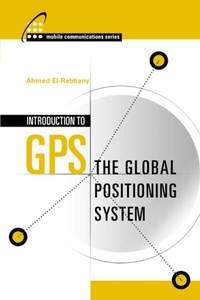
Introduction to GPS
The Global Positioning System
1st Edition
Published on 1. January 2006
189 pages
978-1-58053-547-2 (ISBN)
Description

This resource offers professionals, students and recreational users of GPS a clear non-mathematical explanation of how GPS works and its wide range of applications. It addresses all aspects of the GPS, examines the GPS signal structure and covers the key types of measurement being utilized in the field today. Readers get an in-depth discussion on the errors and biases that affect GPS measurements, along with advice on how to overcome them. Moreover, the book shows how the GPS can be used for a number of different accuracy levels. Datums, coordinate systems and map projections are discussed in a simple manner, offering a clear understanding of this widely misunderstood area. This reference also examines the integration of the GPS with ther systems, and looks at future GPS modernization.
More details
Other editions
Additional editions
Ahmed El-Rabbany
Engineer's Guide to GPS
Book
12/2002
Artech House Publishers
€70.76
Article exhausted; check different version
Content
- Intro
- Contents vii
- Preface xiii
- Acknowledgments xv
- 1 Introduction to GPS 1
- 1.1 Overview of GPS 1
- 1.2 GPS segments 2
- 1.3 GPS satellite generations 4
- 1.4 Current GPS satellite constellation 5
- 1.5 Control sites 6
- 1.6 GPS: The basic idea 8
- 1.7 GPS positioning service 9
- 1.8 Why use GPS? 10
- References 11
- 2 GPS Details 13
- 2.1 GPS signal structure 13
- 2.2 GPS modernization 15
- 2.3 Types of GPS receivers 16
- 2.4 Time systems 18
- 2.5 Pseudorange measurements 19
- 2.6 Carrier-phase measurements 21
- 2.7 Cycle slips 22
- 2.8 Linear combinations of GPS observables 23
- References 25
- 3 GPS Errors and Biases 27
- 3.1 GPS ephemeris errors 28
- 3.2 Selective availability 29
- 3.3 Satellite and receiver clock errors 31
- 3.4 Multipath error 32
- 3.5 Antenna-phase-center variation 34
- 3.6 Receiver measurement noise 35
- 3.7 Ionospheric delay 36
- 3.8 Tropospheric delay 38
- 3.9 Satellite geometry measures 39
- 3.10 GPS mission planning 42
- 3.11 User equivalent range error 44
- References 44
- 4 Datums, Coordinate Systems, and Map Projections 47
- 4.1 What is a datum? 48
- 4.2 Geodetic coordinate system 49
- 4.3 What coordinates are obtained with GPS? 53
- 4.4 Datum transformations 53
- 4.5 Map projections 55
- 4.6 Marine nautical charts 62
- 4.7 Local arbitrary mapping systems 64
- 4.8 Height systems 65
- References 66
- 5 GPS Positioning Modes 69
- 5.1 GPS point positioning 70
- 5.2 GPS relative positioning 71
- 5.3 Static GPS surveying 72
- 5.4 Fast (rapid) static 74
- 5.5 Stop-and-go GPS surveying 75
- 5.6 RTK GPS 77
- 5.7 Real-time differential GPS 78
- 5.8 Real time versus postprocessing 80
- 5.9 Communication (radio) link 81
- References 83
- 6 Ambiguity-Resolution Techniques 85
- 6.1 Antenna swap method 87
- 6.2 On-the-fly ambiguity resolution 88
- References 90
- 7 GPS Data and Correction Services 91
- 7.1 Data service 92
- 7.2 DGPS radio beacon systems 94
- 7.3 Wide-area DGPS systems 95
- 7.4 Multisite RTK system 98
- References 99
- 8 GPS Standard Formats 101
- 8.1 RINEX format 101
- 8.2 NGS-SP3 format 105
- 8.3 RTCM SC-104 standards for DGPS services 108
- References 115
- 9 GPS Integration 117
- 9.1 GPS/GIS integration 117
- 9.2 GPS/LRF integration 118
- 9.3 GPS/dead reckoning integration 120
- 9.4 GPS/INS integration 121
- 9.5 GPS/pseudolite integration 123
- 9.6 GPS/cellular integration 125
- References 127
- 10 GPS Applications 129
- 10.1 GPS for the utilities industry 129
- 10.2 GPS for forestry and natural resources 131
- 10.3 GPS for precision farming 132
- 10.4 GPS for civil engineering applications 133
- 10.5 GPS for monitoring structural deformations 134
- 10.6 GPS for open-pit mining 135
- 10.7 GPS for land seismic surveying 138
- 10.8 GPS for marine seismic surveying 139
- 10.9 GPS for airborne mapping 140
- 10.11 GPS for vehicle navigation 144
- 10.12 GPS for transit systems 146
- 10.13 GPS for the retail industry 147
- 10.14 GPS for cadastral surveying 149
- 10.15 GPS stakeout (waypoint navigation) 150
- References 151
- 11 Other Satellite Navigation Systems 155
- 11.1 GLONASS satellite system 155
- 11.2 Chinese regional satellite navigation system (Beidou system) 157
- 11.3 Regional augmentations 157
- 11.4 Future European global satellite navigation system 11.4 (Galileo system) 158
- References 159
- Appendix A GPS Accuracy and Precision Measures 161
- Reference 162
- Appendix B Useful Web Sites 163
- B.1 GPS/GLONASS/Galileo information and data 163
- B.2 GPS manufacturers 165
- About the Author 167
