

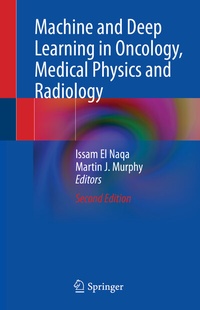
Machine and Deep Learning in Oncology, Medical Physics and Radiology
Description

This book, now in an extensively revised and updated second edition, provides a comprehensive overview of both machine learning and deep learning and their role in oncology, medical physics, and radiology. Readers will find thorough coverage of basic theory, methods, and demonstrative applications in these fields. An introductory section explains machine and deep learning, reviews learning methods, discusses performance evaluation, and examines software tools and data protection. Detailed individual sections are then devoted to the use of machine and deep learning for medical image analysis, treatment planning and delivery, and outcomes modeling and decision support. Resources for varying applications are provided in each chapter, and software code is embedded as appropriate for illustrative purposes. The book will be invaluable for students and residents in medical physics, radiology, and oncology and will also appeal to more experienced practitioners and researchers and members ofapplied machine learning communities.
Reviews / Votes
"This is a must-read for anyone interested in the intersection of technology and healthcare. A roadmap, if you like, to a future where cancer can be conquered with the help of AI and human ingenuity." (Dewinder Bhachu, RAD Magazine, June, 2024)
More details
Other editions
Additional editions
Persons
Issam El Naqa
is founding Chair of Machine Learning Department and Associate Member of Radiation Oncology at Moffitt Cancer Center in Tampa, Florida.. He is board certified as a medical physicist by the American Board of Radiology. Dr. El Naqa received his BSc (1992) and MSc (1995) in Electrical and Communication Engineering from the University of Jordan, Jordan. He completed his PhD (2002) in Electrical and Computer Engineering at the Illinois Institute of Technology, Chicago, IL, USA, receiving the highest academic distinction award for his work. He also completed an MA (2007) in Biology Science at Washington University, where he was hired as an instructor (2005-7) and then an Assistant Professor (2007-10) in the departments of radiation oncology and the division of biomedical and biological sciences. He subsequently became an Associate Professor at McGill University Health Centre/Medical Physics Unit (2010-15). He later joined the Department of Radiation oncology atthe University of Michigan at Ann Arbor (2015-20), where he was a Professor and associate member in Applied Physics and the Michigan institute of data science. Dr. El Naqa is a recognized authority in the fields of machine learning, data analytics, and oncology outcomes modeling and has published extensively in these areas with more than 200+ peer-reviewed journal publications and 4 edited textbooks. He has been a member and fellow of several academic and professional societies including AAPM and IEEE. His research has been funded by several federal and private grants in Canada and the USA and served on national and international study sections. He acts as a peer-reviewer and editorial board member for several leading international journals in his areas of expertise.
Martin J Murphy
is Professor Emeritus of radiation oncology at Virginia Commonwealth University (VCU), where he directed research into image-guided surgery and radiation therapy, employing principles of machine learning and neural networks. He received his PhD in physics from the University of Chicago. Subsequently, he did research in nuclear physics, astrophysics, and space sciences at the Lawrence Berkeley Laboratory, the University of Washington, and the Lockheed Palo Alto Research Laboratory before joining the original development team for the CyberKnife in 1992. He continued CyberKnife development and other image-guidance applications at Stanford before joining the radiation oncology department at VCU in 2003. He has been the principal investigator for numerous NIH and private sector grants to apply robotics and machine learning to image guidance.
