

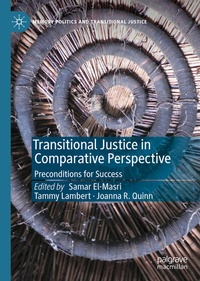
Transitional Justice in Comparative Perspective
Description

Reviews / Votes
"Underpinned by an inherent sense of optimism, this book goes beyond simply identifying the obstacles to successful transitional justice processes to make a positive contribution to thinking about how those obstacles might be overcome. It is an important and timely addition to the growing literature on success in the study and practice of transitional justice." (Professor Renée Jeffery, Griffith University)"On the vital question of when transitional justice works, this volume takes research in a new direction. In addition to the design of mechanisms themselves, it effectively demonstrates that nature of the institutions and attitudes present at the time are equally crucial for their success or failure. Moreover, rather than just showing that context matters, the authors illustrate ways in which these pre-conditions can be changed to improve the prospects of transitional justice efforts, providing clear guidance for policymakers." (Andrew G. Reiter, Associate Professor ofPolitics and International Relations, Mount Holyoke College)
"Beginning from the understanding that the quality of a transitional justice process depends on the conditions in which it is created, this volume seeks to ask what those conditions are and how they can be fostered. By examining how to impact both attitudes and institutions in transitional states the contributions to this book interrogate through conceptually-framed empirical case studies what contextual conditions make transitional justice work, or at least work better. The scholarship here represents a contribution that emphasizes the need for researchers and practitioners to expand their temporal interest to address not only the past in terms of a history of violations and the future in terms of ensuring non-recurrence, but to focus very much on changing the present to maximize the potential of transitional justice. In so doing it tells us about transitional justice more broadly, in terms of what makes processeffective and how the change it seeks to drive can be made to 'stick'." (Simon Robins, Transitional Justice Researcher and Practitioner)
More details
Other editions
Additional editions
Persons
Tammy Lambert is Researcher in Political Science and Transitional Justice and Post-Conflict Reconstruction at The University of Western Ontario.
Joanna R. Quinn is Director of the Centre for Transitional Justice and Post-Conflict Reconstruction at The University of Western Ontario.
