

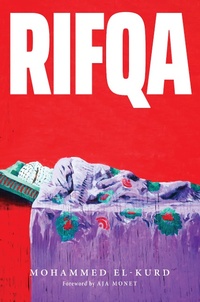
Rifqa
Description

Rifqa is Mohammed El-Kurd's debut collection of poetry, written in the tradition of Ghassan Kanafani's Palestinian Resistance Literature. The book narrates the author's own experience of dispossession in Sheikh Jarrah--an infamous neighborhood in Jerusalem, Palestine, whose population of refugees continues to live on the brink of homelessness at the hands of the Israeli government and US-based settler organizations. The book, named after the author's late grandmother who was forced to flee from Haifa upon the genocidal establishment of Israel, makes the observation that home takeovers and demolitions across historical Palestine are not reminiscent of 1948 Nakba, but are in fact a continuation of it: a legalized, ideologically-driven practice of ethnic cleansing.
More details
Person
Mohammed El-Kurd is a writer, poet, journalist, and organizer from Jerusalem, occupied Palestine. He is the Nation's first-ever Palestine Correspondent and editor-at-large at Mondoweiss, the recipient of numerous honors and awards, and the author of the highly-acclaimed poetry collection Rifqa, which has been translated into several languages.
Content
- Intro
- Copyright
- Contents
- Foreword: Love Is Older Than "Israel" by aja monet
- One
- In Jerusalem
- Who Lives in Sheikh Jarrah?
- Born on Nakba Day
- This Is Why We Dance
- Girls in the Refugee Camp
- Bulldozers Undoing God
- Smuggling Bethlehem
- A Song of Home
- Portrait of My Nose
- Rifqa
- Two
- Wednesday
- 1948/1998
- Fifteen-Year-Old Girl Killed for Attempting to Kill a Soldier (with a Nail File), or Context
- No Moses in Siege
- Things I Cannot Say
- Boy Sells Gum at Qalandiyah
- Math
- War Machines Dress Up as Drag Queens
- Elderly Woman Falls Asleep on My Shoulder
- Three Women
- Three
- Laugh
- Kroger
- Autobiography
- The Day Is Like Butter
- Small Talk
- Park Benches with Teeth
- No Poetry in This
- And They Leave and Never Leave
- Amal Hayati
- Four
- Anti-Biography
- Why Do You Speak of the Nakba at the Party?
- Martyrs
- Crows
- Lice
- Where Am I From Jerusalem?
- Bush
- The Biggest Punch Line of All Time
- Sheikh Jarrah Is Burning
- Farewell, Palestine's Jasmine
- Afterword: Lest There Be Unclarity
- Acknowledgments
- Gratitude
- Back Cover
