

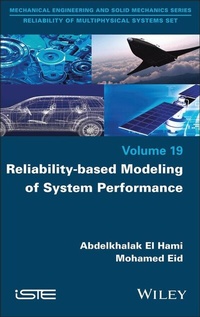
Reliability-based Modeling of System Performance
Description

This book progressively builds up the functional complexity of system modeling. It starts by modeling the simplest system that can be designed, and then moves to the functional modeling of the multi-state system, step-by-step.
Reliability-based Modeling of System Performance deals with modeling the functioning of systems by presenting its concepts, methods and mathematical tools. It is accessible to engineering students and academics who have already acquired basic knowledge of probability theory, applied statistics, differential calculus, integrals, combinatorial calculus and Boolean algebra.
More details
Other editions
Additional editions
Persons
Abdelkhalak El Hami is a university professor at INSA Rouen Normandie, France. He specializes in optimization, reliability and AI of multi-physical systems.
Mohamed Eid is an associate professor at INSA Rouen Normandie, France. He is an expert in complex, multidisciplinary and multisectoral system performance modeling.
Content
Introduction
Probabilistic modeling of system performance is built primarily on a solid foundation of reliability theory. It can therefore be called "reliability-based modeling of system performance". Although it has organic links with applied statistics, combinatorial calculations and Boolean algebra, reliability-based modeling is a distinct discipline that is conceptually different from the disciplines cited above. Currently, reliability-based modeling covers a very wide spectrum of applications, such as system reliability engineering, functional analysis, operational safety, risk analysis and management, risk management and maintenance optimization, system degradation and aging, system failure monitoring, diagnosis and prognosis, performance analysis, mass-production and quality control, structural reliability and software reliability.
The focus of the book is restricted to the reliability, availability, maintenance, and safety (RAMS) modeling of complex systems, excluding passive systems (structures) and software.
The book is accessible to engineering students and engineers who have already acquired the elementary knowledge of probability theory, applied statistics, differential calculus, integrals, combinatorial calculus and Boolean algebra.
Having specified above the areas contributing to the reliability-based modeling of system's performance, the primary functional qualities concerned are the availability and the reliability of the system. These functional qualities are probabilistic in nature and statistically measurable. As soon as the concepts of availability and reliability are well understood, other derived qualities arise and complete the functional characterization of the system, such as the system functional space and the transition rates between the states defining the system functional space and the probabilities of sojourning in the states. Our recourse to mathematics does only serve to support the paradigm of reliability-based modeling of system's performance practiced by system engineering.
Throughout the book, the complexity of systems modeling is gradually built up. We start by modeling the operation of the simplest system that engineers can conceive, which is the "binary-state system". We will call it the elementary component. Progressively, we proceed towards the functional modeling of the multistate system. In this approach, the multistate system is built from independent and coherent elementary components. Independence and functional coherence of the constituents are well defined in the book. However, neither dependency nor functional incoherence of constituents has been addressed in the book.
Whether the system is binary or multistate, the definition of failure always remains of a functional nature. The physical roots of a failure may only appear at the lowest levels of the functional analysis where the elementary component failure appears. The lowest level of any functional analysis is conventionally decreed by the engineers and/or by the analysts. The functional boundaries separating between components and systems are also conventional. A system in a specific step of the analysis can become a component in the next step and vice versa. Gradually, this allows the modeling of the increasing functional complexity up to the system of systems. The book explores this possibility through the functional binarization of the multistate systems. The binarization of the multistate systems ensures the conservation of the fundamental mathematical models that describe the availability and the reliability of every functional entity through the full scale of complexity. Consequently, the availability and the reliability of every functional entity are governed by the same fundamental system of differential and integral equations, regardless of the degree of its complexity. The functional complexity is finally determined by the number of states defining the system, the functional space structure and the logical relations structuring the system functionalities. For low and medium complexity systems, the availability and the reliability can be determined by some analytical or numerical models. For higher complexities, analysts may call for the numerical simulation using the Monte Carlo simulation or similar methods. The book gives insights into these methods through simple didactic applications. The book is structured in eight chapters.
In Chapter 1, we insist on the identification of the system through its functionalities. As mentioned above, a system is a functional entity. As such, "availability" designates the aptitude of the system to supply its required functionalities on demand. It does not refer to its physical condition or being. A physically sound system may not be available because it is poorly cooled though its cooling unit is also sound. Indeed, it may not provide the required cooling capacity because the system operating temperature is beyond the safe thermal operating limits. Admittedly, the confusion between functionality and the physical system arises at the most elementary stage of the successive segmentation of functions and sub-functions. At the lowest stage of the segmentation, the elementary system would be arbitrarily called a component. The analyst arbitrarily sets the functional threshold below which the component would arise, in the most suitable way for his/her analysis. This threshold could obviously vary from one analysis to another. This elementary functional entity embodied in a component will be described in the simplest way that the systems engineer can imagine. It would exclusively be either "available" or "unavailable". The component therefore operates in perpetual transitions between the availability state and the unavailability state, until the end of its operational life. The transitions are characterized by a failure rate and a repair rate. The elementary component has a binary operating pattern, which is characterized by its failure and repair rates. Thus, we introduce the concept of the elementary component. The mathematical modeling of the availability and the reliability of the elementary component is developed in detail in Chapter 1.
Chapter 2 deals with the mathematical modeling of the availability and the reliability of the multistate system using the elementary models developed in Chapter 1. The multistate system is built by the functional assembly of the elementary components under the conditions that the elementary components are independent and functionally coherent. The independence requires that the transitions of the elementary components do not mutually infer. The functional coherence requires that the transition of any of the elementary components to an unavailability state cannot increase the overall availability of the system and that the transition of any of the elementary components to an availability state cannot increase the overall unavailability of the system. That is to say, in other words, the functional degradation of an elementary component can only degrade the overall functional state of the system, and the functional upgrading of an elementary component can only upgrade the overall functional state of the system. Having established the principles of independence and functional coherence, we only need to describe the logical functional relationships that structure all the elementary components within a well-defined system. These logical functional relations operate in two elementary algebraic modes, which are the union (OR) and the intersection (AND), in the Boolean sense of the terms. Then, the functional assembly of the elementary components in a single system is carried out using the elementary Boolean operators: OR "?" and AND "?"1. To introduce the notion of multistate system, we start by modeling the simplest multistate system one may conceive. That is a multistate system built up by only two elementary components. Some other multistate systems of higher order will equally be modeled before establishing the generic demarch of multistate systems modeling. Finally, we also demonstrate that any multistate system can be reduced to a binary elementary component by dividing its global functional space into a (sub-) space of availability states and a (sub-) space of unavailability states. The binarization of a multistate system will be introduced with the help of two additional notions: the critical states and the critical transitions. The mathematical modeling of the availability and the reliability of the multistate systems and their binarization gives birth to the notions of the equivalent parameters, that is, the equivalent failure and equivalent repair rates.
In Chapter 3, we treat the modeling of the matrix-like system (n × l), with n elementary components in-series, which are repeated in-parallel l times. This system is found, quite often, in the electronic devices of detection and signal analysis systems, active and passive redundant systems and manufacturing processes. Quite often too, the n × l involved components are identical. Analysts may be interested in matrix systems for two different, but not decoupled, reasons. The first concerns the modeling of the availability and the reliability of the systems in the extension of Chapter 2 after a direct adaptation to the matricial structure. The second reason is rather for the modeling of the performance degradations of a system (matrix-like or not) if the operation of the system is rather classified in phases defined by thresholds which is determined by the number of the available or the unavailable...
