

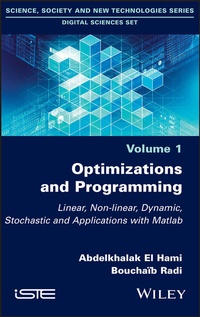
Optimizations and Programming
Linear, Non-linear, Dynamic, Stochastic and Applications with Matlab
1st Edition
Published on 8. April 2021
288 pages
978-1-119-81825-0 (ISBN)
Description

This book is a general presentation of complex systems, examined from
the point of view of management. There is no standard formula to
govern such systems, nor to effectively understand and respond to
them.
The interdisciplinary theory of self-organization is teeming with
examples of living systems that can reorganize at a higher level of
complexity when confronted with an external challenge of a certain
magnitude.
Modern businesses, considered as complex systems, ideally know how
to flexibly and resiliently adapt to their environment, and also how to
prepare for change via self-organization. Understanding sources of
potential crisis is essential for leaders, though not all crises are
necessarily bad news, as creative firms know how to respond to
challenges through innovation: new products and markets,
organizational learning for collective intelligence, and more.
the point of view of management. There is no standard formula to
govern such systems, nor to effectively understand and respond to
them.
The interdisciplinary theory of self-organization is teeming with
examples of living systems that can reorganize at a higher level of
complexity when confronted with an external challenge of a certain
magnitude.
Modern businesses, considered as complex systems, ideally know how
to flexibly and resiliently adapt to their environment, and also how to
prepare for change via self-organization. Understanding sources of
potential crisis is essential for leaders, though not all crises are
necessarily bad news, as creative firms know how to respond to
challenges through innovation: new products and markets,
organizational learning for collective intelligence, and more.
More details
Other editions
Additional editions
Abdelkhalak El Hami | Bouchaib Radi
Optimizations and Programming
Linear, Non-linear, Dynamic, Stochastic and Applications with Matlab
Book
05/2021
1st Edition
Wiley-ISTE
€164.50
Shipment within 15-20 days
Persons
Abdelkhalak El Hami is Full Professor of Universities at INSA-RouenNormandie, France. He is the author/co-author of several books and is
responsible for the Chair of mechanics at the Conservatoire National des
Arts et Metiers in Normandy, as well as for several European
pedagogical projects. He is a specialist in problems of optimization and
reliability in multi-physical systems.
Bouchaib Radi is Professor at the Faculty of Science and Technology at
Hassan Premier University, Morocco. He is a specialist in numerical
optimization methods and system reliability.
responsible for the Chair of mechanics at the Conservatoire National des
Arts et Metiers in Normandy, as well as for several European
pedagogical projects. He is a specialist in problems of optimization and
reliability in multi-physical systems.
Bouchaib Radi is Professor at the Faculty of Science and Technology at
Hassan Premier University, Morocco. He is a specialist in numerical
optimization methods and system reliability.
Content
- Cover
- Half-Title Page
- Title Page
- Copyright Page
- Contents
- Preface
- PART 1: Programmation
- 1 Linear Programming
- 1.1. Introduction
- 1.2. Definitions
- 1.3. Geometry of the linear program
- 1.3.1. Polyhedra
- 1.3.2. Extreme points and vertices
- 1.4. Graphical solving of a linear program
- 1.5. Simplex algorithm
- 1.5.1. Basic solutions and basic feasible solutions
- 1.5.2. Simplex tableau
- 1.5.3. Change of feasible basis
- 1.5.4. Existence and uniqueness of an optimal solution
- 1.6. Initialization of the simplex algorithm
- 1.6.1. Big M method
- 1.6.2. Auxiliary program or Phase I
- 1.6.3. Degeneracy and cycling
- 1.6.4. Geometric structure of realizable solutions
- 1.7. Interior-point algorithm
- 1.8. Duality
- 1.8.1. Duality theorem
- 1.9. Relaxation
- 1.9.1. Lagrangian relaxation
- 1.10. Postoptimal analysis
- 1.10.1. Effect of modifying b
- 1.10.2. Effect of modifying c
- 1.11. Application to an inventory problem
- 1.11.1. Optimal solution
- 1.11.2. Sensitivity to variation in stock
- 1.11.3. Dual problem of the competitor
- 1.12. Using Matlab
- 2 Integer Programming
- 2.1. Introduction
- 2.2. Solving methods
- 2.2.1. Branch-and-bound method
- 2.2.2. The branch-and-cut method
- 2.3. Binary programming
- 2.3.1. Knapsack problem
- 2.3.2. Investment problem
- 2.4. Decomposition principle
- 2.4.1. Benders decomposition
- 2.5. Using Matlab
- 3 Dynamic Programming
- 3.1. Introduction
- 3.2. Solving strategy
- 3.3. Discrete DP
- 3.3.1. Bellman's equation and the principle of optimality
- 3.3.2. Approach of the method
- 3.3.3. A few examples of DP
- 3.3.4. Solving an LP
- 3.3.5. Shortest path problem
- 3.3.6. Knapsack problem
- 3.3.7. Stock management problem
- 3.4. Continuous DP
- 3.4.1. Hamilton-Jacobi equation
- 3.4.2. Application to a consumption-savings model
- 3.5. Stochastic DP
- 3.5.1. Decision-chance process
- 3.5.2. Solving method
- 3.5.3. Application to a contract problem
- 3.5.4. Optimal binary search tree
- 3.6. Using Matlab
- 4 Stochastic Programming
- 4.1. Introduction
- 4.2. Presentation of the problem
- 4.3. Optimal feedback in an open loop
- 4.4. Stochastic linear programming
- 4.4.1. Models with probability thresholds on the constraints
- 4.5. Stochastic linear programs with recourse
- 4.5.1. L-shaped method
- 4.5.2. Multicut L-shaped method
- 4.5.3. Interior linearization method
- 4.6. Nonlinear stochastic programming
- 4.6.1. Approaches to two-step problems with recourse
- 4.6.2. Regularized decomposition method
- 4.6.3. Methods based on the Lagrangian
- 4.6.4. Frank-Wolfe method for problems with simple recourse
- 4.6.5. Approximation by sampling average: Monte Carlo method
- 4.6.6. Stochastic gradient method
- 4.7. Stochastic dynamic programming
- 4.7.1. Markov decision process
- 4.7.2. Scenario tree
- 4.8. Application to the reliability of mechanical systems
- 4.8.1. Position and modeling of the reliability problem
- 4.9. Using Matlab
- PART 2: Optimization
- 5 Combinatorial Optimization
- 5.1. Introduction
- 5.2. Symmetric TSP
- 5.2.1. Historical overview
- 5.2.2. Solving methods
- 5.3. Asymmetric traveling salesman problem
- 5.3.1. Variants of the ATSP
- 5.3.2. Mathematical formulations
- 5.3.3. Methods for solving the ATSP
- 5.4. Vehicle routing problem
- 5.4.1. Definition
- 5.4.2. Fields of application
- 5.4.3. Parameters of the VRP
- 5.4.4. Variants of the VRP
- 5.4.5. Mathematical formulation of the VRP
- 5.4.6. Algorithmic complexity
- 5.5. Selective routing problem
- 5.5.1. Problems similar to the VRP
- 5.5.2. Mathematical formulation
- 5.6. Using Matlab
- 6 Unconstrained Nonlinear Programming
- 6.1. Introduction
- 6.2. Mathematical formulation
- 6.2.1. Existence and uniqueness results
- 6.3. Optimality conditions
- 6.4. Quadratic problems
- 6.4.1. Gradient method with optimal step size
- 6.4.2. Conjugate gradient method
- 6.5. Newton's algorithm
- 6.6. Methods of descent and linear search
- 6.6.1. Presentation of methods of descent
- 6.6.2. Method of greatest slope
- 6.6.3. Acceptable step size
- 6.6.4. Linear search
- 6.6.5. Newton's method with linear search
- 6.7. Quasi-Newton methods
- 6.7.1. DFP and BFGS methods
- 6.8. Relaxation method
- 6.9. Gradient method
- 6.10. Least squares problem
- 6.10.1. Gauss-Newton method
- 6.10.2. Levenberg-Marquardt algorithm
- 6.10.3. Kalman filter
- 6.11. Direct search methods
- 6.11.1. Nelder-Mead algorithm
- 6.11.2. Torczon method
- 6.12. Application to an identification problem
- 6.13. Using Matlab
- 6.13.1. The fminsearch function
- 6.13.2. The fminunc function
- 6.13.3. Relaxation method
- 7 Constrained Nonlinear Optimization
- 7.1. Introduction
- 7.2. Mathematical formulation
- 7.3. Lagrange multipliers
- 7.4. Optimization with inequality constraints
- 7.4.1. First-order conditions of optimality
- 7.4.2. Presentation of saddle points
- 7.4.3. Saddle point and optimization
- 7.4.4. Convex case
- 7.5. Constrained minimization algorithms
- 7.5.1. Relaxation method
- 7.5.2. Projection method
- 7.5.3. Exterior penalty method
- 7.5.4. Uzawa's algorithm
- 7.6. Newton algorithms: SQP method
- 7.6.1. Equality constraints
- 7.6.2. Inequality constraints
- 7.7. Application to structure optimization
- 7.8. Using Matlab
- 7.8.1. The fmincon function
- 7.8.2. The fminbnd function
- 7.8.3. Penalty method
- Appendices
- Appendix 1: Reminders from Linear Algebra
- A1.1. Vector space
- A1.1.1. General definitions
- A1.1.2. Free families, generating families and bases
- A1.2. Linear mappings
- A1.3. Matrices
- A1.3.1. Operations on matrices
- A1.3.2. Change of basis matrices
- A1.3.3. Matrix notation
- A1.4. Determinants
- A1.5. Scalar product
- A1.6. Vector norm
- Appendix 2: Reminders about functions from Rn into R
- A2.1. Differentiability
- A2.2. Convexity
- A2.3. Quadratic function
- Appendix 3: Optimization Toolbox
- A3.1. Introduction
- A3.2. Various functions
- A3.3. Matlab's optimization application
- Appendix 4: Software
- A4.1. Autonomous and multipurpose optimization software
- A4.2. Packages for specific classes of problems
- A4.3. Optimization software for design
- A4.4. Solvers for stochastic optimization
- References
- Index
- Other titles fromi iSTE in Mechanical Engineering and Solid Mechanics
- EULA
