

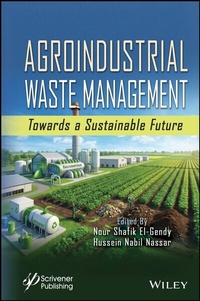
Agroindustrial Waste Management
Description

Lead the transition toward a zero-waste circular bioeconomy with this essential resource, which provides expert insights into leveraging nano-biotechnology and molecular biology to transform agroindustrial waste into high-value solutions for climate mitigation, wastewater treatment, and corrosion control.
Climate change has come to the forefront as a global issue due to its negative impacts on the availability of water resources, food and agricultural security, ecosystems, human health, and biodiversity. In both developed and developing countries, climate impacts are reverberating through the economy, threatening water availability, and contributing to rising sea levels and increases in extreme weather, threatening development and economic stability. Millions of tons of agroindustrial wastes are produced annually all over the world, further contributing to environmental concerns because they are not economically reused and create air, soil, and water pollution that has a negative impact on human health, the economy, and the environment. This book will focus on how the valorization of agroindustrial wastes can be applied to solve pollution, waste management, and energy problems, discussing the application of molecular biology, nanotechnology, and other techniques, to illustrate potential solutions to this growing global problem. It will cover different fields of nano-biotechnology and their impact on climate change, with special emphasis on bio-upcycling of different agroindustrial wastes into biocides and corrosion inhibitors for the mitigation of corrosion, biosurfactants, and photo- and biocatalysts for wastewater treatment and water desalination. Finally, the book will discuss the challenges and opportunities of biowaste valorization to create zero-waste in a future circular bioeconomy. Through expert insights and real-world case studies, this guide will serve as an essential resource for innovations in agroindustry.
More details
Other editions
Additional editions
Persons
Nour Shafik El-Gendy, PhD is a Professor in the field of Petroleum and Environmental Biotechnology and acting Head of the Process Design and Development Department at the Egyptian Petroleum Research Institute. She has published four chapters, four books, and 107 research papers in international journals and conferences. She is an expert in the field of environmental pollution, wastewater treatment, biofuels, petroleum upgrading, green chemistry, nanobiotechnology, valorization of wastes, and biocorrosion.
Hussein Nabil Nassar, PhD is a researcher in the field of Petroleum and Environmental Biotechnology in the Petroleum Biotechnology Lab of the Process Design and Development Department at the Egyptian Petroleum Research Institute. He is an author of more than thirty-three research papers and has participates in nine international workshops and 15 international conferences. He is an expert in the fields of oil pollution, bioremediation, biosorption, biofuels, green chemistry, wastewater treatment, biodesulfurization, biodenitrogenation, and nanobiotechnology.
Content
Preface xvii
1 Bioremediation of Agroindustrial Waste 1
Anita Gupta and Sunita Upadhaya
2 Sustainable Waste Management Systems and Techniques 45
Huwaida Ahmed Bahashwan, Mohamad Anuar Kamaruddin, Faris Aiman Norashiddin, Nor Habsah Md Sabiani, Mohd Suffian Yusoff, Mark Harris Zuknik and Hamidi Abdul Aziz
3 Eco-Friendly Valorization of Agroindustrial Residues for a Zero-Waste Future 93
Aly Reda, Mohamed Nabeel and Tamer Shoeib
4 Pretreatment and Bioconversion for Valorization of Biomass Residues of Edible and Nonedible Crops 139
Ahmad Mustafa, Shah Faisal, Mamoona Munir, Febri Odel Nitbani, Ozben Kutlu, Boutaina Rezki, Cassamo U. Mussagy, M. Shaaban Sadek, Mushtaq Ahmad, Tamer M.M. Abdellatief, Shazia Sultana and Carlo Pastore
5 Advancing Sustainable Energy: Circular Utilization of Lignocellulosic Biomass for Bioethanol and Renewable Biofuels in the Green Economy 169
Nour Shafik El-Gendy, Hussein Nabil Nassar and Basma A. Ali
6 Emergence of Third-Generation Biofuel: An Outlook on Present and Future Stance 235
Chirom Aarti, Kaustubh R. Sawant, Divya Mudgil and Sanjukta Subudhi
7 Wastewater Treatment Using Agroindustrial-Based Biomass: Pollutants' Eradication and Energy Generation 293
Charu Sharma, Vijay Kumar, Shivesh Sharma and Vivek Kumar
8 Recovery of Heavy Metals from Wastewater Treatment and Anaerobic Digester Sludge Using a Chemical Precipitation Process 323
Lai Jun Tung, Nik Azimatolakma Awang, Hamidi Abdul Aziz and Nur Syamimi Zaidi
9 Agro-Waste: A Potential Bio-Surfactant Source 357
Mousumi Gharai, N. Vasumathi, Ajita Kumari and T.V. Vijaya Kumar
10 Agroindustrial Waste and Biosurfactant 393
Nursyafi Amila Hilmy, Auni Asyifa Muslim, Aina Nabila Mohamad Nazri, Rosnani Alkarimiah and Hamidi Abd Aziz
11 Green Synthesis of Nanoparticles Using Different Agroindustrial Wastes 429
Parvindar M. Sah, Harshala S. Naik and Rajesh W. Raut
12 Eco-Friendly Walnut Shell Agro-Waste-Derived CQDs for Insecticide Sensing, Anti-Inflammatory, and Cytotoxic Studies 463
M. Saranya Devi, T. Daniel Thangadurai and N. Manjubaashini
13 Advanced Oxidation Processes of Landfill Leachate 487
iti Nor Farhana Zakaria, Elfreda Peter and Hamidi Abdul Aziz
14 Genetically Modified Microorganisms Being Released into Ecosystems: Biomonitoring 519
Desouky Abd-El-Haleem
References 532
About the Editors 537
Index 541
