

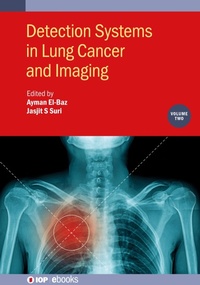
Detection Systems in Lung Cancer and Imaging, Volume 2
Description

This book covers recent advancements in lung cancer and imaging, covering detection and classification. This volume examines Lung Nodule Detection, Lung Nodule and Features Extraction, and Modern Approaches for Lung Nodule Diagnosis. Nodule detection focuses on algorithmic and deep learning practises, and their related CT imaging and dynamic programming methods. The classification applications of texture and shape analysis for nodules are covered, including computerised methods for more effective detection. Finally, the book examines the modern approaches used for nodule diagnosis. Specific focus is placed on deep learning for automated classification, machine learning for data analysis, and CT automatic detection of nodules.
Key Features:
- Unique focus on advance work in detection system and classification systems.
- An updated reference for lung cancer detection via imaging.
- Focus on progressive deep learning and machine learning applications for more effective detection.
More details
Other editions
Additional editions
Persons
Ayman El-Baz is a Distinguished Professor at University of Louisville, Kentucky, United States and University of Louisville at Alamein International University (UofL-AIU), New Alamein City, Egypt. He earned his Ph.D. in electrical engineering from the University of Louisville in 2006. Dr. El-Baz was named as a Fellow for IEEE, Coulter, AIMBE and NAI for his contributions to the field of biomedical translational research. Dr. El-Baz has almost two decades of hands-on experience in the fields of bio-imaging modeling and non-invasive computer-assisted diagnosis systems. He has authored or coauthored more than 700 technical articles.
Jasjit S. Suri is an innovator, scientist, visionary, and internationally recognized leader in biomedical engineering. With over 25 years in biomedical devices and management, he earned his Ph.D. from the University of Washington and a Business Management degree from Weatherhead, Case Western Reserve University. Dr. Suri received the President's Gold Medal in 1980, became a Fellow of the American Institute of Medical and Biological Engineering, and earned the Marquis Lifetime Achievement Award in 2018.
Content
Preface
Acknowledgments
Editor biographies
List of contributors
1 A deep ensemble model for the detection and classification of lung cancer in clinical images
2 Segmentation and classification of lung nodule images from the LIDC-IDRI database using a massive-training artificial neural network (MTANN)
3 Predicting cancer survival time from a small CT database using handcrafted features and deep learning
4 Advanced AI model for lung cancer detection and genetic mutation prediction
5 Recent progress in imaging techniques for early lung cancer diagnosis
6 Role of imaging techniques in the screening and detection of lung cancer
7 Deep learning and classical segmentation techniques for lung cancer imaging
8 Deep insights into pulmonary oncology: modern algorithms for robust lung cancer diagnosis
9 Toward explainable AI in lung cancer care: methods, clinical integration, and future cross-cancer insights
10 Virtual biopsies and beyond: integrating AI into precision pulmonology
