

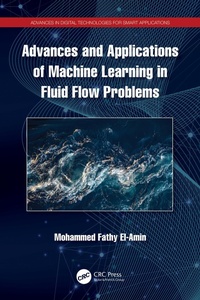
Advances and Applications of Machine Learning in Fluid Flow Problems
1st Edition
Published on 11. February 2026
272 pages
978-1-040-50716-2 (ISBN)
Description

The rapid growth of machine learning in recent years has made it a popular tool for data analysis, modeling, and prediction. As more data is generated from fluid flow simulations and experiments, the use of machine learning algorithms has become essential in making sense of it all. Advances and Applications of Machine Learning in Fluid Flow Problems provides insight into the effective use of machine learning in fluid flow and its potential impact on the field. It examines the application of machine learning techniques in various fluid flow problems, including but not limited to turbulent flow, multiphase flow, complex geometries, flow control, turbulence modeling, particle-fluid interactions, numerical simulations, data-driven modeling, flow in porous media, oil/gas reservoir simulation, permeability prediction, and more. It serves as a useful tool for a wide range of readers in the professional, industrial, and academic sectors.
Covers both the theories and practical applications of machine learning in fluid flow problems, making the book a unique and valuable resource for professionals and researchers in the field.
Provides a comprehensive examination of the application of machine learning for all aspects of fluid flow problems.
Covers both the theories and practical applications of machine learning in fluid flow problems, making the book a unique and valuable resource for professionals and researchers in the field.
Provides a comprehensive examination of the application of machine learning for all aspects of fluid flow problems.
More details
Series
Edition
1. Auflage
Language
English
Place of publication
London
United Kingdom
Publishing group
Taylor & Francis Ltd
Target group
Professional and scholarly
Illustrations
24 Tables, black and white; 99 Line drawings, black and white; 99 Illustrations, black and white
File size
49,61 MB
ISBN-13
978-1-040-50716-2 (9781040507162)
Copyright in bibliographic data and cover images is held by Nielsen Book Services Limited or by the publishers or by their respective licensors: all rights reserved.
Schweitzer Classification
Other editions
Additional editions
Book
approx. 02/2026
1st Edition
CRC Press
€144.50
Not yet published
Person
Prof. Mohamed Fathy El-Amin Mousa is a distinguished full professor of applied mathematics and computational sciences at Effat University, Saudi Arabia, and Aswan University, Egypt. With a career spanning more than 25 years, Dr. El-Amin has established a global reputation for pioneering contributions in computational modeling, fluid dynamics, reservoir simulation, porous media transport, heat and mass transfer, hydrogen energy, and renewable energy technologies.
He earned his Ph.D. in Applied Mathematics. His postdoctoral journey included prestigious fellowships from the Alexander von Humboldt Foundation in Germany and the Japan Society for the Promotion of Science (JSPS) in Japan, as well as research appointments at renowned institutions such as Stuttgart University, Kyushu University, King Abdullah University of Science and Technology (KAUST), and the University of Texas at Austin.
Dr. El-Amin has published over 200 peer-reviewed articles, book chapters, and conference papers, alongside several edited volumes and special journal issues. His recent authored books, including Numerical Modeling of Nanoparticle Transport in Porous Media (Elsevier, 2023) and Fractional Modeling of Fluid Flow and Transport Phenomena (Elsevier, 2025), reflect his leadership in bridging mathematical theory with practical energy and environmental challenges.
Currently, Dr. El-Amin leads research projects on atmospheric water generation using desiccant materials and underground hydrogen storage, aiming to support sustainable energy and water security initiatives. His research innovations have led to patents and new prototype developments, particularly involving carbon nanotubes and graphene-based technologies.
An active member of several international scientific societies, including INTERPORE and the Society of Petroleum Engineers (SPE), Dr. El-Amin has been consistently recognized among the World's Top 2% Scientists by Stanford University rankings. His contributions have earned him multiple awards for excellence in research, teaching, and civic engagement.
Beyond research, Dr. El-Amin is deeply committed to mentoring graduate students, supervising numerous MSc and Ph.D. theses, and actively participating in university leadership roles, including chairing promotion and research committees. His philosophy emphasizes interdisciplinary collaboration and the real-world application of scientific knowledge to meet the global challenges of energy, water, and sustainability.
He earned his Ph.D. in Applied Mathematics. His postdoctoral journey included prestigious fellowships from the Alexander von Humboldt Foundation in Germany and the Japan Society for the Promotion of Science (JSPS) in Japan, as well as research appointments at renowned institutions such as Stuttgart University, Kyushu University, King Abdullah University of Science and Technology (KAUST), and the University of Texas at Austin.
Dr. El-Amin has published over 200 peer-reviewed articles, book chapters, and conference papers, alongside several edited volumes and special journal issues. His recent authored books, including Numerical Modeling of Nanoparticle Transport in Porous Media (Elsevier, 2023) and Fractional Modeling of Fluid Flow and Transport Phenomena (Elsevier, 2025), reflect his leadership in bridging mathematical theory with practical energy and environmental challenges.
Currently, Dr. El-Amin leads research projects on atmospheric water generation using desiccant materials and underground hydrogen storage, aiming to support sustainable energy and water security initiatives. His research innovations have led to patents and new prototype developments, particularly involving carbon nanotubes and graphene-based technologies.
An active member of several international scientific societies, including INTERPORE and the Society of Petroleum Engineers (SPE), Dr. El-Amin has been consistently recognized among the World's Top 2% Scientists by Stanford University rankings. His contributions have earned him multiple awards for excellence in research, teaching, and civic engagement.
Beyond research, Dr. El-Amin is deeply committed to mentoring graduate students, supervising numerous MSc and Ph.D. theses, and actively participating in university leadership roles, including chairing promotion and research committees. His philosophy emphasizes interdisciplinary collaboration and the real-world application of scientific knowledge to meet the global challenges of energy, water, and sustainability.
Content
Table of Contents
Biography
List of figures
List of tables
Part I Introduction
Chapter 1Overview of Machine Learning
Chapter 2 Challenges, Limitations, and Recommendations
Part II ML for Turbulent Flows
Chapter 3 PIV, CFD and ML for Turbulent Jet
Chapter 4 Turbulent Jets Using Time Series
Chapter 5 Machine Learning for Permeability
Chapter 6 Hybrid Forecasting for Petroleum Reservoir
Chapter 7 PINN for Second-Order Porous Medium
Part IV ML for Hydrogen Energy
Chapter 8 Hydrogen Migration in Porous Media
Chapter 9 Hydrogen Leakage
Part V ML for Wind Energy
Chapter 10 Wind Farm Optimization and ML
Biography
List of figures
List of tables
Part I Introduction
Chapter 1Overview of Machine Learning
Chapter 2 Challenges, Limitations, and Recommendations
Part II ML for Turbulent Flows
Chapter 3 PIV, CFD and ML for Turbulent Jet
Chapter 4 Turbulent Jets Using Time Series
Chapter 5 Machine Learning for Permeability
Chapter 6 Hybrid Forecasting for Petroleum Reservoir
Chapter 7 PINN for Second-Order Porous Medium
Part IV ML for Hydrogen Energy
Chapter 8 Hydrogen Migration in Porous Media
Chapter 9 Hydrogen Leakage
Part V ML for Wind Energy
Chapter 10 Wind Farm Optimization and ML
