

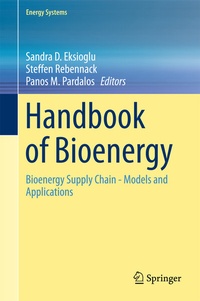
Handbook of Bioenergy
Description

This handbook brings together recent advances in the areas of supply chain optimization, supply chain management, and life-cycle cost analysis of bioenergy. These topics are important for the development and long-term sustainability of the bioenergy industry.
The increasing interest in bioenergy has been motivated by its potential to become a key future energy source. The opportunities and challenges that this industry has been facing have been the motivation for a number of optimization-related works on bioenergy.
Practitioners and academicians agree that the two major barriers of further investments in this industry are biomass supply uncertainty and costs. The goal of this handbook is to present several cutting-edge developments and tools to help the industry overcome these supply chain and economic challenges.
Case studies highlighting the problems faced by investors in the US and Europe illustrate the impact of certain tools in making bioenergy an economically viable energy option.
Reviews / Votes
"This book, edited by Eksioglu (Clemson Univ.), Rebennack (Colorado School of Mines), and Pardalos (Univ. of Florida), focuses on new developments in and tools for bioenergy supply chain management. . The numerous end-of-chapter references provide a good review of the literature in this important field. Summing Up: Recommended. Upper-division undergraduates through professionals/practitioners." (L. E. Erickson, Choice, Vol. 53 (6), February, 2016)
More details
Other editions
Additional editions
Persons
Content
Biomass to energy supply chain network design: An overview of models, solution approaches and applications.- BLOMST - An Optimization Model for the Bioenergy Supply Chain.- Optimal allocation of lignocellulosic biomass feedstocks for biofuel production: A Case Study of California.- Collaborative railway transportation strategy to increasing imports of Russian wood for the Finnish forest energy industry.- Gis-based methodology for optimum location of biomass extraction plants and power plants using both logistic criteria and agricultural suitability criteria.- Supply Chain Network Model for Biodiesel Production via Wastewaters from Pulp & Paper Industry.- Decision Support Models for Integrated Design of Bioenergy Supply Chains.- Biomass co-firing.- Economic and land-use optimization of lignocellulosic-based bioethanol supply chains under stochastic environment.- Biofuel Supply Chain Design and the Impacts on the Transportation Systems and Infrastructure.- Biofuel Lifecycle Energy andEnvironmental Impacts: The Challenges of Co-product Allocation.- Life-cycle Assessment of Bio-fuel Production using Syngas from Biomass.- Physical and economic aspects to assessing woody biomass availability for bioenergy production and related supply constraints.- The Role of Biofuels in Achieving a National Energy Independence Plan.
