

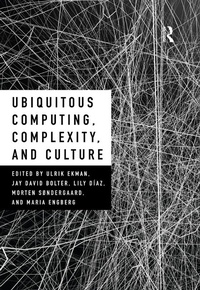
Ubiquitous Computing, Complexity and Culture
Published on 22. December 2015
431 pages
978-1-317-70457-7 (ISBN)
Description

The ubiquitous nature of mobile and pervasive computing has begun to reshape and complicate our notions of space, time, and identity. In this collection, over thirty internationally recognized contributors reflect on ubiquitous computing's implications for the ways in which we interact with our environments, experience time, and develop identities individually and socially. Interviews with working media artists lend further perspectives on these cultural transformations. Drawing on cultural theory, new media art studies, human-computer interaction theory, and software studies, this cutting-edge book critically unpacks the complex ubiquity-effects confronting us every day.
The companion website can be found here: http://ubiquity.dk
The companion website can be found here: http://ubiquity.dk
Reviews / Votes
"This massively important volume presents critical and inspiring insights into how computers and media are not merely discrete things but pervade and invade the world from the molecular to the planetary. Ubiquitous Computing, Complexity and Culture is transdisciplinary in the true sense of the word: not merely trying to connect different disciplines and methods, but carving out a research field in between existing ones; an investigation into the computational environments that govern how we live and sense. This is the key handbook for an emerging field." - Professor Jussi Parikka, Winchester School of Art, University of Southampton; author of Insect Media and What is Media Archaeology?More details
Language
English
Place of publication
London
United Kingdom
Publishing group
Taylor & Francis Ltd
Target group
College/higher education
File size
11,25 MB
ISBN-13
978-1-317-70457-7 (9781317704577)
Copyright in bibliographic data and cover images is held by Nielsen Book Services Limited or by the publishers or by their respective licensors: all rights reserved.
Schweitzer Classification
Other editions
Additional editions
Ulrik Ekman | Jay David Bolter | Lily Diaz
Ubiquitous Computing, Complexity and Culture
Book
07/2017
1st Edition
Routledge
€116.30
Article not available at the moment
Ulrik Ekman | Jay David Bolter | Lily Diaz
Ubiquitous Computing, Complexity and Culture
Book
12/2015
1st Edition
Routledge
€331.90
Shipment within 15-20 days
Persons
Ulrik Ekman is Associate Professor at the Department of Arts and Cultural Studies, University of Copenhagen, Denmark.
Jay David Bolter is the Wesley Chair of New Media at the Georgia Institute of Technology, USA.
Lily Diaz is Professor of New Media at Aalto University, Finland.
Morten Sondergaard is Associate Professor and Senior Curator of Interactive Media Art at Aalborg University Copenhagen, Denmark.
Maria Engberg is Assistant Professor at Malmoe University, Department of Computer Science and Media Technology, and an Affiliate Researcher at the Augmented Environments Lab at Georgia Institute of Technology, USA.
Jay David Bolter is the Wesley Chair of New Media at the Georgia Institute of Technology, USA.
Lily Diaz is Professor of New Media at Aalto University, Finland.
Morten Sondergaard is Associate Professor and Senior Curator of Interactive Media Art at Aalborg University Copenhagen, Denmark.
Maria Engberg is Assistant Professor at Malmoe University, Department of Computer Science and Media Technology, and an Affiliate Researcher at the Augmented Environments Lab at Georgia Institute of Technology, USA.
Content
Introduction, Ulrik Ekman; Part 1 Individuating; Chapter 1 Individuations, Ulrik Ekman; Chapter 2 Cultural Theory, Lily Diaz; Chapter 3 Topology Of Sensibility, Mark B. N. Hansen; Chapter 4 Weather Patterns, Or How Minor Gestures Entertain The Environment, Erin Manning; Chapter 5 Peekaboo, I See You!, Lily Diaz; Chapter 6 The Implied Producer And The Citizen Of The Culture Of Ubiquitous Information, Morten Sondergaard; Chapter 7 Media Art, Morten Sondergaard; Chapter 8 Complexity And Reduction- Interview With David Rokeby, Ulrik Ekman; Chapter 9 Interface, Bodies, And Process- Interview With Teri Rueb, Jay David Bolter; Chapter 10 Interaction Design, Jay David Bolter; Chapter 11 The Elephants In The (Server) Room: Sustainability And Surveillance In The Era Of Big Data, Simon Penny; Chapter 12 Towards Transdisciplinary Design Of Ubiquitous Computing Systems Supporting End-User Development, Irene Mavrommati; Chapter 13 Ambient Literature: Writing Probability, Jonathan Dovey; Chapter 14 Software Studies, Ulrik Ekman; Chapter 15 Ubiquitous Memory: I Do Not Remember, We Do Not Forget, Wendy Hui Kyong Chun; Part 2 Situating; Chapter 16 Situating: Contextuality And Context-Awareness, Jay David Bolter; Chapter 17 Cultural Theory, Maria Engberg; Chapter 18 Thinking In Networks: Artistic-Architectural Responses To Ubiquitous Information, Yvonne Spielmann; Chapter 19 A Portrait Of The Artist As A Smart City: Body, Complexity, And Urban Life, Henriette Steiner, Kristin Veel; Chapter 20 Distraction Reconsidered: On The Cultural Stakes Of The Ambient, Malcolm McCullough; Chapter 21 The Information Environment, Sean Cubitt; Chapter 22 Media Always And Everywhere, Sarah Kember, Joanna Zylinska; Chapter 23 Media Art, Lily Diaz; Chapter 24 From Simple Rules To Complex Performances-Interview With Blast Theory'S Matt Adams, Lily Diaz; Chapter 25 Complex Historicity, Maria Engberg; Chapter 26 Interview With Mogens Jacobsen, Morten Sondergaard; Chapter 27 Ubiquitous-Alife In Technosphere 2.0, Jane Prophet, Helen Pritchard; Chapter 28 Interaction Design, Maria Engberg; Chapter 29 Disability, Locative Media, And Complex Ubiquity, Katie Ellis, Gerard Goggin; Chapter 30 Indexical Visualization-The Data-Less Information Display, Dietmar Offenhuber, Orkan Telhan; Part 3 Eventualizing; Chapter 31 Events, Lily Diaz; Chapter 32 Cultural Theory, Maria Engberg; Chapter 33 (IN)Visibility, (UN)Awareness, and A New Way Of Seeing Through Complex Cinema, Maria Poulaki; Chapter 34 Cutting And Folding The Borgesian Map, Patricia Pisters; Chapter 35 Media Art, Ulrik Ekman; Chapter 36 Hiding In Plain Sight-Interview With Hasan Elahi, Jay David Bolter; Chapter 37 Interaction Design, Morten Sondergaard; Chapter 38 Interaction As Performance, Giulio Jacucci; Chapter 39 The Collective Novice, Jonas Loewgren; Chapter 40 Software Studies, Jay David Bolter; Chapter 41 Information Events, Big Data, And The Flash Crash, John Johnston;
