

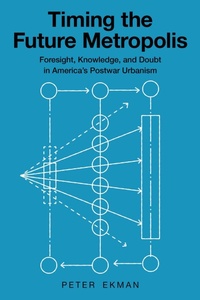
Timing the Future Metropolis
Description

Timing the Future Metropolis-an intellectual history of planning, urbanism, design, and social science-explores the network of postwar institutions, formed amid specters of urban "crisis" and "renewal," that set out to envision the future of the American city. Peter Ekman focuses on one decisive node in the network: the Joint Center for Urban Studies, founded in 1959 by scholars at Harvard and MIT.
Through its sprawling programs of "organized research," its manifold connections to universities, foundations, publishers, and policymakers, and its years of consultation on the planning of a new city in Venezuela-Ciudad Guayana-the Joint Center became preoccupied with the question of how to conceptualize the urban future as an object of knowledge. Timing the Future Metropolis ultimately compels a broader reflection on temporality in urban planning, rethinking how we might imagine cities yet to come-and the consequences of deciding not to.
More details
Other editions
Additional editions

Person
Peter Ekman teaches the history and theory of landscape and urbanism in the School of Architecture at the University of Southern California. He is a postdoctoral fellow at USC's Center on Science, Technology, and Public Life, and at the Berggruen Institute.
Content
Urban Times
Centers and Their Edges
The Atmosphere and the Network
"Our Retrospection Will All Be to the Future"
"A Documented Experience"
Reoriented
The Belated City
"A Forward Signal"
