

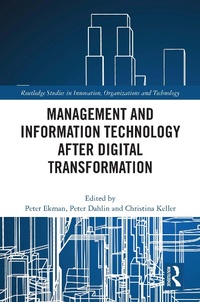
Management and Information Technology after Digital Transformation
1st Edition
Published on 22. September 2021
284 pages
978-1-000-45166-5 (ISBN)
Description

With the widespread transformation of information into digital form throughout society - firms and organisations are embracing this development to adopt multiple types of IT to increase internal efficiency and to achieve external visibility and effectiveness - we have now reached a position where there is data in abundance and the challenge is to manage and make use of it fully. This book addresses this new managerial situation, the post-digitalisation era, and offers novel perspectives on managing the digital landscape.
The topics span how the post-digitalisation era has the potential to renew organisations, markets and society. The chapters of the book are structured in three topical sections but can also be read individually. The chapters are structured to offer insights into the developments that take place at the intersection of the management, information systems and computer science disciplines. It features more than 70 researchers and managers as collaborating authors in 23 thought-provoking chapters.
Written for scholars, researchers, students and managers from the management, information systems and computer science disciplines, the book presents a comprehensive and thought-provoking contribution on the challenges of managing organisations and engaging in global markets when tools, systems and data are abundant.
The topics span how the post-digitalisation era has the potential to renew organisations, markets and society. The chapters of the book are structured in three topical sections but can also be read individually. The chapters are structured to offer insights into the developments that take place at the intersection of the management, information systems and computer science disciplines. It features more than 70 researchers and managers as collaborating authors in 23 thought-provoking chapters.
Written for scholars, researchers, students and managers from the management, information systems and computer science disciplines, the book presents a comprehensive and thought-provoking contribution on the challenges of managing organisations and engaging in global markets when tools, systems and data are abundant.
More details
Series
Edition
1. Auflage
Language
English
Place of publication
London
United Kingdom
Publishing group
Taylor & Francis Ltd
Target group
College/higher education
Product notice
Reflowable
Illustrations
7 Tables, black and white; 12 Line drawings, black and white; 12 Illustrations, black and white
ISBN-13
978-1-000-45166-5 (9781000451665)
Copyright in bibliographic data and cover images is held by Nielsen Book Services Limited or by the publishers or by their respective licensors: all rights reserved.
Schweitzer Classification
Other editions
Additional editions
Peter Ekman | Peter Dahlin | Christina Keller
Management and Information Technology after Digital Transformation
Book
05/2023
1st Edition
Routledge
€65.60
Shipment within 15-20 days
Peter Ekman | Peter Dahlin | Christina Keller
Management and Information Technology after Digital Transformation
Book
09/2021
1st Edition
Routledge
€206.70
Shipment within 15-20 days
Persons
Peter Ekman is an associate professor of marketing at Maelardalen University and deputy dean of the Swedish Research School of Management and IT hosted by Uppsala University. His research focuses on firm digitalisation within business networks and service ecosystems, often in a global sustainability or globalizationn context.
Peter Dahlin is an associate professor of business at Maelardalen University, Sweden, and honorary visiting scholar at the University of Exeter, UK, and is affiliated to the Business School. His research interests include applied analytics, network analysis and business performance.
Christina Keller is the dean of the Swedish Research School of Management and IT at Uppsala University and professor in informatics at Lund University School of Economics and Management. Her main research interests include online learning, design science research and information systems in healthcare.
Peter Dahlin is an associate professor of business at Maelardalen University, Sweden, and honorary visiting scholar at the University of Exeter, UK, and is affiliated to the Business School. His research interests include applied analytics, network analysis and business performance.
Christina Keller is the dean of the Swedish Research School of Management and IT at Uppsala University and professor in informatics at Lund University School of Economics and Management. Her main research interests include online learning, design science research and information systems in healthcare.
Content
Preface
Peter Ekman, Peter Dahlin and Christina Keller
Foreword
Fredrik Nilsson and Fredrik Tell
1. Perspectives on Management and Information Technology after Digital Transformation
Peter Ekman, Peter Dahlin and Christina Keller
2. Digital Transformation: Towards a New Perspective for Large Established Organisations in a Digital Age
Alan W. Brown
Part 1 - The transformation of society and markets
3. Managing Digital Servitization: A Service Ecosystem Perspective
David Soerhammar, Bard Tronvoll and Christian Kowalkowski
4. Caught on the platform or jumping onto the digital train: Challenges for industries lagging behind in digitalisation
Peter Ekman, Magnus Berglind and Steven Thompson
5. Digitalisation for Sustainability: Conceptualisation, Implications and Future Research Directions
Elena Anastasiadou, Linda Alkire and Jimmie Roendell
6. Reaching New Heights in the Cloud: The Digital Transformation of the Video Games Industry
Kevin Walther and David Soerhammar
7. Hyper-Taylorism and Third-order Technologies: Making Sense of the Transformation of Work and Management in a Post-digital Era
Christoffer Andersson, Lucia Crevani, Anette Hallin, Caroline Ingvarsson, Chris Ivory, Inti Jose Lammi, Eva Lindell, Irina Popova and Anna Uhlin
8. Why Space is Not Enough: Service innovation and service delivery in senior housing
Petter Ahlstroem, Goeran Lindahl, Markus Fellesson, Boerje Bjelke and Fredrik Nilsson
9. Challenges in Implementing Digital Assistive Technology in Municipal Healthcare
Ann Svensson, Linda Bergkvist, Charlotte Baeccman and Susanne Durst
Part 2 - Managerial and organisational challenges
10. Modern project management: Challenges for the future
Klas Sundberg, Birger Rapp and Christina Keller
11. Managing the Paradoxes of Digital Product Innovation
Fredrik Svahn and Bendik Bygstad
12. When External Reporting Goes Social: New Conditions for Transparency and Accountability?
Cecilia Gullberg
13. Robotic Process Automation and the Accounting Profession's Extinction Prophecy
Matthias Holmstedt, Fredrik Jeanson and Angelina Sundstroem
14. Managing Digital Employee-Driven Innovation: The Role of Middle-Level Managers and Ambidextrous Leadership
Izabelle Baeckstroem and Peter Magnusson
15. Digital Gamification of Organisational Functions and Emergent Management Practices
Edward Gillmore
16. Leveraging Digital Technologies in Enterprise Risk Management
Jason Crawford and Jan Lindvall
Section 3 - Framing digitalisation
17. The End of Business Intelligence and Business Analytics
Matthias Holmstedt and Peter Dahlin
18. 'Deleted User': Signalling Digital Disenchantment in the Post-Digital Society
Cristina Ghita, Claes Thoren and Martin Stojanov
19. The Role of Boundary-Spanners in the Post-Digitalised Multinational Corporation
Henrik Dellestrand, Olof Lindahl and Jakob Westergren
20. The Effect of Digital Transformation on Subsidiary Influence in the Multinational Enterprise
Noushan Memar, Ulf Andersson, Peter Dahlin and Peter Ekman
21. Understanding Information System Outsourcing in the Digital Transformation Era: The Business-relationship Triad View
Cecilia Erixon and Peter Thilenius
22. Transforming the Management/Profession Divide: The Use of the Red-Green Matrix in Swedish Schools
Anton Borell, Johan Klaassen, Roland Almqvist and Jan Loewstedt
23. Integrating research in master's programmes: Developing students' skills to embrace digitally transformed markets
Todd Drennan, Cecilia Thilenius Lindh and Emilia Rovira Nordman
Index
Peter Ekman, Peter Dahlin and Christina Keller
Foreword
Fredrik Nilsson and Fredrik Tell
1. Perspectives on Management and Information Technology after Digital Transformation
Peter Ekman, Peter Dahlin and Christina Keller
2. Digital Transformation: Towards a New Perspective for Large Established Organisations in a Digital Age
Alan W. Brown
Part 1 - The transformation of society and markets
3. Managing Digital Servitization: A Service Ecosystem Perspective
David Soerhammar, Bard Tronvoll and Christian Kowalkowski
4. Caught on the platform or jumping onto the digital train: Challenges for industries lagging behind in digitalisation
Peter Ekman, Magnus Berglind and Steven Thompson
5. Digitalisation for Sustainability: Conceptualisation, Implications and Future Research Directions
Elena Anastasiadou, Linda Alkire and Jimmie Roendell
6. Reaching New Heights in the Cloud: The Digital Transformation of the Video Games Industry
Kevin Walther and David Soerhammar
7. Hyper-Taylorism and Third-order Technologies: Making Sense of the Transformation of Work and Management in a Post-digital Era
Christoffer Andersson, Lucia Crevani, Anette Hallin, Caroline Ingvarsson, Chris Ivory, Inti Jose Lammi, Eva Lindell, Irina Popova and Anna Uhlin
8. Why Space is Not Enough: Service innovation and service delivery in senior housing
Petter Ahlstroem, Goeran Lindahl, Markus Fellesson, Boerje Bjelke and Fredrik Nilsson
9. Challenges in Implementing Digital Assistive Technology in Municipal Healthcare
Ann Svensson, Linda Bergkvist, Charlotte Baeccman and Susanne Durst
Part 2 - Managerial and organisational challenges
10. Modern project management: Challenges for the future
Klas Sundberg, Birger Rapp and Christina Keller
11. Managing the Paradoxes of Digital Product Innovation
Fredrik Svahn and Bendik Bygstad
12. When External Reporting Goes Social: New Conditions for Transparency and Accountability?
Cecilia Gullberg
13. Robotic Process Automation and the Accounting Profession's Extinction Prophecy
Matthias Holmstedt, Fredrik Jeanson and Angelina Sundstroem
14. Managing Digital Employee-Driven Innovation: The Role of Middle-Level Managers and Ambidextrous Leadership
Izabelle Baeckstroem and Peter Magnusson
15. Digital Gamification of Organisational Functions and Emergent Management Practices
Edward Gillmore
16. Leveraging Digital Technologies in Enterprise Risk Management
Jason Crawford and Jan Lindvall
Section 3 - Framing digitalisation
17. The End of Business Intelligence and Business Analytics
Matthias Holmstedt and Peter Dahlin
18. 'Deleted User': Signalling Digital Disenchantment in the Post-Digital Society
Cristina Ghita, Claes Thoren and Martin Stojanov
19. The Role of Boundary-Spanners in the Post-Digitalised Multinational Corporation
Henrik Dellestrand, Olof Lindahl and Jakob Westergren
20. The Effect of Digital Transformation on Subsidiary Influence in the Multinational Enterprise
Noushan Memar, Ulf Andersson, Peter Dahlin and Peter Ekman
21. Understanding Information System Outsourcing in the Digital Transformation Era: The Business-relationship Triad View
Cecilia Erixon and Peter Thilenius
22. Transforming the Management/Profession Divide: The Use of the Red-Green Matrix in Swedish Schools
Anton Borell, Johan Klaassen, Roland Almqvist and Jan Loewstedt
23. Integrating research in master's programmes: Developing students' skills to embrace digitally transformed markets
Todd Drennan, Cecilia Thilenius Lindh and Emilia Rovira Nordman
Index
