

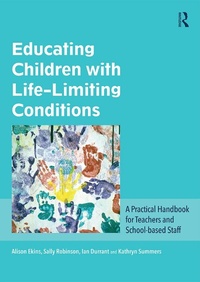
Educating Children with Life-Limiting Conditions
A Practical Handbook for Teachers and School-based Staff
Published on 8. May 2017
222 pages
978-1-317-19423-1 (ISBN)
Description

Educating Children with Life-Limiting Conditions supports teachers who are working with children with life-limiting or life-threatening conditions in mainstream schools by providing them with the core knowledge and skills that underpin effective practice within a whole-school and cross-agency approach.
Mainstream schools now include increasing numbers of children with life-limiting or life-threatening conditions, and this accessible book is written by a team comprised of both education and health professionals, helping to bridge the gap between different services.
Recognising the complexity of individual cases, the authors communicate key principles relating to the importance of communication, multi-professional understanding and working and proactive planning for meeting the needs of any child with a life-limiting or life-threatening condition that can be applied to a range of situations.
Reflective activities and practical resources are provided and are also available to download. This book will be of interest to teachers in mainstream schools, as well as teachers, SENCOs and senior leaders in all school settings, school nurses, children's nurses and allied health professionals.
Mainstream schools now include increasing numbers of children with life-limiting or life-threatening conditions, and this accessible book is written by a team comprised of both education and health professionals, helping to bridge the gap between different services.
Recognising the complexity of individual cases, the authors communicate key principles relating to the importance of communication, multi-professional understanding and working and proactive planning for meeting the needs of any child with a life-limiting or life-threatening condition that can be applied to a range of situations.
Reflective activities and practical resources are provided and are also available to download. This book will be of interest to teachers in mainstream schools, as well as teachers, SENCOs and senior leaders in all school settings, school nurses, children's nurses and allied health professionals.
Reviews / Votes
'With the increasing number of pupils in both special and mainstream schools who have complex medical needs, this is a must have book for every staff-room. The easy to read format gives opportunity for reflection and very practical and informative advice and support for all school practitioners. Written by education and health professionals, you get a real sense of a multi-disciplinary approach to meeting the needs of our most vulnerable pupils. A very difficult subject dealt with in a caring, compassionate and very helpful way.' - Lorraine Petersen OBE, Educational Consultant and Former CEO of NASEN.'This is a book on a vital but neglected, and for some teachers rather frightening, subject, that is reassuring, practical and inspirational. It sets out the key principles, knowledge and skills that are needed for implementing effective strategies for working with children with life limiting conditions in mainstream schools, outlining the elements of good practice, using a joined up, whole school multi-professional approach to which teachers will relate easily. It is grounded by the reflective activities which engage the reader from the outset and ensure that the valuable learning can be applied in real life school and classroom situations. I learned a good deal from reading this.' - Katherine Weare, Emeritus Professor, Southampton Education School, University of Southampton.
More details
Language
English
Place of publication
London
United Kingdom
Publishing group
Taylor & Francis Ltd
Target group
Professional and scholarly
Illustrations
7 s/w Abbildungen, 22 s/w Tabellen, 7 s/w Zeichnungen
22 Tables, black and white; 7 Line drawings, black and white; 7 Illustrations, black and white
File size
2,85 MB
ISBN-13
978-1-317-19423-1 (9781317194231)
Copyright in bibliographic data and cover images is held by Nielsen Book Services Limited or by the publishers or by their respective licensors: all rights reserved.
Schweitzer Classification
Other editions
Additional editions
Alison Ekins | Sally Robinson | Ian Durrant
Educating Children with Life-Limiting Conditions
A Practical Handbook for Teachers and School-based Staff
Book
05/2017
1st Edition
Routledge
€43.50
Shipment within 10-20 days
Alison Ekins | Sally Robinson | Ian Durrant
Educating Children with Life-Limiting Conditions
A Practical Handbook for Teachers and School-based Staff
Book
05/2017
1st Edition
Routledge
€208.33
Shipment within 10-20 days
Persons
Dr Alison Ekins is Course Director of the National Award for SEN Coordination at Canterbury Christ Church University, UK.
Dr Sally Robinson is Principal Lecturer in Health Promotion and Public Health at Canterbury Christ Church University, UK.
Ian Durrant is Senior Lecturer at Canterbury Christ Church University, UK.
Kathryn Summers is Principal Lecturer in Children's Nursing at Canterbury Christ Church University, UK.
Dr Sally Robinson is Principal Lecturer in Health Promotion and Public Health at Canterbury Christ Church University, UK.
Ian Durrant is Senior Lecturer at Canterbury Christ Church University, UK.
Kathryn Summers is Principal Lecturer in Children's Nursing at Canterbury Christ Church University, UK.
Content
Section 1- Policy and Practice
Chapter 1: Introduction
Chapter 2: Policy context
Chapter 3: The Teaching for Life Project
Section 2- Knowledge and Skills
Chapter 4: Understanding Life Limiting and Life Threatening Conditions
Chapter 5: Medical care
Chapter 6: Working Collaboratively
Chapter 7: Communication skills
Chapter 8: Supporting other children within the school
Chapter 9: Teaching and learning approaches
Chapter 10: Handling emotional and behavioural changes
Section 3- A Whole School Approach to Support
Chapter 11: Establishing a positive whole school culture
Chapter 12: Whole school policies
Section 4- Practical resources
Chapter 13: Directory of useful contacts and agencies
Chapter 14: Glossary of medical and educational terms explained
Chapter 15: Photocopiable Resources
Section 5- Conclusions
Chapter 16: Learning from each other- implications for practice
Chapter 1: Introduction
Chapter 2: Policy context
Chapter 3: The Teaching for Life Project
Section 2- Knowledge and Skills
Chapter 4: Understanding Life Limiting and Life Threatening Conditions
Chapter 5: Medical care
Chapter 6: Working Collaboratively
Chapter 7: Communication skills
Chapter 8: Supporting other children within the school
Chapter 9: Teaching and learning approaches
Chapter 10: Handling emotional and behavioural changes
Section 3- A Whole School Approach to Support
Chapter 11: Establishing a positive whole school culture
Chapter 12: Whole school policies
Section 4- Practical resources
Chapter 13: Directory of useful contacts and agencies
Chapter 14: Glossary of medical and educational terms explained
Chapter 15: Photocopiable Resources
Section 5- Conclusions
Chapter 16: Learning from each other- implications for practice
