

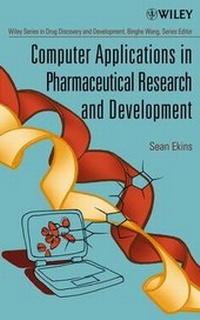
Computer Applications in Pharmaceutical Research and Development
Description

Reviews / Votes
"Computer Applications in Pharmaceutical Research and Development"is ideal for information technologists who want to understand theapplication of computers across the entire drug research anddevelopment process." (Journal of Clinical Research BestPractices, September 2008) "...a well-put-together volume with a lot of very interestingand timely information to convey...it would be a nice addition toindividual, academic, and industrial libraries." (Journal ofMedicinal Chemistry, December 28, 2006) "...strongly recommended both to the structural and medicinalchemistry community, and also to...computational chemists...thewhole book is really very readable and enjoyable." (StructuralChemistry, December 2006)More details
Other editions
Additional editions
Persons
Content
Preface xi
Acknowledgments xiii
Contributors xv
Part I: Computers in Pharmaceutical Research And Development: a General Overview 1
1. History of Computers in Pharmaceutical Research and Development: A Narrative 3
Donald B. Boyd and Max M. Marsh
2. Computers as Data Analysis and Data Management Tools in Preclinical Development 51
Weiyong Li and Kenneth Banks
3. Statistical Modeling in Pharmaceutical Research and Development 67
Andrea de Gaetano, Simona Panunzi, Benoit Beck, and Bruno Boulanger Copyrighted Material
Part II: Understanding Diseases: Mining Complex Systems for Knowledge 103
4. Drug Discovery from Historic Herbal Texts 105
Eric J. Buenz
5. Contextualizing the Impact of Bioinformatics on Preclinical Drug and Vaccine Discovery 121
Darren R. Flower
6. Systems Approaches for Pharmaceutical Research and Development 139
Sean Ekins and Craig N. Giroux
Part III: Scientific Information Handling and Enhancing Productivity 167
7. Information Management-Biodata in Life Sciences 169
Richard K. Scott and Anthony Parsons
8. Chemoinformatics Techniques for Processing Chemical Structure Databases 187
Valerie J. Gillet and Peter Willett
9. Electronic Laboratory Notebooks 209
Alfred Nehme and Robert A. Scoffin
10. Strategies for Using Information Effectively in Early-Stage Drug Discovery 229
David J. Wild
11. Improving the Pharmaceutical R&D Process: How Simulation Can Support Management Decision Making 247
Andrew Chadwick, Jonathan Moore, Maggie A.Z. Hupcey, and Robin Purshouse
Part IV: Computers in Drug Discovery 275
12. Computers and Protein Crystallography 277
David J. Edwards and Roderick E. Hubbard
13. Computers, Cheminformatics, and the Medicinal Chemist 301
Weifan Zheng and Michael Jones
14. The Challenges of Making Useful Protein-Ligand Free Energy Predictions for Drug Discovery 321
Jun Shimada
15. Computer Algorithms for Selecting Molecule Libraries for Synthesis 353
Konstantin V. Balakin, Nikolay P. Savchuk, and Alex Kiselyov
16. Success Stories of Computer-Aided Design 377
Hugo Kubinyi
17. Pharmaceutical Research and Development Productivity: Can Software Help? 425
Christophe G. Lambert and S. Stanley Young
Part V: Computers in Preclinical Development 443
18. Computer Methods for Predicting Drug Metabolism 445
Sean Ekins
19. Computers in Toxicology and Risk Assessment 469
John C. Dearden
20. Computational Modeling of Drug Disposition 495
Cheng Chang and Peter W. Swaan
21. Computer Simulations in Pharmacokinetics and Pharmacodynamics: Rediscovering Systems Physiology in the 21st Century 513
Paolo Vicini
22. Predictive Models for Better Decisions: From Understanding Physiology to Optimizing Trial Design 529
James R. Bosley, Jr.
Part VI: Computers in Development Decision Making, Economics, and Market Analysis 555
23. Making Pharmaceutical Development More Efficient 557
Michael Rosenberg and Richard Farris
24. Use of Interactive Software in Medical Decision Making 571
Renée J. Goldberg Arnold
Part VII: Computers in Clinical Development 591
25. Clinical Data Collection and Management 593
Mazen Abdellatif
26. Regulation of Computer Systems 633
Sandy Weinberg
27. A New Paradigm for Analyzing Adverse Drug Events 649
Ana Szarfman, Jonathan G. Levine, and Joseph M. Tonning
Part VIII: Further Applications and Future Development 677
28. Computers in Pharmaceutical Formulation 679
Raymond C. Rowe and Elizabeth A. Colbourn
29. Legal Protection of Innovative Uses of Computers in R&D 703
Robert Harrison
30. The Ethics of Computing in Pharmaceutical Research 715
Matthew K. McGowan and Richard J. McGowan
31. The UltraLink: An Expert System for Contextual Hyperlinking in Knowledge Management 729
Martin Romacker, Nicolas Grandjean, Pierre Parisot, Olivier Kreim, Daniel Cronenberger, Thérèse Vachon, and Manuel C. Peitsch
32. Powerful, Predictive, and Pervasive: The Future of Computers in the Pharmaceutical Industry 753
Nick Davies, Heather Ahlborn, and Stuart Henderson
Index 775
