

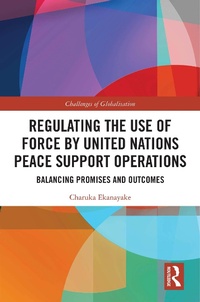
Regulating the Use of Force by United Nations Peace Support Operations
Balancing Promises and Outcomes
1st Edition
Published on 30. May 2021
286 pages
978-1-000-39567-9 (ISBN)
Description

This Book attempts to deduce regulatory standards that can close the gaps between the Promises made and the Outcomes secured by the United Nations in relation to its use of force. It explores two broad questions in this regard: why the contemporary legal framework relevant to the regulation of force during Armed Conflict cannot close the gaps between the said Promises and Outcomes and how the 'Unified Use of Force Rule' formulated herein, achieves this. This is the first book to coherently analyse the moral as well as legal aspects relevant to UN use of force.
UN peace operations are rapidly changing. Deployed peacekeepers are now required to use force in pursuance of numerous objectives such as self-defence, protecting civilians, and carrying out targeted offensive operations. As a result, questions about when, where, and how to use force have now become central to peacekeeping. While UN peace operations have managed to avoid catastrophes of the magnitude of Rwanda and Srebrenica for over two decades, crucial gaps still exist between what the UN promises on the use of force front, and what it achieves. Current conflict zones such as the Central African Republic, Eastern Congo, and Mali stand testament to this. This book searches for answers to these issues and identifies how an innovative mix of the relevant legal and moral rules can produce regulatory standards that can allow the UN to keep their promises. The discussion covers analytical ground that must be traversed 'behind the scenes' of UN deployment, well before the first troops set foot on a battlefield. The analysis ultimately produces a 'Unified Use of Force Rule', that can either be completely or partially used as a model set of Rules of Engagement by UN forces.
This book will be immensely beneficial to law students, researchers, academics and practitioners in the fields of international relations, international law, peacekeeping, and human rights.
UN peace operations are rapidly changing. Deployed peacekeepers are now required to use force in pursuance of numerous objectives such as self-defence, protecting civilians, and carrying out targeted offensive operations. As a result, questions about when, where, and how to use force have now become central to peacekeeping. While UN peace operations have managed to avoid catastrophes of the magnitude of Rwanda and Srebrenica for over two decades, crucial gaps still exist between what the UN promises on the use of force front, and what it achieves. Current conflict zones such as the Central African Republic, Eastern Congo, and Mali stand testament to this. This book searches for answers to these issues and identifies how an innovative mix of the relevant legal and moral rules can produce regulatory standards that can allow the UN to keep their promises. The discussion covers analytical ground that must be traversed 'behind the scenes' of UN deployment, well before the first troops set foot on a battlefield. The analysis ultimately produces a 'Unified Use of Force Rule', that can either be completely or partially used as a model set of Rules of Engagement by UN forces.
This book will be immensely beneficial to law students, researchers, academics and practitioners in the fields of international relations, international law, peacekeeping, and human rights.
More details
Series
Edition
1. Auflage
Language
English
Place of publication
London
United Kingdom
Publishing group
Taylor & Francis Ltd
Target group
College/higher education
Product notice
Reflowable
Illustrations
5 Line drawings, black and white; 5 Illustrations, black and white
ISBN-13
978-1-000-39567-9 (9781000395679)
Copyright in bibliographic data and cover images is held by Nielsen Book Services Limited or by the publishers or by their respective licensors: all rights reserved.
Schweitzer Classification
Other editions
Additional editions
Charuka Ekanayake
Regulating the Use of Force by United Nations Peace Support Operations
Balancing Promises and Outcomes
Book
05/2021
1st Edition
Routledge
€61.90
Shipment within 15-20 days
Charuka Ekanayake
Regulating the Use of Force by United Nations Peace Support Operations
Balancing Promises and Outcomes
Book
05/2021
1st Edition
Routledge
€206.70
Shipment within 15-20 days
Charuka Ekanayake
Regulating the Use of Force by United Nations Peace Support Operations
Balancing Promises and Outcomes
Book
05/2021
Routledge
Unfortunately, price unknown
Available (delivery time upon request)
Person
Charuka Ekanayake (LLB (Hons) London, LLM (Colombo), LLM (UNITO/UNICRI), PhD (Griffith)) is an Adjunct Research Fellow of the Law Futures Centre at Griffith University, Australia. He has functioned as a Research Assistant at the Law Futures Centre, and the Institute for Ethics, Governance and Law of the same University. He is a legal practitioner and holds practicing licenses in Sri Lanka and New South Wales, Australia.
Content
Foreword Preface 1. Introduction 2. United Nations Peace Support Operations - Institutional Frameworks, Command and Control Structures, and Attribution of Conduct 3. The Resort to and Use of Force by the UN: The Legal and the Moral 4. A Normative Framework for UN Uses of Force: The Applicability of the Candidate Regimes 5. Targeting Under International Human Rights Law and International Humanitarian Law 6. Resolving Conflicts, Identifying Regulatory Standards and Closing Gaps Between Promises and Outcomes 7. Conclusion Appendices Bibliography
