

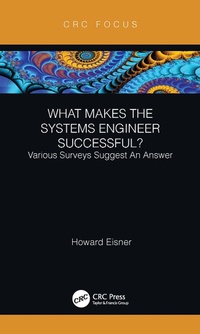
What Makes the Systems Engineer Successful? Various Surveys Suggest An Answer
1st Edition
Published on 2. December 2020
120 pages
978-1-000-33160-8 (ISBN)
Description

This book offers a survey of successful attributes of the systems engineer. It focuses on the key positive attributes of what today's systems engineer should be and puts a model in place for achievement and behavior for future systems engineers.
The book, in survey form, provides a description of how and why systems engineers can be, and have been, successful. It offers successful attributes, focuses on the key positive qualities, and drills down to the success features to aim for and the failure characteristics to avoid. The ending result is that it sets a model for achievement and behavior for future systems engineers to follow a successful path.
This book will be helpful to systems engineers, industrial engineers, mechanical engineers, general engineers, and those in technical management.
The book, in survey form, provides a description of how and why systems engineers can be, and have been, successful. It offers successful attributes, focuses on the key positive qualities, and drills down to the success features to aim for and the failure characteristics to avoid. The ending result is that it sets a model for achievement and behavior for future systems engineers to follow a successful path.
This book will be helpful to systems engineers, industrial engineers, mechanical engineers, general engineers, and those in technical management.
More details
Edition
1. Auflage
Language
English
Place of publication
London
United Kingdom
Publishing group
Taylor & Francis Ltd
Target group
College/higher education
Professional and scholarly
Illustrations
1 Tables, black and white; 1 Line drawings, black and white; 1 Illustrations, black and white
ISBN-13
978-1-000-33160-8 (9781000331608)
Copyright in bibliographic data and cover images is held by Nielsen Book Services Limited or by the publishers or by their respective licensors: all rights reserved.
Schweitzer Classification
Other editions
Additional editions
Book
10/2024
1st Edition
CRC Press
€32.80
Shipment within 15-20 days
Book
12/2020
1st Edition
CRC Press
€76.70
Shipment within 15-20 days
Book
12/2020
CRC Press
Unfortunately, price unknown
Available (delivery time upon request)
Person
Howard Eisner spent 30 years in industry and 24 years in academia. In the former he was a working engineer, manager, executive (ORI, Inc. and the Atlantic Research Corporation) and president of two high-tech firms (Intercon Systems Corporation and the Atlantic Research Services Corporation). In academia he was professor of engineering management and distinguished research professor in the engineering school of the George Washington University (GWU). At GWU, he taught courses in systems engineering, technical enterprises, project management, modulation and noise, and information theory.
He has written ten books that relate to engineering, systems and management. He has also given lectures, tutorials, and presentations to professional societies such as INCOSE (International Council on Systems Engineering), government agencies (such as the Departments of Defense and Transportation, and NASA) and the Osher Lifelong Learning Institute (OLLI).
In 1994 he was given the outstanding achievement award from the GWU Engineering Alumni.
Dr. Eisner is a life fellow of the IEEE (Institute of Electrical and Electronics) and a fellow of INCOSE and the New York Academy of Sciences. He is also a member of Tau Beta Pi, Eta Kappa Nu, Sigma Xi and Omega Rho, various honor/research societies. He received a Bachelor's degree (BEE) from the City College of New York (1957), an MS degree in electrical engineering from Columbia University (1958) and a Doctor of Science (DSc) degree from the GWU (1966).
Since 2013, he has served as professor emeritus of engineering management and distinguished research professor at the GWU. As such, he has continued to explore advanced topics and write about engineering, systems and management.
He has written ten books that relate to engineering, systems and management. He has also given lectures, tutorials, and presentations to professional societies such as INCOSE (International Council on Systems Engineering), government agencies (such as the Departments of Defense and Transportation, and NASA) and the Osher Lifelong Learning Institute (OLLI).
In 1994 he was given the outstanding achievement award from the GWU Engineering Alumni.
Dr. Eisner is a life fellow of the IEEE (Institute of Electrical and Electronics) and a fellow of INCOSE and the New York Academy of Sciences. He is also a member of Tau Beta Pi, Eta Kappa Nu, Sigma Xi and Omega Rho, various honor/research societies. He received a Bachelor's degree (BEE) from the City College of New York (1957), an MS degree in electrical engineering from Columbia University (1958) and a Doctor of Science (DSc) degree from the GWU (1966).
Since 2013, he has served as professor emeritus of engineering management and distinguished research professor at the GWU. As such, he has continued to explore advanced topics and write about engineering, systems and management.
Content
1 Systems Engineering: No Room at the Top
2 Selected Best Systems Engineers
3 Synthesizer
4 Listener
5 Curious/Systems Thinker
6 Manager/Leader
7 Expert/ESEP
8 Expert/Domain Knowledge
9 Perseverer
10 Recapitulation
Appendix A - INCOSE Fellow Inputs
Appendix B - Across the Board Articles
Index
2 Selected Best Systems Engineers
3 Synthesizer
4 Listener
5 Curious/Systems Thinker
6 Manager/Leader
7 Expert/ESEP
8 Expert/Domain Knowledge
9 Perseverer
10 Recapitulation
Appendix A - INCOSE Fellow Inputs
Appendix B - Across the Board Articles
Index
