

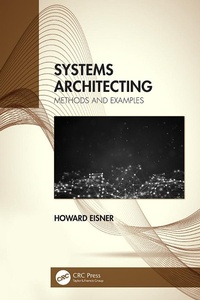
Systems Architecting
Methods and Examples
1st Edition
Published on 23. September 2019
106 pages
978-1-000-65175-1 (ISBN)
Description

This book provides a new approach to systems architecting not previously available. The book provides a compact innovative procedure for architecting any type of system.
Systems Architecting: Methods and Examples describes a method of system architecting that is believed to be a substantial improvement over "methods" previously covered in other systems architecting books.
Incorporates analytic procedure (decision analysis)
Defines and evaluates alternative architectures
Improves upon existing architecting methods
Considers cost-effectiveness of alternatives
Provides for competitive analysis and its advantages
Shows alternatives on one simple and easily understood page
With the book's relatively straightforward approach, it shows how to architect systems in a way that both developers and clients/customers can readily understand. It uses one of the essential principles suggested by Rechtin and Maier, namely, Simplify, Simplify, Simplify.
Systems engineers as well as students taking systems engineering courses will find this book of interest.
Systems Architecting: Methods and Examples describes a method of system architecting that is believed to be a substantial improvement over "methods" previously covered in other systems architecting books.
Incorporates analytic procedure (decision analysis)
Defines and evaluates alternative architectures
Improves upon existing architecting methods
Considers cost-effectiveness of alternatives
Provides for competitive analysis and its advantages
Shows alternatives on one simple and easily understood page
With the book's relatively straightforward approach, it shows how to architect systems in a way that both developers and clients/customers can readily understand. It uses one of the essential principles suggested by Rechtin and Maier, namely, Simplify, Simplify, Simplify.
Systems engineers as well as students taking systems engineering courses will find this book of interest.
More details
Edition
1. Auflage
Language
English
Place of publication
London
United Kingdom
Publishing group
Taylor & Francis Ltd
Target group
Professional and scholarly
Illustrations
5 Line drawings, black and white; 5 Illustrations, black and white
ISBN-13
978-1-000-65175-1 (9781000651751)
Copyright in bibliographic data and cover images is held by Nielsen Book Services Limited or by the publishers or by their respective licensors: all rights reserved.
Schweitzer Classification
Other editions
Additional editions
Book
11/2019
CRC Press
Unfortunately, price unknown
Available (delivery time upon request)
Book
09/2019
1st Edition
CRC Press
€60.65
Shipment within 15-20 days
Book
09/2019
1st Edition
CRC Press
€170.00
Shipment within 15-20 days
Person
Howard Eisner spent 30 years in industry and 24 years in academia. In the former, he was a working engineer, manager, executive (at ORI, Inc. and the Atlantic Research Corporation) and president of two high-tech companies (Intercon Systems and the Atlantic Research Services Company). In academia, he was a professor of engineering management and a distinguished research professor in the engineering school at the George Washington University (GWU). At GWU, he taught courses in systems engineering, technical enterprises, project management, modulation and noise, and information theory.
He has written nine books that relate to engineering, systems, and management. He has also given lectures, tutorials and presentations to professional societies (such as INCOSE - International Council on Systems Engineering), government agencies, and the Osher Lifelong Learning Institute (OLLI).
In 1994, he was given the outstanding achievement award from the GWU Engineering Alumni.
Dr. Eisner is a life fellow of the IEEE and a fellow of INCOSE and the New York Academy of Sciences. He is a member of Tau Beta Pi, Eta Kappa Nu, Sigma Xi, and Omega Rho, various honor/research societies. He received a Bachelor's degree (BEE) from the City College of New York (1957), an MS degree in electrical engineering from Columbia University (1958), and a Doctor of Science (DSc) degree from the George Washington University (GWU) (1966).
Since 2013. He has served as professor emeritus of engineering management and a distinguished research professor at the GWU. As such, he has continued to explore advanced topics in engineering, systems and management.
He has written nine books that relate to engineering, systems, and management. He has also given lectures, tutorials and presentations to professional societies (such as INCOSE - International Council on Systems Engineering), government agencies, and the Osher Lifelong Learning Institute (OLLI).
In 1994, he was given the outstanding achievement award from the GWU Engineering Alumni.
Dr. Eisner is a life fellow of the IEEE and a fellow of INCOSE and the New York Academy of Sciences. He is a member of Tau Beta Pi, Eta Kappa Nu, Sigma Xi, and Omega Rho, various honor/research societies. He received a Bachelor's degree (BEE) from the City College of New York (1957), an MS degree in electrical engineering from Columbia University (1958), and a Doctor of Science (DSc) degree from the George Washington University (GWU) (1966).
Since 2013. He has served as professor emeritus of engineering management and a distinguished research professor at the GWU. As such, he has continued to explore advanced topics in engineering, systems and management.
Content
1. Background. 2. Purpose and Features. 3. What Is An Architecture? 4. Evaluation of Alternatives. 5. Architecting of a House. 6. Architecting of an Automobile. 7. Commentary - A Preferred Architecture. 8. Descriptions, Views and Tradeoffs. 9. DoDAF and Other Frameworks. 10. Software. 11. Cost Estimation. 12. Summary. Appendix A - Group Architecting. Appendix B - Functional Decomposition. Appendix C - Special Topics.
