

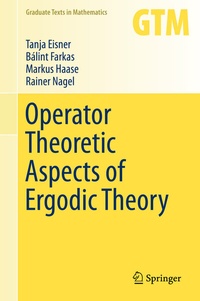
Operator Theoretic Aspects of Ergodic Theory
Published on 18. November 2015
XVIII, 628 pages
978-3-319-16898-2 (ISBN)
Description

Stunning recent results by Host-Kra, Green-Tao, and others, highlight the timeliness of this systematic introduction to classical ergodic theory using the tools of operator theory. Assuming no prior exposure to ergodic theory, this book provides a modern foundation for introductory courses on ergodic theory, especially for students or researchers with an interest in functional analysis. While basic analytic notions and results are reviewed in several appendices, more advanced operator theoretic topics are developed in detail, even beyond their immediate connection with ergodic theory. As a consequence, the book is also suitable for advanced or special-topic courses on functional analysis with applications to ergodic theory.
Topics include:
an intuitive introduction to ergodic theory
an introduction to the basic notions, constructions, and standard examples of topological dynamical systems
Koopman operators, Banach lattices, lattice and algebra homomorphisms, and the Gelfand-Naimark theorem
measure-preserving dynamical systems
von Neumann's Mean Ergodic Theorem and Birkhoff's Pointwise Ergodic Theorem
strongly and weakly mixing systems
an examination of notions of isomorphism for measure-preserving systems
Markov operators, and the related concept of a factor of a measure preserving system
compact groups and semigroups, and a powerful tool in their study, the Jacobs-de Leeuw-Glicksberg decomposition
an introduction to the spectral theory of dynamical systems, the theorems of Furstenberg and Weiss on multiple recurrence, and applications of dynamical systems to combinatorics (theorems of van der Waerden, Gallai,and Hindman, Furstenberg's Correspondence Principle, theorems of Roth and Furstenberg-Sárközy)
Beyond its use in the classroom, Operator Theoretic Aspects of Ergodic Theory can serve as a valuable foundation for doing research at the intersection of ergodic theory and operator theory
Topics include:
an intuitive introduction to ergodic theory
an introduction to the basic notions, constructions, and standard examples of topological dynamical systems
Koopman operators, Banach lattices, lattice and algebra homomorphisms, and the Gelfand-Naimark theorem
measure-preserving dynamical systems
von Neumann's Mean Ergodic Theorem and Birkhoff's Pointwise Ergodic Theorem
strongly and weakly mixing systems
an examination of notions of isomorphism for measure-preserving systems
Markov operators, and the related concept of a factor of a measure preserving system
compact groups and semigroups, and a powerful tool in their study, the Jacobs-de Leeuw-Glicksberg decomposition
an introduction to the spectral theory of dynamical systems, the theorems of Furstenberg and Weiss on multiple recurrence, and applications of dynamical systems to combinatorics (theorems of van der Waerden, Gallai,and Hindman, Furstenberg's Correspondence Principle, theorems of Roth and Furstenberg-Sárközy)
Beyond its use in the classroom, Operator Theoretic Aspects of Ergodic Theory can serve as a valuable foundation for doing research at the intersection of ergodic theory and operator theory
Reviews / Votes
"This book can serve as a good introduction to an active research area. Each chapter ends with a nice list of exercises. At the end of the book complementary material can be found on measure theory, functional analysis, operator theory, the Riesz representation theorem, and more. This makes the book self-contained. The book has the potential to become a basic reference in this field." (Idris Assani, Mathematical Reviews, January, 2017)More details
Series
Edition
1st ed. 2015
Language
English
Place of publication
Cham
Switzerland
Publishing group
Springer International Publishing
Target group
Primary & secondary/elementary & high school
Product notice
Reflowable
Illustrations
XVIII, 628 p.
File size
6,46 MB
ISBN-13
978-3-319-16898-2 (9783319168982)
DOI
10.1007/978-3-319-16898-2
Schweitzer Classification
Other editions
Additional editions
Tanja Eisner | Bálint Farkas | Markus Haase
Operator Theoretic Aspects of Ergodic Theory
Book
11/2015
Springer
€74.89
Shipment within 10-15 days
Persons
Tanja Eisner is a Professor of Mathematics at the University of Leipzig. Bálint Farkas is a Professor of Mathematics at the University of Wuppertal. Markus Haase is a Professor of Mathematics at the Delft Institute of Applied Mathematics. Rainer Nagel is a Professor of Mathematics at the University of Tübingen.
Content
What is Ergodic Theory?.- Topological Dynamical Systems.- Minimality and Recurrence.- The C*-algebra C(K) and the Koopman Operator.- Measure-Preserving Systems.- Recurrence and Ergodicity.- The Banach Lattice Lp and the Koopman Operator.- The Mean Ergodic Theorem.- Mixing Dynamical Systems.- Mean Ergodic Operators on C(K).- The Pointwise Ergodic Theorem.- Isomorphisms and Topological Models.- Markov Operators.- Compact Semigroups and Groups.- Topological Dynamics Revisited.- The Jacobs-de Leeuw-Glicksberg Decomposition.- Dynamical Systems with Discrete Spectrum.- A Glimpse at Arithmetic Progressions.- Joinings.- The Host-Kra-Tao Theorem.- More Ergodic Theorems.- Appendix A: Topology.- Appendix B: Measure and Integration Theory.- Appendix C: Functional Analysis.- Appendix D: The Riesz Representation Theorem.- Appendix E: Theorems of Eberlein, Grothendieck, and Ellis.
