

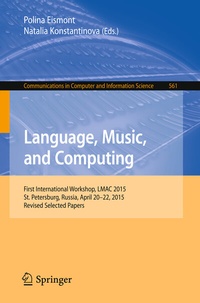
Language, Music, and Computing
First International Workshop, LMAC 2015, St. Petersburg, Russia, April 20-22, 2015, Revised Selected Papers
Published on 14. December 2015
XII, 177 pages
978-3-319-27498-0 (ISBN)
Description

This book constitutes the proceedings of the First International Workshop on Language, Music and Computing, LMAC 2015, held in St. Petersburg, Russia, in April 2015.
The 13 papers presented in this volume were carefully reviewed and selected from 38 submissions. They were organized in topical sections on music and language in education; corpus studies of language and music; problems of notation; and linguistic studies of music.
Reviews / Votes
"All 13 revised selected papers are worth reading. The proceedings would definitely benefit both postgraduate students and researchers of linguistics, musicology, and computing. I would definitely recommend it for a scientific library." (Soubhik Chakraborty, Computing Reviews, January, 2017)More details
Series
Edition
1st ed. 2015
Language
English
Place of publication
Cham
Switzerland
Publishing group
Springer International Publishing
Target group
Professional and scholarly
Product notice
Reflowable
Illustrations
XII, 177 p. 50 illus. in color.
File size
14,00 MB
ISBN-13
978-3-319-27498-0 (9783319274980)
DOI
10.1007/978-3-319-27498-0
Schweitzer Classification
Other editions
Additional editions
Polina Eismont | Natalia Konstantinova
Language, Music, and Computing
First International Workshop, LMAC 2015, St. Petersburg, Russia, April 20-22, 2015, Revised Selected Papers
Book
12/2015
Springer
€53.49
Shipment within 10-15 days
Content
- Intro
- Preface
- Organization
- Contents
- General Questions
- Analogies and Parallels in the Structure of Music and Verbal Languages
- Abstract
- 1 Introduction
- 2 Parallels in Terminology
- 3 Parallels in Morphology
- 4 Parallels in Logic of Subordination
- 5 Conclusion
- References
- In Search of Meaning: Study on Relation of Language and Music in Works of Russian Scientists
- Abstract
- 1 Introduction
- 2 Studies of Meaning in Russian Musicology
- 3 In Search of Meaning
- 3.1 Objectives and Methodology
- 3.2 Data
- 3.3 Results and Discussion
- 4 Conclusion
- References
- Music and Language in Education
- Language, Music, Fire, and Chess: Remarks on Music Evolution and Acquisition
- Abstract
- 1 Introduction
- 2 Patel's Basic Claim
- 3 Is Music Perception a Mental Module? Fodor's 1973 Diagnostics Applied
- 3.1 Rapidity and Automaticity
- 3.2 Informational Encapsulation
- 3.3 Domain-Specificity
- 3.4 Neural Specificity
- 3.5 Existence of Universals
- 4 Is Music Perception a Biological System? Patel's 2008 Diagnostics Revisited
- 4.1 Biological Cost of Failure
- 4.2 Babbling and Specialized Anatomy
- 4.3 Predisposition and Precocious Learning
- 4.4 Critical Period
- 4.5 Existence of Alternate Modalities
- 4.6 Summary
- 5 A Plausible Story of Music Evolution
- 5.1 Mithen's HMMMMM
- 6 Conclusion: Thoughts on Creativity, Genius, and Technical Mastery
- References
- Constructive Interrelationship Between Structural Components in Early Music and Language Learning
- Abstract
- 1 Introduction
- 2 Musical versus Lingual Components
- 2.1 Spatialization
- 2.2 Temporality
- 2.3 Tonality
- 2.4 Dynamics
- 3 Workshops
- 3.1 Musical Melody versus Lingual Intonation
- 3.2 Musical versus Lingual Dynamics
- 3.3 Breathing Technique
- 3.4 Concentration
- 3.5 Communication/Self-esteem
- 4 Conclusion
- References
- Inverting the Mozart Effect: Discovering What Composers Can Learn from Writing
- Abstract
- References
- Corpus studies of Language and Music
- Probabilistic Topic Modeling of the Russian Text Corpus on Musicology
- Abstract
- 1 Introduction
- 2 Topic Modeling of Text Corpora
- 3 Probabilistic Topic Modeling Toolkit
- 4 The Russian Text Corpus on Musicology
- 5 Design of Experiments and Analysis of Results
- 6 Conclusion
- 7 Further Development of Research
- References
- Brazilian Portuguese Pronominal Verbs: How to Identify Them?
- Abstract
- 1 Introduction
- 2 The Characterization of BPPV
- 3 Proposal for a Formal Representation of Pronominal Verbs Based on Functionalism
- 4 The BPPV and the WordNet.Br
- 5 Final Considerations
- References
- Some Observations on Everyday Singing Behaviour Based on Long-Term Audio Recordings
- Abstract
- 1 Introduction
- 2 Data and Method
- 2.1 Research Data
- 2.2 Episodes of Everyday Life
- 2.3 Participants
- 2.4 Definitions
- 2.5 Limitations of Data and Method
- 3 Results
- 3.1 Singing Activity of Participants
- 3.2 Age Distribution of Singing Participants
- 3.3 Participants' Singing Behaviour
- 3.4 Types of Everyday Singing Activities
- 4 Conclusions
- Acknowledgements
- References
- Problems of Notation
- Shaping Tunes: Sharing Musical Information Across Cultural Boundaries
- Abstract
- 1 Introduction
- 2 Two Cultures
- 3 Writing Music Down
- 4 Rethinking Notations
- 4.1 Swarasruti: An Audio-Visual Notation System for Indian Music
- 5 Conclusions
- Acknowledgments
- References
- Further Reading
- A Proposal for a New System of Reading and Writing Music for the Blind
- Abstract
- 1 Introduction
- 1.1 Conventional Music Notation
- 1.2 The Braille System
- 1.3 Braille Musicography
- 2 Objectives and Justification
- 3 Proposal
- 3.1 Description of the System
- 3.2 Tests
- 4 Conclusion
- Acknowledgements
- References
- Linguistic Studies of Music
- Structural Interaction of Poetry and Music Components in Songs by Sergei Rachmaninoff
- Abstract
- 1 Introduction
- 2 Rachmaninoff's Songs (Romances)
- 3 Studies in Temporal Dynamics of Literary and Musical Texts
- 4 Research Methodology
- 5 Rachmaninoff's Song Length
- 6 Analysis of Pitch/Duration Dynamics in Rachmaninoff's Songs
- 7 Dynamic Interaction of Poetry and Musical Components
- 8 Conclusions
- References
- A Linguistic Approach to the Syntax of Early Music: Representation of the Hexachord System by X-Bar Method as an Excavation Tool
- Abstract
- 1 The Problems, Background and Method
- 1.1 Traces of Word Segmentation and Phonologic Analogy
- 1.2 X-Bar Method
- 1.3 Archealogic Approach
- 2 Practical Aspects
- 2.1 External Phrases (Maximals)
- 2.2 Hexachordal Features as the Phonologic Analogy
- 2.3 Internal Phrases (Step and Interval Hierarchy)
- 2.4 Textural Structures and Segmentation Principles
- 3 Application of the Analytical Principles
- 3.1 Evaluation of the First Strophe
- 3.2 Evaluation of the Second Strophe
- 4 Conclusion
- Acknowledgment
- References
- Songs in African Tonal Languages: Contrasting the Tonal System and the Melody
- Abstract
- 1 Introduction
- 2 Methodology
- 2.1 Background and Discussion
- 2.2 Our Approach and Predictions
- 3 Guinean Kpelle
- 3.1 Tonal System
- 3.2 Data
- 3.3 Results
- 4 Guro
- 4.1 Tonal System
- 4.2 Data
- 4.3 Results
- 5 Conclusion
- References
- Author Index
