

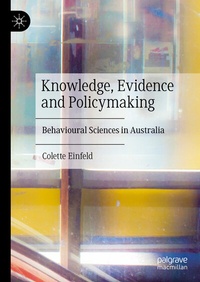
Knowledge, Evidence, and Policymaking
Description

This book provides an insightful and nuanced account of the roles of knowledge and evidence in behavioural science practices. Utilising evidence from Australia, it draws together the fields of evidence-based policymaking and behavioural insights in order to examine how policy actors negotiate the use of scientific evidence, knowledge, lived experience, and ethics in policymaking. It also considers the ways in which different knowledges can 'compete' in public policy, and the roles of policymakers in that competition. Offering insights for both evidence-based policy processes and the application of behavioural insights more generally, the book is a valuable resource for academics and practitioners interested in behavioural sciences, and the impact of different types of evidence in policymaking.
Reviews / Votes
"Colette Einfeld brings a much-needed critical eye to behavioural insights, one of the most popular policy 'solutions' to emerge in contemporary times. In this ground-breaking new book, she tackles not just with questions of the effectiveness (or not) of these approaches, but also grapples with the ethical and contextual dimensions. In laying out the mixed evidence for behavioural insights in practice, Einfeld sheds much-needed light on why governments around the world have been so captured by these ideas. For those interested in understanding the influence and impact of knowledge in practice, Einfeld brings us a thought-provoking and timely contribution." (Janine O'Flynn, Director, Crawford School of Public Policy, The Australian National University, Australia)
"A wonderful book that illuminates the different knowledges at play in the development and enacting of public policy instruments. Through careful investigation and analysis Einfeld illustrates the different uses of knowledge and their impact on policy efficacy. A must read for critical scholars and practitioners interested in understanding why policy instruments don't always 'work'." (Helen Sullivan, Dean, College of Asia and the Pacific, The Australian National University, Australia)
"The book explores an important topic in the practice of public administration and policy and sets out an engaging and critical piece of work. The contributions are innovative and important, demonstrating how policy actors interpret and use knowledge, helping us to better grasp policy in action. The book represents sophisticated interpretive analysis, and deep engagement with key concepts related to the use of knowledge in policy practice. The work goes further than this, however, drawing out critical tensions, contradictions, and puzzles. This is where the detailed empirical work really shines, taking us beyond an explanation of what sorts of knowledge are used, and how, towards a much richer and much more complex story of how policy actors experience and cope with these tensions." (Nick Turnbull, Senior Lecturer in Politics, University of Manchester, UK)
More details
Other editions
Additional editions
Person
Colette Einfeld is a Research Fellow at the College of Asia and the Pacific, Australian National University, Australia. Her research focusses on knowledge and evidence in policy practices in Australia and Asia.
Content
1. Tangled knowledges in behavioural insights: Nudging public policy.- 2. Tangled knowledges.- 3. Webs of knowledge in behavioural insights practices.- 4. Productions of evidence.- 5. Policy makers and the ethics of nudge.- 6. Collaborating and co-designing nudges.- 7. Conclusion.
