

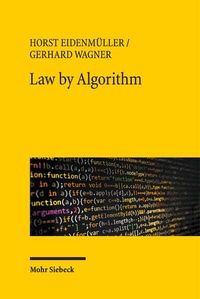
Law by Algorithm
1st Edition
Published on 14. December 2021
272 pages
978-3-16-157509-9 (ISBN)
Description

Welchen Einfluss haben Digitalisierung, Blockchain-Technologie und Künstliche Intelligenz (KI) auf Rechtssetzung, Rechtswissenschaft und Rechtspraxis? Die Autoren des vorliegenden Bandes untersuchen die rechtlich relevanten Entwicklungen, die dadurch geschaffenen Herausforderungen für Rechtspolitik, Rechtsprechung und Rechtsdogmatik, neue regulatorische Aufgaben sowie den Nutzen von KI-Anwendungen für Gesetzgebung und Justiz. Wie kann "Algorithmisches Recht" zum Nutzen aller Menschen eingesetzt werden?
More details
Other editions
Additional editions
Horst Eidenmüller | Gerhard Wagner
Law by Algorithm
Book
12/2021
1st Edition
Mohr Siebeck
€39.00
Shipment within 5-7 days
Persons
Content
- Cover
- Title
- Preface
- Table of Contents
- Chapter 1: Law by Algorithm
- Chapter 2: The Rise of Robots and the Law of Humans
- I. Artificial Intelligence (AI) and the law
- II. Varieties of robots and robot features
- A. Robot applications
- B. Robot features
- III. Regulating self-driving cars
- A. The potential of self-driving cars
- B. Accident liability for fully autonomous cars
- IV. Treating smart cars (machines) like humans?
- V. The case against treating robots like humans
- VI. The (policy) road ahead
- Chapter 3: Machine Performance and Human Failure: How Shall We Regulate Autonomous Machines?
- I. AI and Autonomous Machines
- II. A Welfarist Dystopia
- A. Utilitarianism and Welfarism
- B. Welfarism and AI
- C. Regulatory Consequences
- III. Humanism and Machine Regulation
- A. A Critique of AI-related Welfarism
- 1. The Limits of the Welfarist Calculus
- 2. Concerns about Distributive Justice
- 3. Concerns about Fundamental Human Rights
- B. A Humanistic Approach
- 1. Humans and Machines
- 2. Human Weaknesses and Failure
- 3. Human Rights
- 4. Distributive Justice
- Conclusion
- Chapter 4: Down by Algorithms? Siphoning Rents, Exploiting Biases, and Shaping Preferences: Regulating the Dark Side of Personalized Transactions
- Introduction
- I. Siphoning Rents
- A. Personalized Pricing
- B. Evaluating Personalized Pricing
- C. Self-Help and Its Limits
- D. Potential Regulatory Responses
- II. Exploiting Biases
- A. Consumers in Strategically Set Rationality Traps
- B. Evaluating Rationality Traps and Self-Help by Consumers
- C. Potential Regulatory Responses
- III. Shaping Preferences
- A. Consuming in the Filter Bubble
- B. The Evaporation of Consumer Welfare
- C. Potential Regulatory Responses
- IV. Digital Market Failure
- Conclusion
- Chapter 5: Robot Liability
- I. The Concepts of Robots, Autonomous Systems and IoT-Devices
- II. The European Parliament Resolution of February 2017
- III. The Commission Communication on "Building a European Data Economy"
- IV. Normative Foundations
- V. The Range of Responsible Parties
- VI. The Legal Background
- A. National Tort Law as the Default System
- B. The Products Liability Directive
- C. The Proposed Directive on the Liability of Service Providers
- D. Conclusion
- VII. Shifts in Control Induced by Technology
- A. The Shift from User Control to Manufacturer Control
- B. Dispersion of Control: Unbundling
- VIII. Liability of Manufacturers
- A. The Manufacturer as Best Cost Avoider
- B. The Scope of the Products Liability Directive
- C. The Requirement of a Defect
- D. Burden of Proof - Strict Liability as a Response?
- E. Unbundled Products
- IX. Liability of Users
- X. Liability of the IoT-Device, the Robot Itself
- A. A Legal, not a Philosophical Question
- B. Externalization of Risk through Recognition of ePersons as "Liability Subjects"
- C. Incentives for Robots?
- D. Risk Internalization through Asset Requirements and Insurance Mandates
- E. The Benefit of Robots as Liability Subjects
- XI. Conclusions
- Chapter 6: Robot, Inc.: Personhood for Autonomous Systems?
- Introduction
- I. ePersons and Approaches to Personhood
- A. Laundry Lists
- B. Philosophical Theories
- C. Legal Concepts of Personhood: Pragmatism Rather Than Dogmatism
- II. Limited Personhood and Functions of Liability
- A. Discretion of the Legal System
- B. The Concept of a Liability Subject
- C. Functions of the Liability System
- III. Traditional Liability Subjects
- A. The Range of Responsible Parties
- B. Shifts in Control Induced by Technology
- C. Product Liability as the Default System
- D. User Liability as a Supplement
- IV. Robots as Liability Subjects
- A. The Function of Robot Liability
- B. The Danger of Cost Externalization
- C. Internalization Strategies
- D. Incentivizing Robots?
- Conclusion
- Chapter 7: Liability for Artificial Intelligence: A Proposal of the European Parliament
- I. Introduction
- II. The EU Commission Initiatives
- III. Initiatives of the European Parliament
- IV. Manufacturer vs. Operator Liability
- A. Liability of the Operator
- B. Frontend and Backend Operators
- C. The Backend Operator as Manufacturer
- D. Comparison with the Product Liability Directive
- E. Interplay with the Product Liability Directive
- F. Evaluation
- V. The Choice between Strict Liability and Liability for Fault
- A. The Distinction of the European Parliament
- B. Strict Liability for Systems with High Risk
- C. Fault-Based Liability for Systems Causing Ordinary Risks
- D. A General Clause of Strict Liability vs. an Incremental Approach
- 1. An Enumeration Principle without Enumeration
- 2. Autonomous Robots and Cleaning Devices
- 3. Road Traffic Accidents
- 4. Unmanned aircraft
- 5. Conclusion
- VI. Compensation and Damages
- A. Reference to National Law in Case of Fault-Based Liability
- B. Uniform Regulation of Damages in Cases of Strict Liability
- 1. Caps on Damages
- 2. Scope of Compensation for Personal Injury
- 3. Property Damage
- C. Conclusion
- VII. Insurance Issues
- VIII. Degree of Harmonization
- A. Proviso for Product Liability and Other Matters
- B. Operator Liability
- C. Result
- IX. Conclusion
- Chapter 8: Self-Driving Corporations?
- Introduction
- I. The Trajectory of AI
- A. The History of AI
- B. Today's AI
- C. Tomorrow's AI?
- II. Today's AI and Corporate Law
- A. Impact of Today's AI on Business Organization
- B. "Data Governance": How Today's AI Impacts Corporate Governance
- 1. Scope of available data
- 2. Model selection and training
- 3. Model predictions and wider corporate goals
- 4. Deployment and organizational structure
- C. Data Governance and Corporate Law
- III. Tomorrow's AI and Corporate Law
- A. Self-Driving Subsidiaries
- B. Calibrating Corporate Objectives for Self-Driving Corporations
- C. Alternative Control and Liability Regimes
- D. Regulatory Competition
- Conclusion
- Chapter 9: What Is an Arbitration? Artificial Intelligence and the Vanishing Human Arbitrator
- Introduction
- I. Arbitration and Artificial Intelligence
- A. Artificial Intelligence Applications to Assist Arbitrators
- 1. Tools for case management
- 2. Tools for fact gathering and analysis
- 3. Tools for decision-making
- B. Artificial Intelligence Applications to Replace Arbitrators
- II. The Anatomy of an Arbitration
- A. Involvement of an Independent/Impartial Third Party
- B. Management of the Process
- C. Rendering an Award
- III. Adapting the Legal Framework
- A. The Framework for International Commercial Arbitrations
- B. Recognition and Enforcement of Awards under the New York Convention
- C. Adapting the Domestic Legal Framework
- 1. Regulatory Experiments
- 2. Regulatory Competition
- 3. Moving Forward
- Conclusion
- Chapter 10: Digital Dispute Resolution
- I. Introduction
- II. Digital Enforcement and Smart Contracts
- A. Technology-assisted Contract Management
- B. Smart Contracts
- C. Digital Enforcement
- D. Digital Tools and Private Power
- III. Internal Complaint Mechanisms
- A. Network Effects and their Impact on Dispute Management
- B. Controlling Disputes through Complaint Management
- C. The (Missing) Theory of Complaint Management
- D. Online Complaint Handling
- E. (Anecdotal) Empirical Evidence
- F. Evaluation and Critique
- G. Reform
- IV. External Online Dispute Resolution
- A. Rise of Online Dispute Resolution (ODR)
- B. Regulatory Challenges
- V. Courts in a Digital World
- A. Weakness of the Public Sector with a View to Innovation
- B. Competitors of the Judicial System
- C. Integration of ODR Elements into Judicial Proceedings
- D. The Digital Judge
- VI. Conclusion
- Originally published
- Index
