

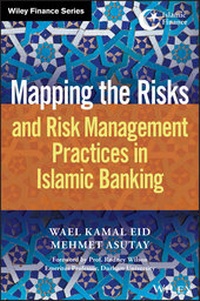
Mapping the Risks and Risk Management Practices in Islamic Banking
Description

issues in Islamic banking
Mapping the Risks And Risk Management Practices In Islamic
Banking is a comprehensive analysis of the current state of
risk management practices within the Islamic banking industry, with
recommendations for policy makers, bankers, and industry
stakeholders. Going beyond the academic, this book presents the
opinions and perceptions of industry financiers and bankers,
alongside primary information and data collected by Islamic finance
professionals to deconstruct and analyze the sector's current risk
management practices. You'll get up to date on the latest attitudes
and trends, and delve into the current issues surrounding risk
management in Islamic banks. With a focus on practical
applications, this authoritative guide discusses the unique risks
facing Islamic banks, from the perspective of a wide range of
practitioners.
Risk management is one of the biggest, most controversial issues
in Islamic finance, yet it remains under-researched. Many
uncertainties exist for which the answers are still unclear, yet
will play a large role in shaping the industry's future. This book
digs deep into current ideas and practices to discover what's being
done, what needs to be done, and what needs to stop happening to
keep the future of Islamic finance strong.
* Explore both Islamic and traditional attitudes toward risk
* Examine current Islamic risk management practices
* Understand the latest industry issues and trends
* Consider the diverse range of risks unique to the Islamic
banking sector
Effective risk management in Islamic banking deserves priority
attention. Unless the industry develops its own genuine risk
management architecture, it cannot achieve its full potential and
the viability needed for a more resilient financial system than the
debunked Wall Street model. Mapping the Risks and Risk
Management Practices in Islamic Banking provides a deep,
authoritative analysis of where the industry is today and where it
needs to develop.
More details
Other editions
Additional editions
Persons
DR. WAEL KAMAL EID is the Chief Risk Officer at SEDCO Holding, the Chairman of the Board Audit and Risk Committee of Al Nahdi Medical Company and a Member of Auto World Audit Committee. He is a risk specialist in Islamic banking who holds an MBA with Distinction from Warwick Business School, and a PhD in risk management from Durham University. He has extensive experience in Risk Management and Islamic banking in the Middle East and Europe. He is also a guest lecturer on Risk Management and Islamic Finance at distinguished universities and speaks regularly at international Risk Management events and conferences. Dr. Eid is the winner of the 2015 Golden Peacock Award for Risk Management by the prestigious Institute of Directors (IoD).
DR. MEHMET ASUTAY is a Professor of Middle Eastern and Islamic Political Economy and Finance at the Durham University Business School; the Director of the Durham Centre in Islamic Economics and Finance; the Programme Director for MSc in Islamic Finance and MSc in Islamic Finance and Management programmes, and is also the Director of the Durham Islamic Finance Summer School. His teaching, research, publication, and supervision of research all falls within Islamic moral economy/Islamic economics, Islamic political economy, Islamic finance and banking, Islamic governance and management, and the Middle Eastern political economies. His articles on his research interest have been published in various international academic journals and professional magazines. Dr. Asutay has also published and edited books on aspects of Islamic moral economy and Islamic finance.
Content
Foreword xi
About the Authors xiii
Chapter 1 Introduction: Research Background and Motivation 1
Systemic Importance of Islamic Banking and Finance 3
Research Aims, Objectives and Questions 5
Research Hypotheses 6
Significance of the Study 7
Overview of the Research Methodology 9
Overview of the Research 10
Chapter 2 Principles of Islamic Banking and Finance 13
Historical Background of Islamic Banking and Finance 14
Size of the Industry 17
Principles of Islamic Banking and Finance 20
Basic Islamic Financing Contracts 20
Sukuk: A Step Toward Securitisation 25
Islamic Banking Versus Conventional Banking 31
Institutional Developments in Islamic Banking and Finance Industry 33
Conclusion 39
Chapter 3 Risk Management in Islamic Banks: A Theoretical Perspective 41
Risk Management: Basic Concepts and Techniques 44
Risk Management and the Credit Crunch 51
Classification of Risks 51
Risks Common to Both Islamic and Conventional Banks 54
Further Risk Areas Specific to Islamic Banks 93
Risk Categories are Entangled 106
Risk Management Issues in Sukuk 107
Risk Mitigation in Islamic Banking 110
Surveying Risk Management Practices in Islamic Banks: A Review of Empirical Research 120
Conclusion 123
Chapter 4 Capital Adequacy for Islamic Banks: A Survey 127
Significance of Capital in Banking 128
Classification of Capital 129
Steps in the Basel Accord 130
Basel II and Islamic Banks 138
Basel III 142
IFSB Principles on Capital Adequacy 143
Capital Adequacy as a Tool for Risk Mitigation 150
Conclusion 151
Chapter 5 Islamic Banking and the Financial Crisis 153
Understanding the Credit Crisis 156
The Financial Crisis and the Need for an Alternative System 163
The Financial Crisis and Islamic Finance and Banking as an Alternative Option 163
Deviations from the Foundational Shari'ah Principles: Evaluating the Operations of Islamic Finance 173
How to Achieve the Full Potential of Islamic Finance 177
Conclusion 181
Chapter 6 Research Framework and Methodology 183
Research Questions and Objectives 183
Research Hypotheses 185
Research Methodology 191
Research Design 191
Research Strategy 193
Research Method 194
Difficulties and Limitations 210
Conclusion 211
Chapter 7 Profiling Perspectives of Risk Dimensions in Islamic Finance: Descriptive Questionnaire Data Analysis 213
Data Analysis and Results 213
Conclusion 250
Chapter 8 Analysing Perceptions of Risk and Risk Management Dimensions and Issues: Inferential Statistical Analysis 253
Risk Perception 254
Risk Management and Reporting 295
Risk Measurement 301
Risk Mitigation 303
Islamic Banking in Practice 304
The Next Chapter in Islamic Banking 306
Conclusion 307
Chapter 9 Exploring Perceptions of Risk and Risk Management Practices in Islamic Banking: Interview Data Analysis 309
Interview Analysis 309
Forming the Main Interview Themes 310
Interview Questions 310
Results and Data Analysis 311
Conclusion 335
Chapter 10 Contextualising the Findings: An Interpretative Discussion 337
Risk Perception in Islamic Banking 337
Islamic Finance Contracts 345
Additional Risk Issues Facing Islamic Financial Institutions 351
Capital Adequacy for Islamic Banks 353
Islamic Banking and the Global Credit Crisis 356
Risk Management and Reporting 363
Risk Measurement 365
Risk Mitigation 367
Islamic Banking in Practice 370
The Future of Islamic Banking 372
Conclusion and Summary 378
Chapter 11 Conclusion and Research Recommendations 381
Summary of the Research 381
Reflecting on the Research Findings 382
Research Implications and Recommendations 386
Limitations of the Study 389
Suggestions for Future Research 390
Appendix 1: Questionnaire 393
List of Acronyms 401
Epilogue 403
Bibliography 405
Index 415
CHAPTER 1
Introduction: Research Background and Motivation
Risk knows no religion
-Michael Ainley, Head of Wholesale Banking, FSA (2007)
Was Michael Ainley right when he assumed that risk management is similar across different cultures and religions, in this case Islamic and conventional banks? Are Islamic banks just like any other bank that provides financial services, and hence have similar risk management requirements?
The subject of risk management in Islamic banking has many facets. On the surface, the frequently repeated story that Islamic banks are more resilient than conventional ones is attractive in a world torn by a financial tsunami. Unfortunately, at least in the current form in which Islamic banking is practised, this is not entirely true. The assumption at one point early in the crisis was that the Islamic market would be entirely unaffected and would sail through the crunch; and people thought that the financial crisis would be the lift-off platform for Islamic banks. On the contrary, the crisis exposed a number of areas in Islamic banking that needed to be dealt with.
This study examines different aspects of risk management issues in Islamic banking. At the heart of this book is the question of whether Islamic banks are more or less risky than their conventional peers. A review of the existing literature does not provide a clear-cut answer to this question. The majority of the relevant literature gives conflicting views using theoretical arguments rather than a formal empirical analysis. The question is clearly an empirical one, the answer to which requires feedback from the market place. The study thus attempts to fill this gap in the empirical literature on risk management in Islamic banking through a survey-based questionnaire and in-depth interviews.
The difficulties afflicting conventional financial markets since mid-2007 have led to more attention being paid to Islamic alternatives. While the modern Islamic finance industry is still young, it has been growing rapidly for several years, largely on the back of an oil-fuelled economic boom in the Middle East. Much demand came from non-Islamic investors who were simply attracted by good investment opportunities. With awareness of the industry rising, Islamic banks have expanded their operations, especially in the core markets of the Middle East and South Asia, but also in newer markets with substantial Muslim populations, including Sub-Saharan Africa and parts of Europe.
At the same time, risk management is receiving increased attention everywhere due to the financial crisis, and risk management products and methods for Islamic banking and finance (IBF) are certainly a hot issue. The market turmoil of the past few years has triggered a wide-ranging reassessment of the global financial system and a need to understand the causes that led to a financial crisis of a severity not seen since the Great Depression. One of the main areas of attention has been the failure of many financial institutions to manage their risks adequately. In most cases, the industry debate has focused on pure risk management failures, particularly the shortcomings of risk models in measuring risks accurately, without addressing the broader issue of how risk is managed at the highest macroeconomic levels and how the whole financial system is based on greed and lack of morality. Since then the credit crunch has afforded advocates of Islamic finance an opportunity to emphasise Shari'ah principles relating to debt and risk, finding a receptive audience beyond the Muslim world. For Islamic financiers, highly complex structured products such as subprime and toxic assets were seen as unacceptable because they were so far removed from their underlying assets.
There appears to be great potential for further growth in Islamic banking, which is still at a relatively early stage. However, there are also a number of challenges associated with developing a new industry with a different approach to risk management. It is notable that although Islamic banks were unscathed by the subprime crisis, many have since suffered from the negative effects of the broader recession, including a collapse in property prices in Dubai, where many Gulf Islamic banks had substantial exposure. The first sukuk defaults occurred in 2009 from two Gulf-based corporate institutions: Kuwait's Investment Dar and Saudi Arabia's Saad Group; others followed shortly after.
This research provides an up-to-date overview of current market practices, issues and trends in risk management for Islamic banks. It focuses on practical applications and discusses a wide range of unique risks faced by Islamic banks from the perspective of different ranges of practitioners. The book asserts that the weaknesses of many financial firms in managing their risks have to be looked at in a comprehensive fashion. The root drivers of the prevailing financial system have to be challenged and replaced by a more transparent and ethical alternative.
This research combines conceptual frameworks with 'hands-on' practical perceptions of risk management in Islamic banking in a pioneering piece of research that Shari'ah scholars, policy-makers, practitioners, academics and researchers will find of relevance and a motivation to conduct further research in this vital but under-researched area. Although a few Shari'ah opinions are included in the book, religious and Shari'ah discussions are beyond the scope of this research.
SYSTEMIC IMPORTANCE OF ISLAMIC BANKING AND FINANCE
Islamic finance is the fastest-growing sector in the financial industry at present. Launched to reconcile the financial with the theological needs of a global community of 1.5 billion Muslims, Islamic finance today offers a broad and sophisticated range of products and services. Double-digit growth rates for Shari'ah-compliant assets over the past decade have naturally driven Islamic financiers to look beyond historical boundaries to explore new territories, both within and outside the Muslim world.
The increasing international interest in Islamic finance is a reflection of the success that this industry has achieved during its short history. Moreover, Shari'ah principles that place emphasis on providing economic added-value to stakeholders, and aim to create equivalence in benefits and costs, free from harmful speculation, are gaining more attention and better understanding globally. Several Western supervisory bodies are incorporating amendments to their supervisory and regulatory legislation to allow for Islamic institutions and Shari'ah-compliant products, which will reinforce the role of Islamic finance globally. Nowadays, in European, American and most Western markets, financial institutions are offering more products and services to cater for Islamic finance. Moreover, a great number of financial institutions in Gulf Cooperation Council (GCC) countries and in Asia are managing funds of over USD 300 billion and are encouraged by their markets to provide Islamic financial services (Moody's, 2011a).
Islamic banking, being the main sub-sector within the Islamic finance industry, has been pioneering this exponential growth. According to Moody's (2011a), the total assets held by Islamic banks globally amounted to more than USD 1 trillion by the end of 2010. While Islamic banks have been hit by the economic downturn, they have been considerably less affected than most conventional banks. This is mainly because, unlike conventional banks, the Islamic banks have not been exposed to losses from investment in toxic assets, nor have they been highly dependent on wholesale funds. Furthermore, Islamic instruments are highly useful alternative investments for the diversification of portfolios, as they have low correlation to other market segments, allow the selective underweighting of particular sectors, and seem to be relatively independent of even market turbulences like the subprime crisis. As a consequence, the increasing standardisation of derivatives and sukuk, as well as the growing liquidity and organisation of the Islamic capital market, offers many opportunities to innovative investors.
With such a background, it is obvious that Islamic banks have come a long way. The future of these institutions, however, will depend on how they cope with the rapidly changing financial world. With globalisation and the information technology revolution, the scope of different financial institutions has expanded beyond national jurisdictions, particularly for investment and wholesale banks. As a result, the financial sector in particular has become more dynamic, competitive and complex. There has been unprecedented development in computing, mathematical finance and innovation of risk management techniques. Moreover, the financial crisis is likely to challenge the global risk management foundations. All these developments are expected to magnify the challenges that Islamic financial institutions (IFIs) face, particularly as more well-established conventional institutions have begun to provide Islamic financial products. IFIs need to equip themselves with the up-to-date management skills and operational systems to cope with this environment. One major factor that will determine the survival and growth of the industry is how well these institutions manage the risks generated in providing Islamic financial services.
The last three decades have witnessed a shift of focus in the development of Islamic banking. The original objective of the 1960s and 1970s of developing an interest-free...
