

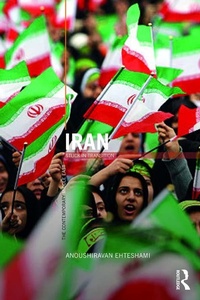
Iran
Stuck in Transition
Published on 3. February 2017
310 pages
978-1-351-98544-4 (ISBN)
Description

Having been ruled, more or less continuously, by a range of monarchical dynasties for three millennia, the end of the monarchy in Iran was relatively sudden, taking place in two short years. Since then, Iran has gone through tumultuous change, yet is still apparently caught in a cycle of transition. Iran has now created a complex but unique and non-transferrable system of government, but the question to be asked is whether the Islamic republic has lived up to its founding expectations, serving the Iranian people and helping them to realize their aspirations.
This book is the first comprehensive analytical study of the forces which have been shaping and changing modern Iran and its relations with the rest of the world. It looks at the roots of the 1979 revolution and the forces unleashed during the modernization process under the Pahlavi monarchy. Applying a range of theoretical approaches to understanding the Islamic republic's neo-authoritarian political system, Anoushiravan Ehteshami reflects on how the country's new elite emerged and how these new political forces have changed Iran, the stresses on its political system, the forces shaping the country's political economy, and the Islamic republic's international relations. As some of Iran's leaders appear to crave permanent revolution as their means of staying in power, this book argues that the struggle for the soul of the Islamic Republic has mired the country in a cycle of change: Constant reform and transition. The republic finds itself stuck in transition.
Written in a clear and insightful manner, this book provides an unparalleled analysis of the Islamic Republic of Iran as a major regional actor and gives fresh insights into the political workings of the world's only Shia, and revolutionary, Islamic republic. It will be of great importance to students and scholars of Middle East Politics and International Relations, as well as the policy community whose gaze is never too far from this unique country.
This book is the first comprehensive analytical study of the forces which have been shaping and changing modern Iran and its relations with the rest of the world. It looks at the roots of the 1979 revolution and the forces unleashed during the modernization process under the Pahlavi monarchy. Applying a range of theoretical approaches to understanding the Islamic republic's neo-authoritarian political system, Anoushiravan Ehteshami reflects on how the country's new elite emerged and how these new political forces have changed Iran, the stresses on its political system, the forces shaping the country's political economy, and the Islamic republic's international relations. As some of Iran's leaders appear to crave permanent revolution as their means of staying in power, this book argues that the struggle for the soul of the Islamic Republic has mired the country in a cycle of change: Constant reform and transition. The republic finds itself stuck in transition.
Written in a clear and insightful manner, this book provides an unparalleled analysis of the Islamic Republic of Iran as a major regional actor and gives fresh insights into the political workings of the world's only Shia, and revolutionary, Islamic republic. It will be of great importance to students and scholars of Middle East Politics and International Relations, as well as the policy community whose gaze is never too far from this unique country.
Reviews / Votes
"Iran: Stuck in Transition exemplifies the best of Ehteshami's scholarship. It is meticulously researched and heavily referenced. Any serious study of contemporary Iran must necessarily take into account Ehteshami's arguments and analyses here." - Mehran Kamrava, Georgetown University, Qatar; review in Iranian Studies"Iran, Stuck in Transition is another fascinating intellectual enterprise by prolific Durham College University professor Anoushiravan Ehteshami. This book is an analysis of various aspects of post-revolutionary Iranian politics. The angle that Ehteshami picked for his analysis makes it unique among the intellectual works in this area. He provides a nuanced portrayal of Iranian politics that casts light on how seemingly conservative and status-quo-oriented "social and political forces in a revolutionary environment" respond to the tides of change from within and without of the polity (p. 2)." - Nima Baghdadi, Florida International University
More details
Series
Language
English
Place of publication
London
United Kingdom
Publishing group
Taylor & Francis Ltd
Target group
College/higher education
Product notice
Reflowable
Illustrations
22 Tables, black and white
File size
1,86 MB
ISBN-13
978-1-351-98544-4 (9781351985444)
Copyright in bibliographic data and cover images is held by Nielsen Book Services Limited or by the publishers or by their respective licensors: all rights reserved.
Schweitzer Classification
Other editions
Person
Anoushiravan Ehteshami is Professor of International Relations, and the Nasser al-Mohammad al-Sabah Chair in International Relations and Director of the HH Sheikh Nasser al-Mohammad al-Sabah Programme in International Relations, Regional Politics and Security at Durham University.
Content
Chronology
Introduction
Narrating Iran in the twenty-first century
1 Modern state formation
Introduction
Historical legacy
Emergence of a modern state
The last Pahlavi
Revolution
The birth of the Islamic republic
2 Politics of the Islamic republic
Introduction
Constitutional arrangements
The first ten years
The second republic
1997: Tehran spring
Neoconservatism rears its head
Nezam in crisis: Iran's tenth presidential elections
Lame duck president?
2013: clocks go forward or back?
Political power and nuclear politics
Authoritarian state, democratic society
3 Iran's political economy
Context
Iran's economic development in the post-Second World War period
Iran's economy under the Islamic republic
The nineties: challenging taboos
Khatami: torn between economics and politics
Ahmadinomics takes hold
A new golden age?
State-society relations under the Islamic republic
Sanctions and the economy
After the sanctions
4 International relations
Introduction
Historical features of Iran's international relations
International relations of a modern state: the Pahlavis
International relations of the Islamic republic
Conclusion
Conclusion
Bibliography
Index 2
Introduction
Narrating Iran in the twenty-first century
1 Modern state formation
Introduction
Historical legacy
Emergence of a modern state
The last Pahlavi
Revolution
The birth of the Islamic republic
2 Politics of the Islamic republic
Introduction
Constitutional arrangements
The first ten years
The second republic
1997: Tehran spring
Neoconservatism rears its head
Nezam in crisis: Iran's tenth presidential elections
Lame duck president?
2013: clocks go forward or back?
Political power and nuclear politics
Authoritarian state, democratic society
3 Iran's political economy
Context
Iran's economic development in the post-Second World War period
Iran's economy under the Islamic republic
The nineties: challenging taboos
Khatami: torn between economics and politics
Ahmadinomics takes hold
A new golden age?
State-society relations under the Islamic republic
Sanctions and the economy
After the sanctions
4 International relations
Introduction
Historical features of Iran's international relations
International relations of a modern state: the Pahlavis
International relations of the Islamic republic
Conclusion
Conclusion
Bibliography
Index 2
