

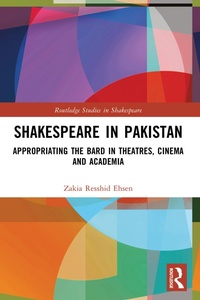
Shakespeare in Pakistan
Appropriating the Bard in Theatres, Cinema and Academia
Published on 2. December 2025
220 pages
978-1-040-42582-4 (ISBN)
Description

Shakespeare in Pakistan offers a comprehensive examination of the appropriation of Shakespearean plays in Pakistan, with a focus on how these works engage with creative, indigenous, cultural, culinary, and religious expressions of identity. The book traces the historical progression of Shakespearean adaptation in both pre- and post-independence Pakistan. This analysis encompasses theatrical and cinematic performances by prominent groups such as Theatre Wallay and the National Academy of Performing Arts (NAPA), both established in 2005. It meticulously explores the recontextualization of Shakespeare's works in the Pakistani context through postdramatic and performance theory lenses. Key performances discussed include Hamlet (2009), Richard III (2018), Here Lies a Noble Man (2015), and The Comedy of Errors (2014). The book also rigorously examines adaptations in Pakistani film and television, including the film Rahm, as well as television serials such as Burns Road ke Romeo and Juliet (2024) and Sang-e-Mah (2023). Drawing on a range of sources-live performances, video recordings, and Urdu translations of Shakespeare's texts used specifically for performance-the study interrogates how Shakespeare is taught in Pakistan and how pedagogical approaches have evolved over time. The analysis further explores how Shakespeare's texts are employed to investigate cultural differences and similarities between the West and the East. This book will be of particular interest to postgraduate students, scholars, and educators engaged in Shakespearean studies, especially within global and cross-cultural pedagogical contexts.
Reviews / Votes
"Zakia Resshid Ehsen's comprehensive investigation of how Shakespeare has been staged, adapted, and taught in Pakistan offers a fascinating new angle on the topic of global Shakespeares"--Lisa Hopkins, Professor Emerita of English, Sheffield Hallam University
"Shakespeare in Pakistan is an erudite study of appropriations as an "inversion tool" to amplify Pakistani Muslim experiences in theatre, cinema, and academia in the pre-partition and post-independence eras. Zakia Resshid Ehsen argues compellingly that Pakistani appropriations revive the Urdu language, redefine Muslim identities, and reframe dominant discourses about Shakespeare and the subcontinent. This book is a crucial intervention in the field that has thus far focused on India and, to some extent, Bangladesh."
--Alexa Alice Joubin, author of Shakespeare and East Asia
"Astute and far-reaching, this book represents a ground-breaking discussion of Shakespeare in Pakistan. Engaging with cinema, translation, television and theatre, including Urdu poetics, Zakia Resshid Ehsen powerfully argues for an approach attuned to gender, class and ethnicity and cognizant of the role the dramatist plays in constructions of national identity."
--Mark Thornton Burnett, Professor of Renaissance Studies, Queen's University Belfast
"Dr. Zakia Resshid Ehsen's work isn't just about Shakespeare-it's about us. What sets her apart is her focus on grounding Shakespeare's words in the lived realities of Pakistan-our history, our struggles, and our humanity. Her work connects people beyond academics to the enduring power of storytelling, resonating with many."
--Omair Rana, Former Teacher of Performing Arts and Actor/Director/Producer in Theatre, Television, and Film
"Zakia Ehsen's book is a testament to our shared humanity and the importance of Shakespeare's writings in the social and literary history of Pakistan. This book will further enhance the projection of art, culture and creativity of Pakistan on the World stage. A must read"
--Ahmed Jamal, film director and producer
"Zakia Resshid's new book is a much-needed intervention in the field of postcolonial Shakespeare Studies in the Pakistani context. Focusing on the different modalities in adaptation and appropriation of Shakespeare plays as performed on stage and film in recent years by upcoming indigenous theater companies such as Theatre Wallahs, as well as in her analysis of the shifting pedagogical strategies around the teaching of Shakespeare's plays, the author has created space for new decolonial readings of the erstwhile Master."
--Fawzia Afzal-Khan, University Distinguished Scholar, Montclair State University
"Shakespeare in Pakistan offers a remarkable must-study into the colonial to postcolonial and decolonial intersections. It debates agendas against legacies that are attached to the British "Bard" and his regional as well as global popularity."
--Professor Waseem Anwar, Director International Centre for Pakistani Writing in English, Kinnaird College for Women, Lahore, Pakistan
More details
Series
Language
English
Place of publication
London
United Kingdom
Publishing group
Taylor & Francis Ltd
Target group
College/higher education
Professional and scholarly
Illustrations
10 Halftones, black and white; 10 Illustrations, black and white
File size
5,47 MB
ISBN-13
978-1-040-42582-4 (9781040425824)
Copyright in bibliographic data and cover images is held by Nielsen Book Services Limited or by the publishers or by their respective licensors: all rights reserved.
Schweitzer Classification
Other editions
Additional editions
Book
approx. 12/2025
1st Edition
Routledge
€207.50
Not yet published

Book
10/2025
Routledge
Unfortunately, price unknown
Available (delivery time upon request)
Person
Zakia Resshid Ehsen is currently serving as an Associate Professor in the Postgraduate Department of English Literature at Kinnaird College for Women. She earned her PhD in English Literature from the University of the Punjab.Dr. Ehsen has received prestigious certifications in Creative Writing and Teaching English Language from globally recognized institutions, including the University of Edinburgh, the University of Reading, the University of Sweden, and Wesleyan University. Her scholarly contributions include research papers published in esteemed international journals such as Shakespeare, Contemporary Social Science, and Multicultural Shakespeare.Her areas of interest include South Asian Literatures, Shakespeare Studies, Film Studies, Theatre and Performing Arts, World History, and Critical Theory.
Content
Introduction
Chapter 1: Shakespeare's Reception and Appropriation in Pre-Partition of Pakistan
Chapter 2: Shakespeare and Pakistan after Independence
Chapter 3: Experimentation and Revival of Pakistani Modern Theatre
Chapter 4: Sang-e-Mah (2022) Pakistani Recontextualizations of Shakespeare's Hamlet (1601)
Chapter 5: Burns Road's Culinary Foodway: A Heterotopic Ode to Shakespeare's Romeo and Juliet in Pakistan's Television Serial
Chapter 6: Cinematic Appropriation of Shakespeare's Measure for Measure (1603): A Gnoseological Exploration of Pakistani Muslim Identity
Chapter 7: Rewriting Shakespeare: Macbeth as Raees in Urdu Tradaptation
Chapter 8: Shakespeare in Academia: Institutionalizing Colonial Agendas in Pakistan
Chapter 9: Rethinking Shakespeare in Pakistani Academia: Beyond Colonial Pedagogies/ Shakespeare in Pakistan: From Colonial Legacy to Transformative Education
Chapter 1: Shakespeare's Reception and Appropriation in Pre-Partition of Pakistan
Chapter 2: Shakespeare and Pakistan after Independence
Chapter 3: Experimentation and Revival of Pakistani Modern Theatre
Chapter 4: Sang-e-Mah (2022) Pakistani Recontextualizations of Shakespeare's Hamlet (1601)
Chapter 5: Burns Road's Culinary Foodway: A Heterotopic Ode to Shakespeare's Romeo and Juliet in Pakistan's Television Serial
Chapter 6: Cinematic Appropriation of Shakespeare's Measure for Measure (1603): A Gnoseological Exploration of Pakistani Muslim Identity
Chapter 7: Rewriting Shakespeare: Macbeth as Raees in Urdu Tradaptation
Chapter 8: Shakespeare in Academia: Institutionalizing Colonial Agendas in Pakistan
Chapter 9: Rethinking Shakespeare in Pakistani Academia: Beyond Colonial Pedagogies/ Shakespeare in Pakistan: From Colonial Legacy to Transformative Education
