

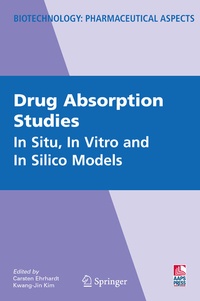
Drug Absorption Studies
Description

In the last 15 years, a great number of cell- or tissue-based in vitro models have been introduced into the biopharmaceutics arena. These models mimic the different biological barriers that a drug has to overcome to finally reach its target organ/cell/receptor. These in vitro models have been found very useful in not only characterising the permeability behaviour of drugs molecules in epithelial and endothelial tissues, but also studying drug delivery systems for improved delivery and enhanced absorption. Compared to the complex in vivo situation, in vitro models offer a fast, convenient approach with cost advantages most of times. Most importantly, they can be standardised and automatised to be applicable to the high-throughput screening.
Starting at the molecular level of studies, continuing with cell monolayer models (both primary and cell lines) and in situ techniques as a final testing format, the book provides a practical approach to contemporary in vitro techniques for drug absorption studies. In addition, chapters on high-throughput assays, in vitro-in vivo correlation, bioinformatics and regulatory issues are covered, giving a comprehensive overview of available models and techniques. Moreover, an appendix comprised with a number of practical protocols is available online, updated as needed, should prove very helpful to apply the techniques directly to the benchside.
More details
Other editions
Additional editions
Content
Dirk Neumann
Abstract The human skin has long since been realized as a possible pathway for drug molecules to enter the human body. The skin, however, impedes drug absorption quite effectively, since one of its main purposes, like in all epithelial tissues, is the protection of the organism by sealing off the body from the environment. While several laboratory techniques exist to assess the migration of drug molecules into and through the skin, computational models able to predict such experimental results in a reliable manner hold obvious advantages. The interest in such models has given rise to numerous and quite different approaches, which makes it virtually impossible to list all of them. Here, a selection of computational models-divided into different classes according to their underlying concept-is presented. The chapter starts with the fundamentals outlining the properties of the skin barrier and the experimental assessment of permeability. In the next sections, the theoretical framework for each class is presented followed by a description of representative models. The chapter concludes with an outlook illustrating current and possible future trends.
Keywords: Skin permeability, Percutaneous absorption, Skin penetration, Mathematical model, Quantitative structure-activity relationships, Permeability coefficient, Human skin
Abbreviations
AIC - Akaike information criterion
ANN - Artificial neural network
COSMO - Conductor-like screening model
kNN - k-nearest-neighbor
LSER - Linear solvation energy relationship
PCA - Principal component analysis
QSPR - Quantitative structure permeability relationship
RC - Retardation coefficient
RMS - Root-mean-square
20.1. Introduction
Despite its physical properties like softness and thinness, the skin forms a formidable and surprisingly effective barrier keeping harmful substances from entering the body while at the same time reducing water loss from the inside. For systemic administration of drugs, however, pharmaceutical companies strive to find means for overcoming this barrier in a predictive manner. Here, computational models for estimating the rate and extent of drug permeation into the human body allow for increased productivity. On the other hand, prediction of transdermal drug absorption may help in risk assessment in cosmetic and agrochemical fields. Consequently, many different predictive models have been developed-which might lead to the premature presumption that the problem of predicting transdermal permeation has been fully solved. When it comes to skin diseases the skin is also a site of topical administration. Strangely enough, the number of models for predicting time-dependent concentration changes within skin layers (skin penetration) is quite small.
This chapter starts with a short introduction on the skin barrier's properties and the methods employed for analyzing experimental data. This is followed by an overview of several selected approaches to predict steady-state diffusion through the skin. Then a few approaches that approximate the structural complexity of the skin by predicting drug diffusion in biphasic or even multiphasic two-dimensional models will be presented. Finally, the chapter concludes with a short summary of the many variables possibly influencing drug permeation and penetration.
