

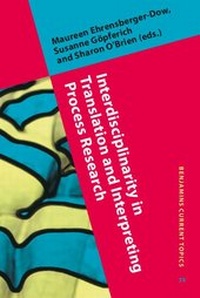
Interdisciplinarity in Translation and Interpreting Process Research
1st Edition
Published on 11. June 2015
V, 159 pages
978-90-272-6848-8 (ISBN)
Description

First published as a special issue of Target (issue 25:1, 2013), this volume explores interdisciplinarity in translation and interpreting process research, fields that have enjoyed a boom in the last decade. For this reason, the time was ripe for a reflection on the broad range of methodologies that have been applied in our endeavours to understand both translation and interpreting processes better. The ten chapters provide a snapshot of how translation and interpreting process researchers have availed themselves of concepts and theories developed in other disciplines, such as psychology, the cognitive sciences, journalism, and literary studies, to examine and illuminate their object of study. This collection demonstrates that translation and interpreting process research borrow heavily from other disciplines and call for a consideration of how translation research can become truly interdisciplinary through increased collaboration, synergy, and mutual advancement.
More details
Other editions
Additional editions
Maureen Ehrensberger-Dow | Susanne Goepferich | Sharon O'Brien
Interdisciplinarity in Translation and Interpreting Process Research
Book
06/2015
John Benjamins Publishing Co
€90.10
Shipment within 10-15 days
Persons
Content
- Interdisciplinarity in Translation and Interpreting Process Research
- Editorial page
- Title page
- LCC data
- Table of contents
- Introduction
- The borrowers
- 1. Introduction
- 2. Borrowing from specific disciplines and sub-disciplines
- 2.1 Linguistics
- 2.2 Psychology
- 2.3 Neuroscience
- 2.4 Cognitive science
- 2.5 Writing and reading
- 2.6 Language technology
- 3. Progress and direction
- Cognitive load in simultaneous interpreting
- 1. Introduction
- 2. Measuring cognitive load
- 2.1 Cognitive load in interpreting research: Analytical methods
- 2.2 Cognitive load in interpreting research: Subjective methods
- 2.3 Cognitive load in interpreting research: Performance methods
- 2.4 Cognitive load in interpreting research: Psycho-psychological methods
- 3. Pupillometry
- 3.1 The pupil
- 3.2 The technology
- 3.3 Using pupillometry to measure cognitive load in simultaneous interpreting
- 3.4 Potential and limitations of pupillometry in simultaneous interpreting
- 4. Conclusion
- Extended Translation
- 1. Introduction
- 2. Extended perspectives on cognition and action
- 2.1 Situated cognition
- 2.2 Actor-network theory
- 2.3 Activity theory
- 3. Empirical case study: changes in translation management
- 3.1 Main findings
- 3.2 Frameworks and concepts for interpreting the findings
- 4. Conclusions
- Towards a new linguistic-cognitive orientation in translation studies
- 1. A plea for a new linguistic-cognitive orientation in translation studies
- 2. Rationale for a new linguistic-cognitive orientation
- 3. Introspective and retrospective translation process studies: how valid and reliable are their outcomes?
- 4. Behavioural experiments on the translation process: how valid, reliable and insightful are their outcomes?
- 5. Bilingual neuro-imaging studies: how useful and relevant are they for translation studies?
- 6. A neuro-linguistic theory of the functioning of two languages in the brain
- 7. Conclusion
- Translation competence
- 1. Introduction
- 2. What didactically relevant variables is the dynamic system of translation competence composed of, and how can they be 'measured'?
- 3. The results interpreted in the light of DST
- 4. Discussion and conclusion
- Applying a newswriting research approach to translation
- 1. Introduction
- 2. The relevance of newswriting research for translation studies
- 2.1 Parallels between writing and translation process research methods
- 2.2 Methodological considerations
- 3. Progression analysis in newswriting research
- 4. Tracing translation processes with progression analysis
- 4.1 First level of progression analysis: the translation situation
- 4.2 Second level of progression analysis: translation activities and practices
- 4.2.1 Computer logging
- 4.2.2 S-notation
- 4.2.3 Progression graphs
- 4.2.4 Eye tracking
- 4.3 Third level of progression analysis: awareness of decision-making
- 4.4 Version analysis of translation products
- 5. Transferring research findings to training and back to the workplace
- Appendix A. Translation brief and German source text
- Appendix B. Steps in ET0413's production of the 5th sentence of the target text
- Metaphor in translation
- 1. Introduction
- 2. Theoretical approaches
- 2.1 Interaction with metaphor studies
- 2.2 Use of a multilingual approach
- 3. Translation process studies and metaphor
- 3.1 Addressing metaphors via TAPs
- 3.2 Addressing metaphors via keystroke logging
- 3.3 Addressing metaphors via eye tracking
- 3.4 Main insights and new questions
- 4. Conclusion
- Investigating the conceptual-procedural distinction in the translation process
- 1. Introduction
- 2. Theoretical underpinnings
- 2.1 Relevance and translation: in search of a cause-effect relation
- 2.2 Some important relevance theory concepts
- 2.2.1 The principle of relevance and the effect-effort relation
- 2.2.2 The conceptual-procedural distinction in relevance theory
- 2.3 Revisiting the conceptual-procedural distinction in translation
- 3. Methodological framework
- 3.1 Experimental design
- 3.2 Procedures for data analysis
- 3.3 Hypotheses
- 4. Analyses and discussion
- 4.1 Types of macro translation units in direct/inverse translation tasks
- 4.2 Editing procedures in micro/macro translation units
- 4.3 Distance indicators of conceptual and procedural encodings
- 4.4 Processing effort in relation to conceptual and procedural encodings
- 5. Concluding remarks
- Appendix. Mapping conceptual and procedural encodings in the source texts
- The role of archival and manuscript research in the investigation of translator decision-making
- 1. Introduction
- 2. Archive, manuscripts and personal papers
- 2.1 Archives, manuscripts and papers in translation studies research
- 3. Case study - drafts of Bellos's retranslation of Perec's Les choses
- 4. Questions of research methodology
- References
- Appendix 1. Photocopy of Bellos's handwritten Draft 3, with amendments (reproduced with the permission of David Bellos).
- Appendix 2. Classification of initial revisions at Draft 3 stage
- Sound effects in translation
- 1. Introduction
- 2. Methodology
- 2.1 Research questions and methods of analysis
- 2.2 Procedure
- 3. Analyses
- 3.1 Results for phase 1
- 3.2 Comparison of results for phases 1 and 2 (March 2010 vs. December 2010)
- 3.2.1 Time and quality (Research questions 1 and 2)
- 3.2.2 Number and types of misrecognitions (Research question 3)
- 3.3 Quantitative conclusions
- 3.4 Retrospective interviews
- 4. Discussion and conclusion
- Dedication
- Acknowledgement
- Subject index
