

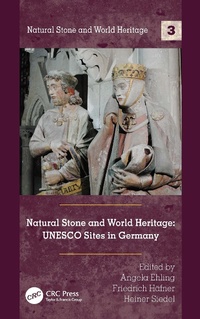
Natural Stone and World Heritage
UNESCO Sites in Germany
1st Edition
Published on 12. September 2021
166 pages
978-1-000-43604-4 (ISBN)
Description

There are many UNESCO World Heritage Sites in Germany. Most of them are built with natural stones. These sites are commonly presented to the public with a lot of information regarding historical, cultural and artistic aspects. Mostly, there is no focus on the main building material if it concerns natural stones.
This work aims to show that it is precisely the natural stone that lends the sites their distinctive character. The used stones demonstrate the context and the interaction with the geology of the surrounding countryside as well as possibilities of transport and treatment. They reflect the culture and society at the time of the building phases.
The second part of the work presents the most important stones that were used at these sites, along with their occurrences, aspects of quarrying in historical times and of course their petrographical, mineralogical and technical features. It is shown how these features influence the weathering of the stones and how restoration of stones is carried out.
The book will serve as a useful source book for geologists, archaeologists, architects, representatives of the natural stone industry, historians and cultural heritage management professionals specifically, and for academic and nonacademic communities, travelers and tourism industry operators in general.
This work aims to show that it is precisely the natural stone that lends the sites their distinctive character. The used stones demonstrate the context and the interaction with the geology of the surrounding countryside as well as possibilities of transport and treatment. They reflect the culture and society at the time of the building phases.
The second part of the work presents the most important stones that were used at these sites, along with their occurrences, aspects of quarrying in historical times and of course their petrographical, mineralogical and technical features. It is shown how these features influence the weathering of the stones and how restoration of stones is carried out.
The book will serve as a useful source book for geologists, archaeologists, architects, representatives of the natural stone industry, historians and cultural heritage management professionals specifically, and for academic and nonacademic communities, travelers and tourism industry operators in general.
More details
Series
Edition
1. Auflage
Language
English
Place of publication
London
United Kingdom
Publishing group
Taylor & Francis Ltd
Target group
College/higher education
Professional and scholarly
Adult education
Illustrations
14 Tables, black and white; 141 Line drawings, color; 6 Halftones, color; 147 Illustrations, color
ISBN-13
978-1-000-43604-4 (9781000436044)
Copyright in bibliographic data and cover images is held by Nielsen Book Services Limited or by the publishers or by their respective licensors: all rights reserved.
Schweitzer Classification
Other editions
Additional editions
Angela Ehling | Friedrich Haefner | Heiner Siedel
Natural Stone and World Heritage
UNESCO Sites in Germany
Book
09/2021
1st Edition
CRC Press
€126.60
Shipment within 15-20 days
Natural Stone and World Heritage
UNESCO Sites in Germany
Book
09/2021
CRC Press
Unfortunately, price unknown
Available (delivery time upon request)
Persons
Angela Ehling studied Geology at the University of Greifswald, Germany, and at the State Mining Institute (Gornyj Institut) Saint Petersburg, Russia. She was employed at the Geological Survey (Berlin) of the German Democratic Republic from 1985 to 1990, and since then she has worked at the Federal Institute for Geosciences and Natural Resources, Hannover-Berlin, Germany, on applied mineralogy and Building/ornamental stones. She obtained her PhD from University Hannover, Germany in 1999. Ehling is responsible for one of the biggest geoscientific and dimension stone collections in Germany. She is involved in several dimension stone projects, even in the context of monument protection. She is consultant of the German government dimension stones used in governmental buildings, she is speaker of the German GHSR-working-group, co-founder and board member of the German network "stones in the city" and guest lecturer at the FH Potsdam, on stone restoration.
Friedrich Haefner studied Geology at the Johannes-Gutenberg-University, Mainz (SW-Germany). In 1974 he received a diploma in Geology. At the end of 1977 he obtained a doctorate in Science at the University of Mainz. Between 1977 and 2014 he was a member of staff of the Geological Survey of Rhineland-Palatinate (federal state of Germany), lastly as head of the department of geology, including engineering geology and commodities. From 1980 to 2000 he gave lectures in engineering geology at the University of Mainz. For 10 years Haefner was speaker of the national German working group of the IAEG-Commission No. 10 "Building stones and ornamental rocks". Between 1997 and 2005 he was speaker of the working group on commodities of the community of Geological Surveys of Germany. He has published more than 80 papers dealing with topics in engineering geology, commodities, building stones and public relations of the geological sciences. Now Haefner acts as a consultant, mainly in the natural stone industry.
Heiner Siedel studied Mineralogy and Geochemistry at the Mining Academy in Freiberg and obtained his PhD from Halle University in 1989 with a petrographic dissertation on low-grade metamorphic slates in the Harz Mts., Germany. Afterwards he worked with the Institute for Concrete Research in Dresden, investigating damage mechanisms in concrete. In 1991 he started his work at the Saxon State Office for Preservation of Monuments in Dresden in a research project about stone deterioration and conservation on monuments. 1996-2000 he worked as scientist and chief executive officer of the Institute of Diagnosis and Conservation on Monuments in Saxony and Saxony-Anhalt, dealing with conservation projects in Germany as well as in Cambodia and Thailand. Since 1999 he teaches restorers in material science at the University of Fine Arts in his hometown Dresden. In 2000 he got a position as senior scientist at the TU Dresden, Institute of Geotechnical Engineering, Chair of Applied Geology, where he teaches Geology, Petrography and Technical Petrography and became an appointed professor in 2012. He is active in the German GHSR working group and member of the Permanent Scientific Committee of the quadrennial International Congress on Deterioration and Conservation of Stone.
Friedrich Haefner studied Geology at the Johannes-Gutenberg-University, Mainz (SW-Germany). In 1974 he received a diploma in Geology. At the end of 1977 he obtained a doctorate in Science at the University of Mainz. Between 1977 and 2014 he was a member of staff of the Geological Survey of Rhineland-Palatinate (federal state of Germany), lastly as head of the department of geology, including engineering geology and commodities. From 1980 to 2000 he gave lectures in engineering geology at the University of Mainz. For 10 years Haefner was speaker of the national German working group of the IAEG-Commission No. 10 "Building stones and ornamental rocks". Between 1997 and 2005 he was speaker of the working group on commodities of the community of Geological Surveys of Germany. He has published more than 80 papers dealing with topics in engineering geology, commodities, building stones and public relations of the geological sciences. Now Haefner acts as a consultant, mainly in the natural stone industry.
Heiner Siedel studied Mineralogy and Geochemistry at the Mining Academy in Freiberg and obtained his PhD from Halle University in 1989 with a petrographic dissertation on low-grade metamorphic slates in the Harz Mts., Germany. Afterwards he worked with the Institute for Concrete Research in Dresden, investigating damage mechanisms in concrete. In 1991 he started his work at the Saxon State Office for Preservation of Monuments in Dresden in a research project about stone deterioration and conservation on monuments. 1996-2000 he worked as scientist and chief executive officer of the Institute of Diagnosis and Conservation on Monuments in Saxony and Saxony-Anhalt, dealing with conservation projects in Germany as well as in Cambodia and Thailand. Since 1999 he teaches restorers in material science at the University of Fine Arts in his hometown Dresden. In 2000 he got a position as senior scientist at the TU Dresden, Institute of Geotechnical Engineering, Chair of Applied Geology, where he teaches Geology, Petrography and Technical Petrography and became an appointed professor in 2012. He is active in the German GHSR working group and member of the Permanent Scientific Committee of the quadrennial International Congress on Deterioration and Conservation of Stone.
Content
Introduction. 1. UNESCO sites in Germany. 2. Natural stones at UNESCO sites in Germany.
