

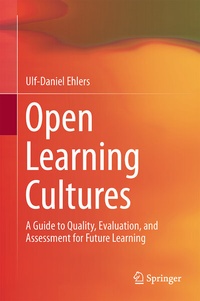
Open Learning Cultures
Description

Today we are seeing a new form of blended learning: not only is technology enhancing the learning environment but formal and informal learning are combining and there is self- and peer-assessment of results. Open learning cultures are challenging the old and long-practiced methods used by educators and transforming learning into a more student-driven and independent activity , which uses online tools such as blogs, wikis or podcasts to connect resources, students and teachers in a novel way.
While in higher education institutions most assessments are still tied to formal learning scenarios, teachers are more and more bound to recognize their students' informal learning processes and networks. This book will help teachers, lecturers and students to better understand how open learning landscapes work, how to define quality and create assessments in such environments, and how to apply these new measures.
To this end, Ehlers first elaborates the technological background for more collaborative, distributed, informal, and self-guided learning. He covers the rise of social media for learning and shows how an architecture of participation can change learning activities. These new paradigms are then applied to learning and education to outline what open learning landscapes look like. Here he highlights the shift from knowledge transfer to competence development, the increase in lifelong learning, and the importance of informal learning, user generated content, and open educational resources. He then shows how to manage quality by presenting a step by step guide to developing customized quality concepts for open learning landscapes. Finally, several methods dealing with assessment in these new environments are presented, including guidelines, templates and use cases to exemplify the approaches.
Overall, Ehlers argues for assessment as an integral part of learning processes, with quality assurance as a method of stimulating a quality culture and continuous quality development rather than as a simple controlling exercise.
More details
Other editions
Additional editions
Person
Ulf-Daniel Ehlers is Professor for Educational Management and Lifelong Learning, and Vice-President for Quality and Academic Affairs at Baden-Wurttemberg State University in Stuttgart, Germany. His research interests are in e-learning, quality development, and educational systems development. He is also President of the European Foundation for Quality in E-Learning, and is active in many research and development projects.
Content
- Intro
- Preface
- What Can You Expect?
- Contents
- Index of Figures
- Index of Tables
- Chapter 1: Introduction: An Avalanche Is Coming
- 1.1 A Fast Track Introduction to the Connection Between Quality and Assessment
- Chapter 2: Discovering the Power of Social Media
- 2.1 Getting Started with Social Media
- 2.2 The Rise of Web 2.0 and Social Media in Higher Education
- 2.3 The Effects of the Next Generation Technology on Higher Education
- 2.3.1 Web 1.0 and Web 2.0
- 2.3.2 From E-learning 1.0 to E-learning 2.0
- 2.4 The Read and Write ``Pro-sumer´´ Web
- 2.5 Harnessing the Power of Social Networks
- 2.5.1 The Strength of Weak Ties
- 2.5.2 The Wealth of Networks
- 2.5.3 The Wisdom of Crowds
- 2.5.4 Crowdsourcing
- 2.6 The Web as a Platform
- 2.7 Architecture of Participation
- 2.8 Looking Ahead: Web 3.0 and the Semantic Web
- Chapter 3: Emerging Open-Learning Cultures: Transforming Higher Education
- 3.1 Understanding Learning Culture as a Holistic Concept for Higher Education
- 3.2 Creating a Model of Learning Culture
- 3.2.1 Organizational Culture According to Edgar H. Schein
- 3.2.2 Organizational Culture According to Geert Hofstede
- 3.2.3 Organizational Culture According to Johannes Rüegg-Stuerm
- 3.2.4 Organizational Culture According to Gareth Morgan
- 3.2.5 Harvesting Elements for a Learning Culture Model
- 3.3 From Knowledge Acquisition to Competence Development
- 3.3.1 How to Develop Competence?
- 3.3.2 Designing Learning for Competence Development
- 3.4 The Rise of Lifelong Learning
- 3.5 The New Blend: Connecting Formal and Informal Learning
- 3.6 Opening Learning Architectures: From Distribution to Collaboration
- 3.7 From Expert via User to Learner-Generated Content
- 3.8 Open Educational Resources and Open Educational Practices
- 3.8.1 Open Educational Resources
- 3.8.2 Creative Commons
- Use of Creative Commons in Higher and Further Education
- 3.8.3 Open Educational Practices
- 3.9 Massive Open Online Courses
- 3.9.1 Myth 1: MOCs Follow Their Own Quality Logic
- 3.9.2 Myth 2: MOOCs Are the Solution for a Better Educated World for All for Free, Especially the Developing and Emerging Coun...
- 3.9.3 Myth 3: MOOCs Use Innovative Learning Design
- 3.9.4 Myth 4: Large Data Will Improve Teaching (Taken from Tony Bates Blog 2013)
- 3.10 From Teachers to Facilitators, Learning-Stewards and Change Agents
- Chapter 4: Open and Community-Based Learning Ecologies: Peers and Networks
- 4.1 Learning Networks Between Peers
- 4.2 Learning Networks: Moving from a Constructive to a Connected and Networked Learning Paradigm
- 4.3 Networks or Communities: Different Learning Ecologies
- 4.4 Communities of Practice
- Chapter 5: The Foundations for Quality of Open-Learning Cultures
- 5.1 Revisiting the Quality Debate in Education
- 5.2 Quality from an Educational Perspective: Participation and Coproduction as Conditions for Educational Quality Development
- 5.3 The Learner´s Role in Quality Development: An Important and Often Misunderstood Principle
- 5.4 How to Involve Learners into Quality Development
- 5.5 A New Approach to High-Quality Learning for Autonomous Learners and Educators: Quality Literacy
- 5.5.1 Theoretical Background and Approach of a New Concept
- 5.5.2 The Four Dimensions of Quality Literacy
- Chapter 6: The Practice of Quality Development: Tools and Concepts for Quality of Open-Learning Cultures
- 6.1 Factors to Consider for Quality Development in Open-Learning Cultures
- 6.1.1 Factor 1: What Is the Object of Quality Development for Open-Learning Cultures?
- 6.1.2 Factor 2: Taking a Holistic Approach to Develop Quality of Learning Cultures
- 6.1.3 Factor 3: Methods and Instruments for Quality Assessment
- 6.1.4 Factor 4: The Stakeholders
- 6.1.5 Factor 5: Coevaluation and Codesign of Quality Development
- 6.2 From Theory to Practice: Shifting the Focus
- 6.2.1 Worksheet
- 6.3 Principles for Quality Development of Open-Learning Cultures
- 6.4 MyQuality: Building Your Own Quality Approach
- Chapter 7: Assessment for Open-Learning Cultures
- 7.1 Revisiting Assessment of Learning Outcomes
- 7.2 Moving Ahead to Assessment for Open-Learning Cultures
- 7.2.1 Self- and Peer Reflection
- 7.2.2 Peer Review
- Blind Vs. Open Refereeing
- Open Vs. Restricted Access
- Criteria and Guideline-Based Vs. Free Commenting
- Qualification, Background, and Motivation of Reviewers
- 7.2.3 Peer Assist
- 7.2.4 Self-Assessment
- 7.2.5 Peer Assessment
- 7.2.6 Self-Evaluation
- 7.2.7 Social Recommendation
- Social Information Retrieval
- Social Navigation
- Recommender Systems
- 7.2.8 E-Portfolio Assessment
- 7.2.9 Rubrics as a Tool for Assessment: Also for Open-Learning Cultures
- 7.3 Final Remarks on Assessment in Open-Learning Cultures
- 7.3.1 Trust and Peer Reputation
- 7.3.2 Selecting a Peer That Fits!
- 7.3.3 Comparison of Assessment Methodologies: Strength and Weaknesses
- Abbreviations
- Definitions
- References
- Video Sources
- Index
