

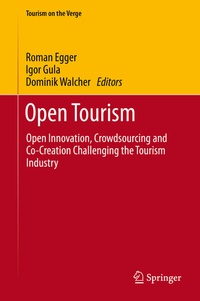
Open Tourism
Description

This book examines the concepts of open innovation, crowdsourcing and co-creation from a holistic point of view and analyzes them considering their suitability to the tourism industry. Methods, theories and models are discussed and examined regarding their practical applicability in tourism. The book illustrates the theoretical mechanisms and principles of Open Innovation, Crowdsourcing and Co-creation with case studies and best practices examples. In addition to the scientific target group, the book is a useful resource for managers of the entire tourism industry.
First, the book presents the theoretical fundamentals and concepts in 11 specific chapters. This basis is then enriched by three parts with case studies, focusing on information, creation and provision respectively. Finally in a concluding part the editors sum up the book and give an outlook on the implications, learnings and future perspectives of open innovation, crowdsourcing and collaborative consumption in the tourism industry.
Reviews / Votes
"This book is easy to read and follow, enriched by a large number of industrial examples and best practices. . this book can be also used as a reference by undergraduate students, with interests in the fields of business management, tourism, or hotel. The value of this book mainly stands out with regard to its holistic overview and comprehensiveness in the inclusion of various examples and best practices for the tourism industry." (Simon Lei, Information Technology & Tourism, Vol. 17, 2017)More details
Other editions
Additional editions
Persons
Professor Roman Egger attended the Tourism- and Hospitality Management School in Klessheim from 1989 until 1994. He graduated in Communications Sciences and gained his Doctorate from the University of Salzburg, where he specialized in the fields of Information and Communication Technologies in Tourism. He worked at the Tourism Board of Salzburg as a marketer. Roman is Lecturer in eTourism at the Salzburg University of Applied Sciences and key researcher at the department of Innovation and Management in Tourism. Roman advises a number of national and international projects in the fields of Information Technologies in Tourism and counsels eTourism-development activities in Sri Lanka, Nepal and Egypt. He has written and co-edited nine books, published a number of articles in Books and Journals and is co-editor of the scientific Journal "Zeitschrift für Tourismuswissenschaft". He is a Member of the International Federation of Information Technology for Travel and Tourism (IFITT), ÖGAF and DGT and AIEST.
Igor Gula is a graduate of a Bachelor's degree program in tourism business studies of the Management Center Innsbruck and of a Master's degree program in innovation and management in tourism of the Salzburg University of Applied Sciences. He completed his internship in the department of Marketing New Media at the headquarters of the Casinos Austria in Vienna. Igor wrote his Bachelor thesis about the trends of the modern ICTs and their impacts on tourism, focusing on Dynamic Packaging, mTourism and Social Semantic Web. For his Master thesis he analysed the aspects of Open Innovation and Crowdsourcing in tourism and conducted a web-based ideas competition in cooperation with the Slovak Tourist Board. Igor is currently in charge of the corporate customer service at the Hotel Zeitgeist Vienna and also studies business administration at the MODUL University in Vienna.
Prof. Dr. Dominik Walcher is the Chair of Marketing and Innovation Management at Salzburg University of Applied Sciences. Since March 2010 is as well a Research Associate at the Massachusetts Institute of Technology (MIT), Boston. Professor Walcher also teaches at numerous universities in Germany, Austria, Switzerland, Italy and Finland. He is an acclaimed speaker at conferences and founder of the "Institute of Market and Innovation Research". His research interests are mass customization, open innovation, sustainability marketing and branding. He has published and consulted extensively.
