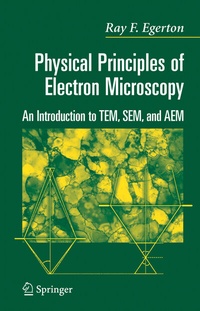
Physical Principles of Electron Microscopy
Description

Scanning and stationary-beam electron microscopes have become an indespensible tool for both research and routine evaluation in materials science, the semiconductor industry, nanotechnology and the biological, forensic, and medical sciences. This book provides an introduction to the theory and current practice of electron microscopy, aimed primarily at undergraduates who need to learn how the basic principles of physics are applied in an important area of science and technology that has contributed greatly to our knowledge of life processes and "inner space." However, it will be equally valuable for technologists who make use of electron microscopes and for graduate students, university teachers and researchers who need a concise text that deals with the basic principles of microscopy. Less technical but broader in scope than other microscopy textbooks, Physical Principles of Electron Microscopy is appropriate for undergraduates and technologists with limited mathematical training.
Reviews / Votes
From the reviews:
"This book comprises a concise introduction to the fundamental physical concepts of electron microscopy and related analytical techniques . . The concepts are well explained and illustrated, and in addition, the author offers a helpful introduction to microscopy, as a whole . . The text includes interesting historical tidbits and also alludes to more recent developments . . It is suitable for institutional or personal purchase." (Andreas Holzenburg, Microbiology Today, July, 2006)
"R.F. Egerton . has now written a short book for beginners on electron microscopy in general: Physical Principles of Electron Microscopy, an Introduction to TEM, SEM, and AEM[10]. . Extremely simple language is used throughout and newcomers to the subject will be grateful for this text, designed to accompany a one-semester undergraduate course." (P. W. Hawkes, Ultramicroscopy, Vol. 107 (54), 2007)
More details
Other editions
Additional editions