

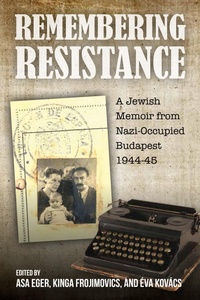
Remembering Resistance
Description

The existence and achievements of Jewish "self-rescuers" within Nazi-occupied Hungary remains, in spite of their significance, historically underexplored. In this illuminating chronicle of the life and work of a Jewish couple, László and Eugenia Szamosi, Remembering Resistance seeks to address this lacunae, offering a unique insight into a family's personal history of resistance under the Nazi regime. Combining oral testimony from fellow survivors, with a previously-unpublished translation of László's memoir, this book foregrounds the remarkable work of the Szamosis and their network, in rescuing Jews from the Death Marches and reuniting displaced families. Through doing so, this book offers a powerful framework for mediating how we remember Jewish experiences of the Holocaust.
More details
Persons
Asa Eger is the grandson of Eugenia and László Szamosi and a Professor of the Islamic World at the University of North Carolina at Greensboro. Focusing on the intersection of archaeology and history he specializes in Anatolia and Syria-Palestine from the Byzantine period through to the twelfth century. His recent publications include; The Archaeology of Medieval Islamic Frontiers (University Press of Colorado, 2019) and Antioch: A History (Routledge, 2021).
Content
List of Illustrations and Documents
Editors' Note
Preface: The Life and Legacy of My Grandparents
Asa Eger
Acknowledgments
Introduction: Shared Experiences, Divided Memories: Diplomats and Jewish Rescuers in Budapest, 1944-1945
Kinga Frojimovics and Éva Kovács
Part I: The Hungary Years, 1942-1949
Chapter 1. Budapest, 1944-1945: A Memoir by László Szamosi
Chapter 2. Documents during the War, 1942-1945
Chapter 3. The Safe Houses of Budapest Where the Szamosis Lived
Chapter 4. Documents after the War, 1945-1949
Chapter 5. Houses after the War, 1944-1949
Part II: The Komoly Years, 1950s to 1980s
Chapter 6. Komoly Memorial Lecture at Bet Hahalutzot, Haifa (1952)
Chapter 7. The Yad Vashem Correspondence, Part One (1958)
Chapter 8. Komoly Memorial Lecture at Beitenu, Haifa (1975)
Part III: The Wallenberg Years, 1981-1986
Chapter 9. László Szamosi and John Bierman's Righteous Gentile (1981, 1982)
Chapter 10. Szamosi as a Promoter for Wallenberg's Rise to Fame (1981-1986)
Chapter 11. Organizing the First World Congress on Hungarian Jews (1982-1984)
Chapter 12. Forty Years After... László Szamosi's Speech in Beer Sheva (1984)
Chapter 13. Honoring László Szamosi upon His Death (1986)
Part IV: The Perlasca Years, Part One: 1986-1992
Chapter 14. The Yad Vashem Correspondence, Part Two (1989-1990)
Chapter 15. The World-Famous "Perlasca Circus" by Eugenia Szamosi
Chapter 16. The Oral History of Eugenia Szamosi, and the United States Holocaust Memorial Museum Correspondence, Part One (1990)
Chapter 17. Bözsi's Last Battle: Fighting Back with the Media
Part V: The Perlasca Years, Part Two: 1998-2023
Chapter 18. The Temple Emanu-El Panel (1998)
Chapter 19. The United States Holocaust Memorial Museum Correspondence, Part Two (2013-2015) and Arcadi Espada's L'autentica impostura (2013-2021)
Epilogue
Appendix I: List of Jews Rescued with Szamosi's Involvement
Appendix II: Szamosi Family Tree
Index
