

Detection of Intrusions and Malware, and Vulnerability Assessment
Description

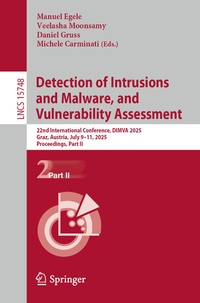
The two-volume set LNCS 15747 and 15748 constitutes the refereed conference proceedings of the 12nd International Conference on Detection of Intrusions and Malware, and Vulnerability Assessment, DIMVA 2025, held in Graz, Austria, during July 9-11, 2025.
The 25 revised full papers and 11 posters are presented in these proceedings were carefully reviewed and selected from 103 submissions. The papers are organized in the following topical sections:
Part I: Web Security; Vulnerability Detection; Side channels; and Obfuscation.
Part II: AI/ML & Security; Android & Patches; OS & Network; and Resilient Systems.
More details
Other editions
Additional editions
Content
.- AI/ML & Security .
.- Towards Explainable Drift Detection and Early Retrain in ML-based Malware Detection Pipelines.
.- InferONNX: Practical and Privacy-preserving Machine Learning Inference using Trusted Execution Environments.
.- Hiding in Plain Sight: On the Robustness of AI-generated code detection.
.- FlexGE: Towards Secure and Flexible Model Partition for Deep Neural Networks.
.- Poster: Exploring the Zero-Shot Potential of Large Language Models for Detecting Algorithmically Generated Domains.
.- Poster: Using Machine Learning to Infer Network Structure from Security Metadata.
.- Android & Patches .
.- More Than You Signed Up For: Exposing Gaps in the Validation of Android's App Signing.
.- An Empirical Study of Multi-Language Security Patches in Open Source Software.
.- Red Light for Security: Uncovering Feature Check and Access Control Gaps in AAOS.
.- Poster: SPECK: From Google Textual Guidelines to Automatic Detection of Android Apps Vulnerabilities.
.- OS & Network .
.- Taming the Linux Memory Allocator for Rapid Prototyping.
.- Linux hurt itself in its confusion! Exploiting Out-of-Memory Killer for Confusion Attacks via Heuristic Manipulation.
.- Overlapping data in network protocols: bridging OS and NIDS reassembly gap.
.- Poster: On the Usage of Kernel Shadow Stacks for User-Level Programs.
.- Referencing your Privileges - A Data-Only Exploit Technique for the Windows Kernel.
.- Resilient Systems .
.- PackHero: A Scalable Graph-based Approach for Efficient Packer Identification.
.- A History of Greed: Practical Symbolic Execution for Ethereum Smart Contracts.
.- FAULTLESS: Flexible and Transparent Fault Protection for Superscalar RISC-V Processors.
.- Poster: Building Confidence in Hardware-based Ransomware Detection through Hardware Performance Counter Event Correlation.
.- Poster: FedBlockParadox - A Framework for Simulating and Securing Decentralized Federated Learning.
