

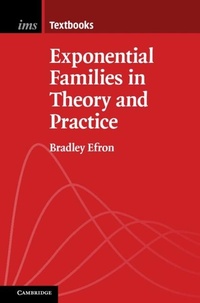
Exponential Families in Theory and Practice
Published on 7. December 2022
978-1-108-80543-8 (ISBN)
Description

During the past half-century, exponential families have attained a position at the center of parametric statistical inference. Theoretical advances have been matched, and more than matched, in the world of applications, where logistic regression by itself has become the go-to methodology in medical statistics, computer-based prediction algorithms, and the social sciences. This book is based on a one-semester graduate course for first year Ph.D. and advanced master's students. After presenting the basic structure of univariate and multivariate exponential families, their application to generalized linear models including logistic and Poisson regression is described in detail, emphasizing geometrical ideas, computational practice, and the analogy with ordinary linear regression. Connections are made with a variety of current statistical methodologies: missing data, survival analysis and proportional hazards, false discovery rates, bootstrapping, and empirical Bayes analysis. The book connects exponential family theory with its applications in a way that doesn't require advanced mathematical preparation.
Reviews / Votes
'This book provides a unique perspective on exponential families, bringing together theory and methods into a unified whole. No other text covers the range of topics in this text. If you want to understand the 'why' as well as the `how' of exponential families, then this book should be on your bookshelf.' Larry Wasserman, Carnegie Mellon University 'I am excited to see the publication of this monograph on exponential families by my friend and colleague Brad Efron. I learned some of this material during my Ph.D. studies at Stanford from the maestro himself, as well as the geometry of curved exponential families, Hoeffding's lemma, the Lindsey method, and the list goes on. They have lived with me my entire career and informed our work on GAMs and sparse GLMs. Generations of Stanford students have shared this privilege, and now generations in the future will be able to enjoy the unique Efron style.' Trevor Hastie, Stanford University 'Exponential families can be magical in simplifying both theoretical and applied statistical analyses. Brad Efron's wonderful book exposes their secrets, from R. A. Fisher's early magic to Efron's own bootstrap: an essential text for understanding how data of all sizes can be approached scientifically.' Stephen Stigler, University of Chicago 'This book provides an original and accessible study of statistical inference in the class of models called exponential families. The mathematical properties and flexibility of this class makes the models very useful for statistical practice - they underpin the class of generalized linear models, for example. Writing with his characteristic elegance and clarity, Efron shows how exponential families underpin, and provide insight into, many modern topics in statistical science, including bootstrap inference, empirical Bayes methodology, high-dimensional inference, analysis of survival data, missing data, and more.' Nancy Reid, University of Toronto 'In this book, Brad Efron illuminates the exponential family as a practical, extendible, and crucial ingredient in all manners of data analysis, be they Bayesian, frequentist, or machine learning. He shows us how to shape, understand, and employ these distributions in both algorithms and analysis. The book is crisp, insightful, and indispensable.' David Blei, Columbia UniversityMore details
Series
Language
English
Place of publication
Cambridge
United Kingdom
Illustrations
Worked examples or Exercises
File size
2,28 MB
ISBN-13
978-1-108-80543-8 (9781108805438)
Copyright in bibliographic data and cover images is held by Nielsen Book Services Limited or by the publishers or by their respective licensors: all rights reserved.
Schweitzer Classification
Other editions
Additional editions
Bradley Efron
Exponential Families in Theory and Practice
Book
12/2022
Cambridge University Press
€108.50
Shipment within 15-20 days
Bradley Efron
Exponential Families in Theory and Practice
Book
12/2022
Cambridge University Press
€41.00
Shipment within 15-20 days
Person
Content
1. One-parameter exponential families; 2. Multiparameter exponential families; 3. Generalized linear models; 4. Curved exponential families, eb, missing data, and the em algorithm; 5. Bootstrap confidence intervals; Bibliography; Index.
