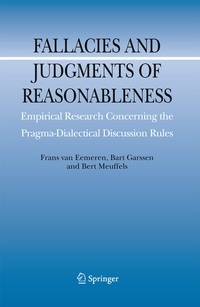
Fallacies and Judgments of Reasonableness
Description

In Fallacies and Judgments of Reasonableness, Frans H. van Eemeren, Bart Garssen and Bert Meuffels report on their systematic empirical research of the conventional validity of the pragma-dialectical discussion rules. The experimental studies they carried out during more than ten years start from the pragma-dialectical theory of argumentation developed at the University of Amsterdam, their home university. In these studies they test methodically the intersubjective acceptability of the rules for critical discussion proposed in this theory by confronting ordinary arguers who have not received any special education in argumentation and fallacies with discussion fragments containing both fallacious and non-fallacious argumentative moves. The research covers a wide range of informal fallacies. In this way, the authors create a basis for comparing the theoretical reasonableness conception of pragma-dialectics with the norms for judging argumentative moves prevailing in argumentative practice. Fallacies and Judgments of Reasonableness provides a unique insight into the relationship between theoretical and practical conceptions of reasonableness, supported by extensive empirical material gained by means of sophisticated experimental research.
Reviews / Votes
From the reviews:
"This book is an excellent contribution to the study of pragma-dialectics. . the present book is an extremely good example of how experimental studies can be designed on the basis of normative theories of argumentation. The authors have succeeded in developing a large set of well thought out experiments, and in reporting clearly about the results." (Jos Hornikx, Information Design Journal, Vol. 18 (2), 2010)
"This book has varying levels of value to different scholars . . The book has several clear merits. First, it is informative about how people view dialogical fallacies, and these results can be understood independent of the pragma-dialectical framework. Second, the research program offers consistent evidence for the conventional validity of the discussion rules at the heart of pragma-dialectics. And finally, it is a nice example of how programmatic empirical research can assist a theoretical project and move it into the domain of practical application." (Dale Hample, Argumentation, Vol. 24, March, 2010)
More details
Other editions
Additional editions