

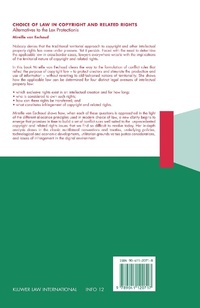
Choice of Law in Copyright and Related Rights
Alternatives to the Lex Protectionis
Published on 26. September 2003
306 pages
978-90-411-7653-0 (ISBN)
Description

Nobody denies that the traditional territorial approach to copyright and other intellectual property rights has come under pressure. Yet it persists. Faced with the need to determine the applicable law in cross-border cases, lawyers everywhere wrestle with the implications of the territorial nature of copyright and related rights.
In this book Mireille van Eechoud clears the way to the formulation of conflict rules that reflect the purpose of copyright law - to protect creators and stimulate the production and use of information - without reverting to old-fashioned notions of territoriality. She shows how the applicable law can be determined for four distinct legal avenues of intellectual property law:
- which exclusive rights exist in an intellectual creation and for how long;
- who is considered to own such rights;
- how can these rights be transferred; and
- what constitutes infringement of copyright and related rights.
Mireille van Eechoud shows how, when each of these questions is approached in the light of the different allocation principles used in modern choice of law, a new clarity begins to emerge that promises in time to build a set of conflict rules well suited to the unprecedented copyright and related rights issues that we find so difficult to resolve today. Her in-depth analysis draws in the classic multilateral conventions and treaties, underlying policies, technological and economic developments, utilitarian grounds versus iustice considerations, and issues of infringement in the digital environment.
In this book Mireille van Eechoud clears the way to the formulation of conflict rules that reflect the purpose of copyright law - to protect creators and stimulate the production and use of information - without reverting to old-fashioned notions of territoriality. She shows how the applicable law can be determined for four distinct legal avenues of intellectual property law:
- which exclusive rights exist in an intellectual creation and for how long;
- who is considered to own such rights;
- how can these rights be transferred; and
- what constitutes infringement of copyright and related rights.
Mireille van Eechoud shows how, when each of these questions is approached in the light of the different allocation principles used in modern choice of law, a new clarity begins to emerge that promises in time to build a set of conflict rules well suited to the unprecedented copyright and related rights issues that we find so difficult to resolve today. Her in-depth analysis draws in the classic multilateral conventions and treaties, underlying policies, technological and economic developments, utilitarian grounds versus iustice considerations, and issues of infringement in the digital environment.
More details
Other editions
Additional editions
Mireille van Eechoud
Choice of Law in Copyright and Related Rights
Alternatives to the Lex Protectionis
Book
09/2003
Kluwer Law International
€215.41
Shipment within 10-20 days
Content
- Cover
- Half Title Page
- Editorial Board
- Title Page
- Copyright Page
- Dedication
- Table of Contents
- Chapter 1 Introduction
- 1.1 Conflict of Laws Concerns in Intellectual Property
- 1.2 Subject-matter and Scope of this Study
- 1.2.1 CENTRAL RESEARCH QUESTION
- 1.2.2 EUROPEAN PERSPECTIVE
- l.2.3 DELINEATION OF ISSUES STUDIED
- 1.3 Some Words on Terminology
- 1.4 Plan
- Chapter 2 Characteristics of the Choice-of-Law Process
- 2.1 Introduction
- 2.2 Objectives of Choice of Law
- 2.2.1 DECISIONAL HARMONY
- 2.2.1.1 Forum Shopping
- 2.2.1.2 Limping Legal Relationships
- 2.2.1.3 European Developments
- 2.2.2 SUBSTANTIVE JUSTICE
- 2.3 The Development of Choice of Law
- 2.3.1 STATUTIST THEORY
- 2.3.2 1HE ALLOCATION METHOD
- 2.4 Characteristics of the Present Day Allocation Method
- 2.4.1 TYPES OF CONFLICT RULES
- 2.4.2 PRINCIPLES UNDERLYING CONNECTING FACTORS
- 2.4.2.1 Closest Connection
- 2.4.2.2 Party Autonomy
- 2.4.2.3 Functional Allocation
- 2.4.2.4 Favour Principle
- 2.4.3 ADmSTMENT OF THE RESULT OF ALLOCATION
- 2.4.3.1 Public Policy
- 2.4.3.2 Priority Rules
- 2.5 Conclusions
- Chapter 3 Foreigners in International Copyright and Related Rights
- 3.1 Introduction
- 3.2 Foreign Authors Prior to The Berne Convention
- 3.2.1 FOREIGNERS UNDER EARL Y DOMESTIC COPYRIGHT LAWS
- 3.2.1.1 Equal Treatment Clauses
- 3.2.2 THE APPEARANCE OF BILATERAL COPYRIGHT TREATIES
- 3.3 The Foreigner in the Berne Convention
- 3.3.1 THE ROAD TO BERNE
- 3.3.2 THE 1884-1886 CONFERENCES AND SUBSEQUENT REVISIONS
- 3.3.2.1 Term of Protection
- 3.3.2.2 Translations
- 3.3.2.3 Works Protected
- 3.3.2.4 Ownership of Audiovisual Works
- 3.3.3 A CLOSER LOOK AT NATIONAL TREATMENT
- 3.3.3.1 Country of Origin
- 3.4 Post-Berne Convention Copyright and Related Rights Treaties
- 3.4.1 TRIPs AGREEMENT
- 3.4.2 COPYRIGHT TREATIES
- 3.4.2.1 WIPO Copyright Treaty 1996
- 3.4.3 RELATED RIGHTS TREATIES
- 3.4.3.1 Rome Convention 1961
- 3.4.3.2 The WIPO Performances and Phonograms Treaty
- 3.4.3.3 Proposed WIPO Audiovisual Performances Treaty (WAPI)
- 3.4.3.4 Proposed WIPO Broadcast Treaty (WBT)
- 3.5 Conclusions
- Chapter 4 The Choice-of-Law Calibre of Copyright and Related Rights Treaties
- 4.1 Introduction
- 4.1.1 TERRITORIALITY & LEGISLATIVE SOVEREIGNTY
- 4.1.2 DROITS INDEPENDANTS VERSUS DROITS ACQUIS
- 4.2 Lex Fori
- 4.3 Lex Protectionis
- 4.3.1 BASIS AND SCOPE OF THE LEX PROTECTIONIS
- 4.3.2 LEX PROTECTIONIS AND MORAL RIGHTS AFTER DEATH
- 4.3.3 LEX PROTECTION IS AND OWNERSHIP IN AUDIOVISUAL WORKS
- 4.4 Lex Originis
- 4.4.1 CONFLICT RULE FOR ALL COPYRIGHT ISSUES
- 4.4.2 CONFLICT RULE FOR INITIAL OWNERSHIP
- 4.5 Conclusions
- Chapter 5 The Rationale of Copyright and Related Rights Law
- 5.1 Introduction
- 5.2 Trends in the Information Markets and Technology
- 5.2.1.1 Commodification of Information and information Technologies
- 5.2.1.2 Changes in the Production of information
- 5.2.1.3 Changes in the Distribution of Information
- 5.3 Legal Characteristics of Copyright and Related Rights
- 5.4 Legal Basis of Copyright and Related Rights
- 5.4.1 JUSTICE ARGUMENTS
- 5.4.2 UTILITY ARGUMENTS
- 5.4.2.1 Incentive for Production
- 5.4.2.2 Efficient Allocation
- 5.4.3 SOCIAL ARGUMENTS
- 5.4.4 CULTURAL POLICY, FREEDOM OF EXPRESSION
- 5.5 Policies Underlying Limitations
- 5.5.1 FUNDAMENTAL FREEDOMS
- 5.5.1.1 Free Speech and Freedom of Iriformation
- 5.5.1.2 Privacy
- 5.5.2 PROMOTION OF CULTURE AND KNOWLEDGE
- 5.5.3 PRACTICAL CONSIDERATIONS
- 5.5.4 FREEDOM OF COMPETITION AND FREE TRADE
- 5.6 Conclusions
- Chapter 6 Conflict Rules for Modem Copyright and Related Rights
- 6.1 Introduction
- 6.2 Existence, Scope and Duration
- 6.2.1 CLOSEST CONNECTION
- 6.2.2 PARTY AUTONOMY
- 6.2.3 FAYOUR PRINCIPLE
- 6.2.4 FUNCTIONAL ALLOCATION IN THE NARROW SENSE (SCHUTZPRlNZIF)
- 6.2.5 FUNCTIONAL ALLOCATION IN THE BROAD SENSE
- 6.3 Initial Ownership
- 6.3.1 THE CREATOR'S LAW: FUNCTIONAL ALLOCATION AS A GENERAL RULE
- 6.3.1.1 Identification of the Creator or Performer
- 6.3.1.2 Initial Ownership of Related Rights other than Performer's Rights
- 6.3.1.3 Identification of the Record Producer, Database Producer or Broadcasting Organisation
- 6.3.1.4 Summary
- 6.3.2 COLLECTIVE WORKS
- 6.3.2.1 Party Autonomy
- 6.3.2.2 Applicable Law in Default of a Choice by Co-Contributors
- 6.3 .3 WORKS CREATED BY EMPLOYEES
- 6.3.3.1 Accessory Allocation to the Employment Contract
- 6.3.3.2 Favour-Restricted Choice by Parties
- 6.4 Transfer of Copyright and Related Rights
- 6.4.1 CONTRACTUAL ASPECTS OF TRANSFER THROUGH EXPLOIT A nON LICENCES OR ASSIGNMENT
- 6.4.1.1 Party Autonomy
- 6.4.1.2 Formal and Material Validity of the Intellectual Property Contract
- 6.4.1.3 Characteristic performance
- 6.4.2 PROPRIETARY ASPECTS OF ASSIGNMENT
- 6.4.3 APPLYTNGTHE CREATOR'S OR PERFORMER'S LAW AS A FAVOUR RESTRICTION
- 6.5 Infringement
- 6.5.1 LEX PROTECTIONIS FOR THE ISSUE OF UNLAWFULNESS
- 6.5.2 LAW GOVERNING THE CONSEQUENCES OF INFRINGING ACTS
- 6.5.2.1 Place of the Wrong (Place of Use)
- 6.5.2.2 Habitual Residence or Place of Business of the Torifeasor
- 6.5.2.3 Habitual Residence of the Injured Party (Right Owner)
- 6.5.3 IDENTIFYING COUNTRIES WITH AN EFFECTIVE CONNECTION TO INFRINGEMENT
- 6.6 Conclusions
- 6.6.1 EXISTENCE, SCOPE AND DURATION
- 6.6.2 INITIAL OWNERSHIP
- 6.6.3 TRANSFER OF COPYRIGHT AND RELATED RIGHTS
- 6.6.4 INFRINGEMENT
- 6.7 Effectuating Alternatives to the Lex Protectionis
- 6.7.1 PRELIMINARY DRAFT ROME II REGULATION
- 6.7.2 REVISION OF THE ROME CONVENTION 1980
- APPENDICES
- Samenvatting
- Abbreviations
- Bibliography
- Table of cases
- Index
- Back Cover
