

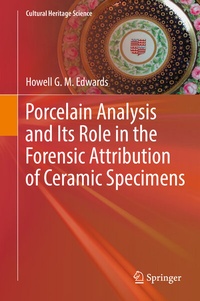
Porcelain Analysis and Its Role in the Forensic Attribution of Ceramic Specimens
Description

More details
Other editions
Additional editions
Person
Howell Edwards studied Chemistry at Jesus College, University of Oxford. Following a Research Fellowship at Jesus College at the University of Cambridge, he took a lectureship in Structural and Inorganic Chemistry at the University of Bradford where he subsequently became Professor of Molecular Spectroscopy and Head of the Chemical and Forensic Sciences Division. In 2003, he received the Sir Harold Thompson Award from Elsevier Science for his international contributions to vibrational spectroscopy. He is the recipient of the Emanuel Boricky Medal for 2008/2009 from Charles University, Prague, for distinguished international contributions to geochemistry and mineralogical analysis. He was awarded the Charles Mann Award from the US Federation of Analytical Chemical Spectroscopic Societies in 2011 for his distinguished international work on the applications of Raman spectroscopy.
Professor Edwards has wide-ranging interests in the applications of Raman spectroscopy to the characterisation of materials particularly in forensic, art historical, astrobiological and archaeological contexts. He is a guest editor and contributing author of the Philosophical Transactions of the Royal Society, the oldest scientific journal in the world. He has been a forerunner in the Raman spectroscopic identification of chemicals produced in biodegradation processes for prehistoric and contemporary systems in an archaeological context - he first investigated the Raman spectra of Dirina lichen colonization of toxic metal substrates on Italian Renaissance wall-paintings in 1991 and has extensively studied the pigments and associated materials involved in paintings from prehistoric cave art to the 20th Century. He is science lead on the European Space agency/Roscosmos ExoMars Raman Laser spectrometer instrument in the Pasteur suite of a planetary rover which will interrogate the Martina surface and subsurface to search for biosignatures and signs of extant and extinct life, scheduled to launch in 2020, with particular responsibility for the interpretation of Raman spectroscopic biosignatures from biogeological niche environments on Mars. He is also UK representative on the ESA/Roscosmos Landing Site Selection Group dedicated to determine where the spacecraft will land on Mars for the deployment of the rover vehicle.
