

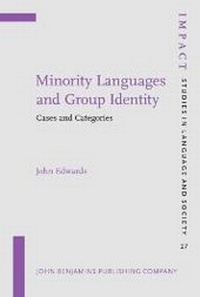
Minority Languages and Group Identity
Cases and Categories
1st Edition
Published on 13. January 2010
IX, 231 pages
978-90-272-8868-4 (ISBN)
Description

The central concern in this book is the relationship between language and group identity, a relationship that is thrown into greatest relief in 'minority' settings. Since much of the current interest in minority languages revolves around issues of identity politics, language rights and the plight of 'endangered' languages, one aim of the book is to summarise and analyse these and other pivotal themes. Furthermore, since the uniqueness of every language-contact situation does not rest upon unique elements or features - but, rather, upon the particular weightings and combinations of features that recur across settings - the second aim here is to provide a general descriptive framework within which a wide range of contact settings may be more easily understood. The book thus begins with a discussion of such matters as language decline, maintenance and revival, the dynamics of minority languages, and the ecology of language. It then offers a typological framework that draws and expands upon previous categorising efforts. Finally, the book presents four case studies that are both intrinsically interesting and - more importantly - provide specific illustrations of the generalities discussed earlier.
More details
Other editions
Additional editions
Book
01/2010
John Benjamins Publishing Co
€104.94
Shipment within 10-15 days
Person
Content
- Minority Languages and Group Identity
- Editorial page
- Title page
- LCC data
- Dedication page
- Table of contents
- An introductory overview
- Themes
- Languages in contact and conflict
- Towards a framework of contact situations
- Four case-studies
- A closing note
- Languages in contact and conflict I
- Introduction
- Indigenous and immigrant languages
- Bilingual solutions
- Minority groups
- Language maintenance
- Languages in contact and conflict II
- Language endangerment and decline
- Language revival
- The 'new' ecology of language
- Parochialism and intercourse
- Metaphors for mobility
- Tensions
- Dealing with linguistic tensions
- Language futures
- Small and stateless languages
- Small state languages
- Languages of wider communication
- Constructed languages
- Some research and policy implications
- A concluding thought
- Towards a typology of minority-language settings
- Introduction
- The typological thrust
- Geographical beginnings
- Beyond geography
- Charles Ferguson: Sociolinguistic profiles
- William Stewart: Language types and functions
- Heinz Kloss: Languages and communities
- Einar Haugen: Language ecology
- The Québec Symposium on language typology
- Howard Giles: Ethnolinguistic vitality
- Harald Haarmann: Ecology revisited
- Paul Lewis and the UNESCO working party: Endangered languages
- Some further insights
- A new approach
- Introductory remarks
- The dimensions of a typological model
- Concluding comments
- Irish
- Introductory note
- A brief historical introduction
- Irish revival efforts
- The Gaeltacht
- Irish and education
- Official and unofficial support for Irish
- Current trends and research findings
- Conclusion
- Gaelic in Scotland
- Introductory note
- A brief historical introduction
- Gaelic in education
- The clearances
- Modern times
- Gaelic: Numbers and use
- Media
- Formal support
- Attitudes to Gaelic
- Gaelic in education today
- Gaelic in Nova Scotia
- Introductory note
- A brief historical introduction
- Modern census figures
- Education
- The Gaelic language - and Scottish culture - in Nova Scotia today
- Gaelic revivalism
- Research findings
- Esperanto
- Introductory note
- A brief historical introduction
- Before Esperanto
- The birth of Esperanto
- The scope of Esperanto
- Popular perceptions of Esperanto
- Scholarly objections and rebuttals
- Research findings
- A future prospect
- Epilogue
- References
- Index
