

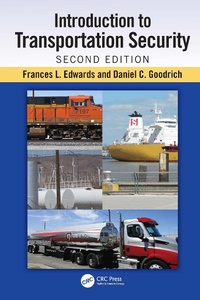
Introduction to Transportation Security
2nd Edition
Published on 22. January 2024
464 pages
978-1-003-80482-6 (ISBN)
Description

Providing students and industry managers with the knowledge, skills, and abilities to effectively manage the security of transportation assets, Introduction to Transportation Security, Second Edition examines:
The core concepts of security, safety, and emergency management practices
The integrated nature of the U.S.critical infrastructure and the threats to intermodal transportation
Those federal agencies working in emergency management, hazmat response, and transportation security and their intelligence and response requirements and capabilities
Cost-beneficial security strategies aimed at preventing catastrophic failures from disasters or intentional sabotage or attack in each transportation mode
Transportation is the lifeline of any nation, connecting people, supporting the economy, and facilitating the delivery of vital goods and services. Past failures and terrorist attacks on such transportation systems, in the U.S. and abroad, have demonstrated such systems' vulnerability, the consequences of any potential damage and disruption, as well as the substantial impacts on people, property, and the economy. Now, more than ever, it has become imperative for public transit and transportation systems, as well as the many private businesses operating in these sectors, to develop comprehensive security programs. This includes accounting for both natural and man-made hazards-and safeguarding people, places, and equipment-while at the same time ensuring operations continuity.
The book covers all transportation critical infrastructure-their modes and their interconnectivity-including highway, air, freight and passenger rail, transit, maritime, and pipeline security. Chapters provide learning objectives, key words, and discussion questions pedagogical elements as well as several case studies to facilitate a practical understanding of the concepts presented. New to this edition is a chapter dedicated to gas and oil pipelines as well as an increased focus throughout of recent cyberattacks, to emphasize the need for physical and cybersecurity integration.
Introduction to Transportation Security, Second Edition serves as a comprehensive, practical overview for students in transportation management, homeland security, and emergency management programs as well as an up-to-date reference for professionals charged with safeguarding the movement of assets within our interconnected transportation network.
The core concepts of security, safety, and emergency management practices
The integrated nature of the U.S.critical infrastructure and the threats to intermodal transportation
Those federal agencies working in emergency management, hazmat response, and transportation security and their intelligence and response requirements and capabilities
Cost-beneficial security strategies aimed at preventing catastrophic failures from disasters or intentional sabotage or attack in each transportation mode
Transportation is the lifeline of any nation, connecting people, supporting the economy, and facilitating the delivery of vital goods and services. Past failures and terrorist attacks on such transportation systems, in the U.S. and abroad, have demonstrated such systems' vulnerability, the consequences of any potential damage and disruption, as well as the substantial impacts on people, property, and the economy. Now, more than ever, it has become imperative for public transit and transportation systems, as well as the many private businesses operating in these sectors, to develop comprehensive security programs. This includes accounting for both natural and man-made hazards-and safeguarding people, places, and equipment-while at the same time ensuring operations continuity.
The book covers all transportation critical infrastructure-their modes and their interconnectivity-including highway, air, freight and passenger rail, transit, maritime, and pipeline security. Chapters provide learning objectives, key words, and discussion questions pedagogical elements as well as several case studies to facilitate a practical understanding of the concepts presented. New to this edition is a chapter dedicated to gas and oil pipelines as well as an increased focus throughout of recent cyberattacks, to emphasize the need for physical and cybersecurity integration.
Introduction to Transportation Security, Second Edition serves as a comprehensive, practical overview for students in transportation management, homeland security, and emergency management programs as well as an up-to-date reference for professionals charged with safeguarding the movement of assets within our interconnected transportation network.
More details
Edition
2nd edition
Language
English
Place of publication
London
United Kingdom
Publishing group
Taylor & Francis Ebooks
Target group
College/higher education
Professional and scholarly
Illustrations
33 Tables, black and white; 6 Line drawings, color; 2 Line drawings, black and white; 73 Halftones, color; 79 Illustrations, color; 2 Illustrations, black and white
ISBN-13
978-1-003-80482-6 (9781003804826)
Copyright in bibliographic data and cover images is held by Nielsen Book Services Limited or by the publishers or by their respective licensors: all rights reserved.
Schweitzer Classification
Other editions
Additional editions
Frances L. Edwards | Daniel C. Goodrich
Introduction to Transportation Security
Book
05/2026
2nd Edition
CRC Press
€52.50
Shipment within 10-20 days
Frances L. Edwards | Daniel C. Goodrich
Introduction to Transportation Security
Book
01/2024
2nd Edition
CRC Press
€108.00
Shipment within 15-20 days
Persons
Frances L. Edwards, MUP, PhD, CEM is the Deputy Director of the National Transportation Security Center at the Mineta Transportation Institute (MTI), and a professor emerita of the Master of Public Administration program at San Jose State University. She is the editor or co-author of four books, 16 reports for MTI and numerous journal articles and book chapters. She is a Certified Emergency Manager with 20 years' experience, FEMA credentialed instructor for ICS, and a California Specialized Training Institute Outreach Instructor for emergency management. She is a faculty member of the Wildfire Interdisciplinary Research Center at San Jose State University.
Daniel C. Goodrich, MPA, MEP, CEM is the Senior Transportation Security Scientist with the Mineta Transportation Institute at San Jose State University, and the instructor for "Security Issues for Transportation Professionals" in the Master of Science in Transportation Management program. He is co-author with Frannie Edwards of ten major publications for MTI, as well as many professional articles and book chapters. He provides emergency management planning and training support to Caltrans and Santa Clara Valley Transportation Authority. He has worked at city and county government and in the private sector, and has sixteen years' military service, including US Marine Corps Security Forces.
Daniel C. Goodrich, MPA, MEP, CEM is the Senior Transportation Security Scientist with the Mineta Transportation Institute at San Jose State University, and the instructor for "Security Issues for Transportation Professionals" in the Master of Science in Transportation Management program. He is co-author with Frannie Edwards of ten major publications for MTI, as well as many professional articles and book chapters. He provides emergency management planning and training support to Caltrans and Santa Clara Valley Transportation Authority. He has worked at city and county government and in the private sector, and has sixteen years' military service, including US Marine Corps Security Forces.
Content
Part I - Safety, Security, and Emergency Management 1. Security Theory and Practice 2. Emergency Management Theory and Practice 3. Federal Agencies and Structures: Transportation Security 4. Layers of Security Part II - Multi-Modal surface Transportation Security: Threats and Strategies 5. Road Transportation: Cars and Trucks 6. Road-Based Busses, Livery, Paratransit, Ambulances and Delivery Vehicles 7. Mass Transit on Fixed Rails and Guideways 8. Freight and Long-Distance Passenger Heavy Rail 9. Maritime Transportation 10. Aviation Operations Security 11. Natural Gas and Hazardous Liquids Pipelines Part III - Putting It All Together 12. Transportation Security, Supply Chain and Critical Infrastructure
